Quick answer: Hotel Gettysburg occupies a prominent Lincoln Square site with a hospitality history reaching back to Scott’s Tavern in 1797. The property changed names, was transformed in the 1890s, closed in 1964, suffered a major 1983 fire, and reopened after reconstruction in 1991. Its ghost stories are modern folklore layered onto a documented commercial site.
A tavern at the center of town
Lincoln Square developed where Gettysburg’s major roads met. Borough preservation records trace the hotel site to Scott’s Tavern, built by James Scott in 1797. William McClellan acquired it in 1809 and renamed it the Indian Queen. Later names included the McClellan House, reflecting changes in ownership and business identity.
This long hospitality history predates the 1863 battle. Taverns offered food, lodging, stabling, news, and meeting space at a busy county-seat crossroads. The square’s commercial role helps explain why hotels remained central as Gettysburg became a destination for veterans, families, tourists, and political visitors.
The Civil War landscape
The square became a contested urban space during the Battle of Gettysburg. Troops passed through streets, civilians sheltered, buildings received wounded people, and supplies moved between positions. Later tourism often compresses this into a single dramatic moment, but the hotel’s site belongs to a larger network of homes, stores, churches, and public buildings affected by occupation and combat.
Abraham Lincoln stayed across the square at the Wills House in November 1863 before delivering the Gettysburg Address. The square therefore links wartime disruption to national commemoration, even when a specific story is attached to the wrong building.
From nineteenth-century hotel to modern property
Large renovations in the 1890s produced the imposing Gettysburg Hotel identity familiar in twentieth-century photographs. The hotel advertised electric lights, steam heat, baths, and dining. In 1955 it served as a temporary White House base while President Dwight D. Eisenhower recovered from a heart attack in Gettysburg.
The hotel closed in 1964. A fire in 1983 badly damaged the long-vacant building. A redevelopment effort involving Gettysburg College and local architectural review led to a reconstructed hotel that opened in 1991. Portions of the historic facade and the site’s long use influenced the new design, but visitors should not assume every interior is a surviving eighteenth- or nineteenth-century room.
Ghost stories at the hotel
Popular accounts describe a nurse, wounded soldiers, unexplained sounds, or figures in halls. Versions differ and often circulate without a dated primary source. The building’s relationship to the battle, fire, vacancy, and reconstruction can encourage stories, but atmosphere does not establish a paranormal event.
HauntsUSA treats these claims as hotel folklore. A useful question is not only “is it haunted?” but also “when did this version of the story appear, and which building phase does it describe?” That approach prevents a modern room from being presented as an untouched battle-era interior.
Reading Lincoln Square responsibly
Use the Gettysburg town history guide to place the hotel within the road network, battlefield, cemetery, and tourism economy. The forthcoming Dobbin House guide provides a contrasting eighteenth-century hospitality property.
The hotel remains an operating business. Public areas, guest floors, events, and private rooms follow current property rules. Do not wander closed areas, disturb guests, or conduct paranormal experiments without explicit operator permission.
Lincoln Square is also a useful place to study architectural change. Brick bonds, facade seams, window patterns, and reconstructed sections reveal that preservation does not always mean retaining an entire original building. Borough review records are more reliable for that chronology than a generalized claim that the hotel has stood unchanged since 1797.
Planning a visit
- Use the hotel’s official site for current lodging, dining, and event information.
- Walk the public square to compare multiple architectural periods.
- Consult borough preservation records for the building chronology.
- Respect guest privacy and staff instructions.
- Label ghost reports as folklore unless their origin can be documented.
Frequently asked questions
When did lodging begin on this site?
Borough records trace the site to Scott’s Tavern, built in 1797.
Was the present hotel unchanged since the battle?
No. The property underwent major late nineteenth-century work, closed in 1964, suffered a 1983 fire, and reopened after reconstruction in 1991.
Did President Eisenhower use the hotel?
Historical accounts say it served as a temporary White House base during his 1955 recovery in Gettysburg.
Is Hotel Gettysburg proven to be haunted?
No. Nurse, soldier, and hallway stories are folklore and guest reports, not independently verified paranormal evidence.
Can non-guests explore the property?
Only enter public areas permitted by the operator. Guest floors and private event spaces may be restricted.
Sources and editorial note
- Hotel Gettysburg: Official Site
- Borough of Gettysburg: Historic Architectural Review record
- Borough of Gettysburg: Town History
HauntsUSA separates the documented hotel chronology from later ghost lore. Visitor information was reviewed on September 27, 2026.
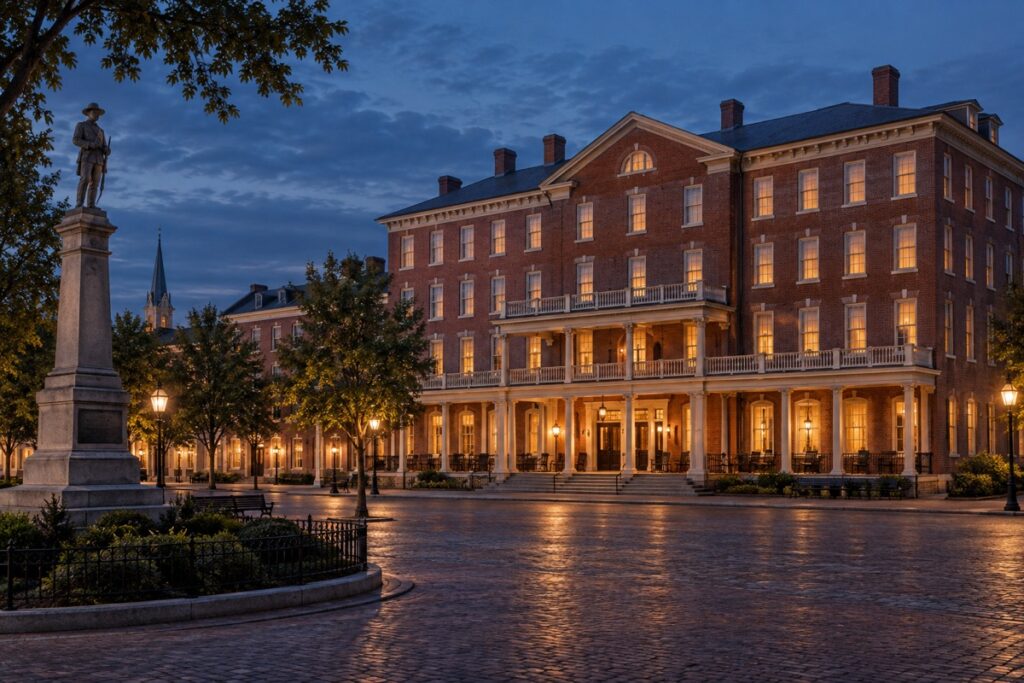
Editorial image: AI-created historical interpretation for HauntsUSA. It is not documentary evidence or proof of paranormal activity.