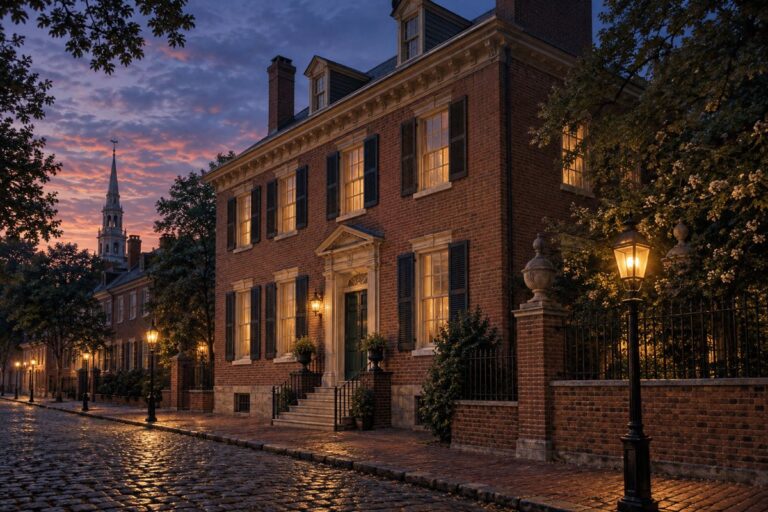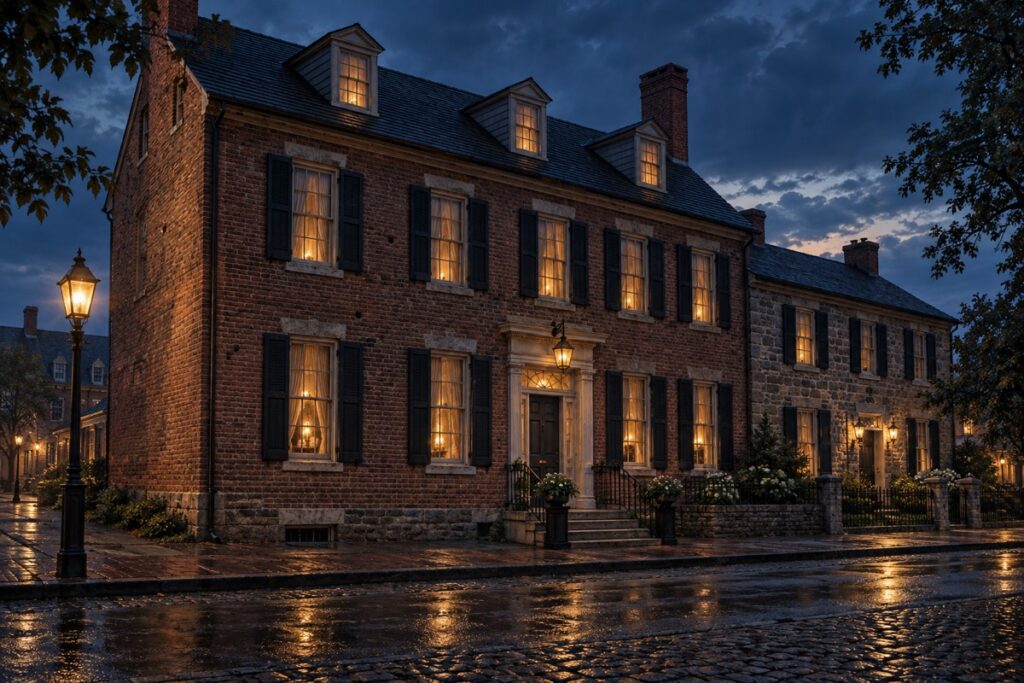
Quick answer: The Farnsworth House Inn is a historic bed and breakfast at 401 Baltimore Street in Gettysburg, Pennsylvania. Its oldest section dates to about 1810, with a brick addition from 1833. More than one hundred bullet marks remain on the exterior, and the inn promotes ghost tours and paranormal programming tied to the 1863 battle.
Why the Farnsworth House Inn matters
The inn offers a close-scale counterpart to the vast battlefield. A visitor can stand beside a wall damaged by gunfire and understand that war crossed streets, homes, gardens, and businesses. Civilian property did not sit safely outside the conflict.
Its present hospitality use creates continuity with the building’s long domestic life. Guests sleep and dine in spaces adapted for modern needs, while tours interpret the battle and paranormal stories. That combination can be effective when documented history remains the guide.
The documented history
The original portion of the house was built around 1810 by John McFarlane. A brick structure followed in 1833. By the time of the Battle of Gettysburg, the property stood on ground affected by fighting through and south of town.
Confederate sharpshooters used buildings along this corridor, and the Farnsworth facade still carries extensive bullet damage. The inn states that a shot from the house may have killed Mary Virginia Jennie Wade, the battle’s best-known civilian fatality. The word may is important because the origin of the fatal shot cannot be established with certainty.
The Lincoln procession passed the property on November 19, 1863, as the president traveled toward the cemetery dedication. That link places the house within both the battle and the creation of national memory. Later preservation and commercial use kept the building visible when many wartime structures disappeared.
History, memory, and the haunted reputation
The inn markets itself as a haunted Gettysburg address. Stories describe soldiers, a child, footsteps, voices, touched objects, and activity in guest rooms or the cellar. Television appearances have spread the reputation nationally.
The bullet scars provide powerful material evidence, but they do not prove a particular ghost identity. Tour stories should state whether a named figure is supported by military records, family documents, staff testimony, or only later tradition.
Overnight lodging can intensify expectation. Old floors move, plumbing travels through walls, street sounds change after midnight, and unfamiliar rooms make guests alert. Those facts coexist with sincere reports without settling their cause.
What to notice during a visit
Study the brick exterior in daylight and look at the distribution of bullet marks. Consider lines of fire and the house’s position on Baltimore Street. Inside, note alterations required for lodging and dining rather than assuming every room remains as it was in 1863.
Walk toward the national cemetery to follow the route associated with Lincoln’s procession. Then compare the inn’s interpretation with National Park Service material for the wider military context.
Planning a visit
- Location: 401 Baltimore Street, Gettysburg, Pennsylvania 17325.
- Access: The property offers lodging, dining, tours, and events on separate schedules. Historic stairs and rooms may limit access.
- Best for: Gettysburg visitors seeking a historic inn, Civil War readers, architecture enthusiasts, and adults interested in structured paranormal programs.
- Before you go: Confirm current hours, tickets, accessibility, and photography rules on the official website.
Frequently asked questions
Is the Farnsworth House Inn haunted?
The inn promotes a haunted reputation and many guests report experiences. These reports remain venue lore and testimony.
Can the public visit?
Yes, through lodging, dining, or ticketed programming. Respect private rooms and current event restrictions.
How much time should visitors allow?
Allow at least an hour for a tour, with more time for dining or an overnight stay. Pair it with several hours on the battlefield.
What is the most important historical context?
The bullet damage and location are documented. Claims about the shot that killed Jennie Wade should be presented as belief rather than certainty.
Sources and editorial note
The official Farnsworth House Inn history and contact pages provide dates, address, bullet-scar information, Lincoln procession context, and the venue’s haunted identity. National Park Service sources should support battle interpretation.
HauntsUSA separates documented history from reported experiences, local legend, and venue marketing. Paranormal claims are never stated as proven fact. Generated artwork is labeled as an editorial interpretation rather than documentary photography.
Last reviewed September 26, 2026. Visitor details can change. Confirm current information with the site before travel.
A house within a battlefield town
The Farnsworth House should be read with other civilian buildings, including homes, churches, stores, and improvised hospitals. Together they show that the battle did not stop at formal lines on a military map. Residents negotiated danger, occupation, hunger, damaged wells, wounded strangers, and the long work of recovery. That urban experience gives the inn’s surviving scars their proper scale.
Work behind the legend
Grand hotels depend on labor that visitors rarely see. Porters, chambermaids, cooks, bakers, waiters, engineers, clerks, and managers created the Parker House reputation day after day. Ghost lists sometimes name an owner or famous guest while ignoring the workers who knew the building most intimately. A richer history follows staff roles, wages, migration, culinary skill, and the practical systems that kept a large hotel running.