Eastern State Penitentiary is a National Historic Landmark in Philadelphia, Pennsylvania, known for its influential radial prison design, its 19th-century experiment in solitary confinement, and the ghost stories later attached to its abandoned cellblocks. The documented history is substantial; the paranormal reputation is best understood as reported experience and folklore rather than established fact.
Why Eastern State Penitentiary matters
Eastern State Penitentiary occupies an unusual place in American history. It is not simply an old prison with a dramatic appearance. When the institution opened in 1829, it embodied a new theory of incarceration: isolation, labor, religious reflection, and tightly controlled movement were supposed to produce penitence. The experiment influenced prison design far beyond Philadelphia and made Eastern State one of the most discussed public buildings of the young United States.
The building also preserves the consequences of that experiment. Its history includes overcrowding, criticism of prolonged isolation, repeated expansions, riots, escapes, and the gradual abandonment of the original system. That record gives modern visitors more to consider than famous inmates or atmospheric ruins. Eastern State is a place to examine how architecture, reform ideals, state power, and human experience met behind a thirty-foot wall.
From reform experiment to “Pennsylvania System”
The institution grew from late-18th-century prison reform efforts in Philadelphia. In 1787, Benjamin Rush, Benjamin Franklin, and other civic leaders helped organize the Philadelphia Society for Alleviating the Miseries of Public Prisons. The group argued that confinement should reform a person rather than rely only on public punishment. Pennsylvania approved funding for a new penitentiary in 1821, and British-born architect John Haviland won the design commission.
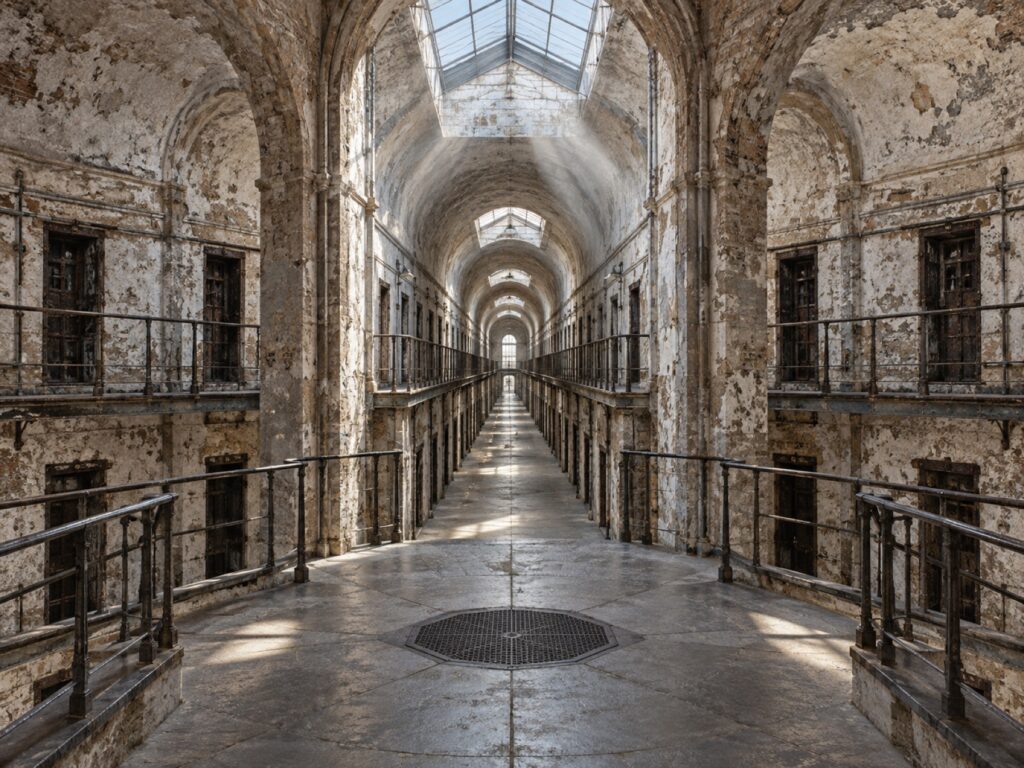
Haviland arranged the original cellblocks like spokes around a central observation hub. Each person was intended to live, work, and exercise apart from others. Individual cells included skylights, exercise yards, and service openings designed to minimize contact. Supporters believed solitude could encourage reflection and remorse. Critics argued that the system inflicted severe mental suffering. Charles Dickens, who visited in 1842, became one of its best-known opponents.
The first prisoner arrived on October 25, 1829. By 1836 the original complex covered roughly eleven acres and contained hundreds of centrally heated cells with plumbing and sewage systems that were advanced for the period. Governments and reformers from other countries studied its design. The Library of Congress describes the building as a physical expression of the Pennsylvania System and notes its importance in international debates about prison design and governance.
Overcrowding, expansion, and closure
Eastern State could not maintain strict separation as its population increased. New cellblocks filled the spaces between Haviland’s original wings, and people increasingly shared cells and common areas. The penitentiary formally abandoned the Pennsylvania System in 1913, though the practice had been eroding for decades. A complex designed for about 250 people held approximately 1,700 by the mid-1920s.
Some popular stories are supported by records, but they still deserve context. Al Capone spent about eight months at Eastern State in 1929 and 1930. A furnished cell associated with his incarceration is displayed today, although the site’s own interpretation cautions that later accounts may exaggerate the extent of his special treatment. In 1945, twelve prisoners escaped through a tunnel; most were caught quickly. More than one hundred people attempted escapes during the prison’s 142 years of operation.
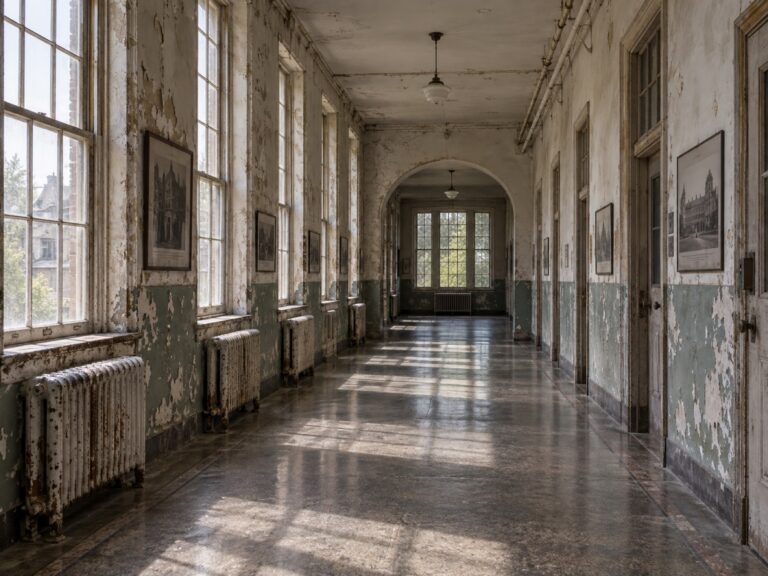
The Commonwealth closed Eastern State in 1970, followed by brief use as a city jail in 1971. The structure then stood largely abandoned for years while vegetation, water, and weather reshaped the cellblocks. Preservation advocates formed a task force in 1988, stabilization work followed, and daily historic tours began in 1994. The preserved “semi-ruin” is deliberate: the site stabilizes much of the surviving fabric without making every corridor look new.
Is Eastern State Penitentiary haunted?
Eastern State Penitentiary is widely described as haunted, but the strongest evidence supports the history of the prison, not proof of paranormal activity. The institution’s own visitor information says officers and incarcerated people reported mysterious visions and eerie experiences as early as the 1940s. Its audio tour discusses visitor sensations, shadowy-figure stories, and an account from a locksmith who reportedly felt an intense energy while removing an old lock.
Those accounts are part of the site’s cultural afterlife, and they should be labeled accordingly: they are reported experiences and local lore. Television programs and paranormal investigators greatly expanded the penitentiary’s supernatural reputation. Media exposure does not verify a claim, and the historic site currently prohibits paranormal investigations and EVP equipment during regular visits. Eastern State’s documented record of isolation, suffering, death, abandonment, and decay readily explains why the building feels haunting even to visitors who do not believe it is literally haunted.
Planning a respectful visit
Eastern State Penitentiary Historic Site is at 2027 Fairmount Avenue in Philadelphia’s Fairmount neighborhood, a short distance from the Philadelphia Museum of Art. The official schedule currently lists daytime hours from 10:00 a.m. to 5:00 p.m., with seasonal Tuesday closures during parts of winter and December. Last entry is generally one hour before closing, and the site recommends allowing about two hours. Hours, tickets, tours, and special-event access can change, so confirm details on the official website before traveling.
The complex is a stabilized historic ruin, not a conventional climate-controlled museum. Visitors should expect uneven surfaces, exposed masonry, outdoor sections, and changing conditions. Much of the tour route accommodates mobility aids and includes ramps, but the National Historic Landmark is not fully ADA compliant. Eastern State publishes an accessibility map and details about captioning, ASL interpretation, sensory accommodations, service animals, and inaccessible spaces. For current help, call the site at 215-236-3300.
Frequently asked questions
Where is Eastern State Penitentiary?
It is at 2027 Fairmount Avenue, Philadelphia, PA 19130, in the Fairmount neighborhood.
When did Eastern State Penitentiary open and close?
The first prisoner arrived in 1829. State prison operations ended in 1970, followed by brief city-jail use in 1971.
Can visitors conduct paranormal investigations?
No. The historic site says paranormal investigations and EVP equipment are not permitted during visits.
Sources and further reading
- Eastern State Penitentiary Historic Site: History of Eastern State
- Eastern State Penitentiary Historic Site: Historical Timeline
- Library of Congress: Historic American Buildings Survey
- National Park Service: National Historic Landmark documentation
- Official Hours of Operation
- Official Accessibility Information
- Official Visitor FAQ and Paranormal-Claim Policy
Last reviewed September 26, 2026. AI-generated editorial artwork is an interpretation, not documentary photography.