Quick answer: Gettysburg is both a living Pennsylvania borough and the center of a vast Civil War memory landscape. The three-day battle of July 1 to 3, 1863, transformed homes, streets, farms, and public buildings. Modern ghost stories grew from that documented trauma, but they should not replace the history of civilians, soldiers, burial, recovery, and commemoration.
Gettysburg before the battle
Gettysburg was founded in 1786 and incorporated in 1806. Its position where major roads converged made it a commercial and administrative center for Adams County. The borough’s official history notes that the Lutheran Theological Seminary was founded in 1826 and Gettysburg College in 1832. Shops, taverns, homes, schools, churches, and farms formed a community long before armies arrived.
That prewar history is essential. The town was not created as a battlefield attraction. Its road network, surrounding ridges, and farms affected military movement, but those same places supported households and livelihoods. A responsible guide keeps residents visible rather than treating every building as scenery for commanders.
Three days in July 1863
Union and Confederate forces fought in and around Gettysburg from July 1 through July 3. Combat moved across fields, ridges, roads, and parts of the borough. The number of dead and wounded overwhelmed a town with only a few thousand residents. Homes, churches, schools, barns, and public buildings became shelters or hospitals.
Mary Virginia “Jennie” Wade was killed while inside her sister’s home and is remembered as the battle’s only direct civilian fatality. Other civilians carried water, baked food, nursed wounded people, hid in cellars, fled through dangerous streets, or returned to damaged property. Their accounts complicate any clean division between battlefield and town.
Burial, the cemetery, and Lincoln
Temporary graves covered the landscape after the armies left. David Wills and others helped organize what became the Soldiers’ National Cemetery for Union dead. President Abraham Lincoln arrived by train on November 18, stayed at the Wills House on the square, and delivered the Gettysburg Address at the cemetery dedication the next day.
The address transformed how later generations understood the battle and the war. The cemetery, Wills House, railroad station, and procession route show how Gettysburg quickly became a national site of mourning and political meaning.
A town shaped by visitors
Battle tourism began almost immediately. Bereaved families, veterans, reporters, entrepreneurs, and curious travelers arrived. Museums, hotels, guide services, souvenir businesses, monuments, and transportation systems developed over decades. The borough’s architecture records both the battle era and the later economy of remembrance.
Today the National Park Service protects much of the battlefield, while the borough contains historic houses, museums, businesses, residences, and public streets. Visitors should distinguish park regulations from rules at privately operated properties and active civic spaces.
How ghost stories entered the landscape
Gettysburg’s ghost lore draws on sudden death, makeshift hospitals, separated families, anonymous burials, and preserved architecture. Reports include footsteps, voices, soldier figures, lights, and sensations in homes and fields. These stories vary widely in age and documentation. Repetition on tours or television does not verify a paranormal cause.
Folklore can show how people process war and loss. It becomes misleading when an invented soldier is assigned a name, when a private tragedy is sensationalized, or when protected ground becomes a stage for unauthorized investigations. HauntsUSA begins with sourced history and labels later claims clearly.
Building a responsible Gettysburg route
- Start with National Park Service orientation and current battlefield guidance.
- Walk Lincoln Square to understand the borough before and after 1863.
- Read civilian history at the Jennie Wade House guide.
- Use the forthcoming Shriver House guide for another household’s experience.
- Do not enter closed fields, buildings, cemeteries, or private property after hours.
Allow at least two days for a first visit: one for battlefield orientation and one for the borough, civilian sites, and cemetery. Check accessibility, weather, road closures, and timed-tour requirements before traveling.
Frequently asked questions
When was the Battle of Gettysburg?
The battle was fought from July 1 through July 3, 1863, in the borough and on surrounding farms and ridges.
Did civilians remain in town?
Yes. Some fled, while others sheltered in homes or cellars and later cared for wounded soldiers amid extensive damage.
Where did Lincoln deliver the Gettysburg Address?
He spoke at the dedication of the Soldiers’ National Cemetery on November 19, 1863.
Are ghost tours permitted everywhere?
No. Public, National Park Service, cemetery, residential, and private properties have different access rules. Follow posted hours and operator policies.
How much time is needed for Gettysburg?
Two days provides a useful first visit. Serious study of the battlefield, borough, museums, and civilian sites can take considerably longer.
Sources and editorial note
- National Park Service: Civilians at Gettysburg
- Borough of Gettysburg: History Overview
- Borough of Gettysburg: Battle History
- Borough of Gettysburg: Town History
HauntsUSA separates documented battle and civilian history from later ghost lore. Visitor information was reviewed on September 27, 2026.
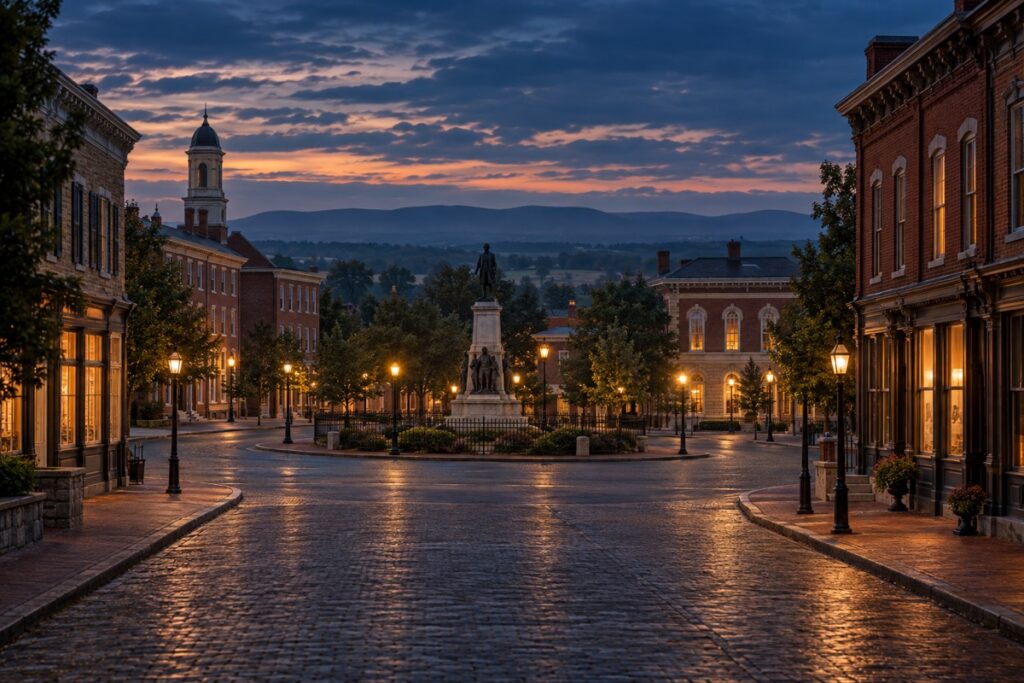
Editorial image: AI-created historical interpretation for HauntsUSA. It is not documentary evidence or proof of paranormal activity.