Quick answer: Howard Street Cemetery is a historic Salem burial ground strongly associated in folklore with Giles Corey. Corey was pressed to death in September 1692 after refusing to enter a plea. His burial place is unknown, so claims that he lies in this cemetery should be labeled legend rather than fact.
Giles Corey’s documented death
Giles Corey was an elderly Salem Farms landowner accused during the witch-trial crisis. He refused to plead guilty or not guilty. Under English legal procedure, a trial could not proceed without a plea, and the court ordered peine forte et dure, the use of heavy weights to force a response. Corey died after being pressed in September 1692.
Later retellings often give him the defiant last words “more weight.” The phrase is deeply embedded in American memory, but surviving accounts differ in wording and detail. A careful history distinguishes the documented legal outcome from later dramatic condensation.
Why Howard Street became part of the story
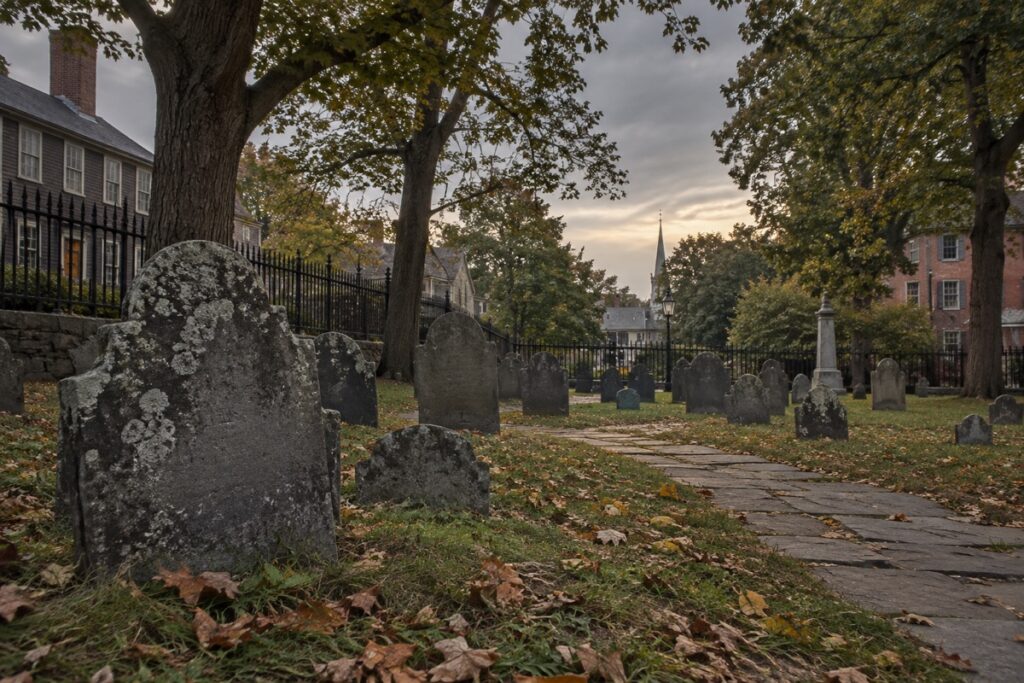
Howard Street Cemetery lies north of downtown Salem near the former jail landscape. Local tradition associates the area with Corey’s death and sometimes with his burial. The exact pressing site and the location of his remains are not securely established. No marker in the cemetery can be treated as his documented grave.
The association may have grown because burial grounds, jail sites, and open land near the edge of an early town offered later storytellers a plausible setting. Repetition on tours and in popular books can make a tradition feel certain even when the archival record does not support the precise location.
The cemetery as a historic place
Howard Street is valuable without a proven Corey grave. It preserves markers from Salem families across changing periods and belongs to the city’s larger network of burial grounds. Gravestones can support research into kinship, epidemics, military service, immigration, craft traditions, and neighborhood development.
Like other early cemeteries, the site is vulnerable to erosion, biological growth, vandalism, and accidental contact. Visitors should use existing paths, avoid gravestone rubbing, and follow all city rules. A respectful visit treats the ground as both a historical archive and a place of burial.
The sheriff’s curse legend
A second tradition says Corey cursed Salem or its sheriff before dying, and that his spirit appears before disasters. Versions connect the legend to later officeholders or public emergencies. These claims are folklore, not a documented causal chain. They tell us more about how communities assign meaning to injustice and catastrophe than about supernatural prediction.
The story endures because Corey’s death was extraordinary, brutal, and rooted in the coercive machinery of the trials. It is possible to discuss that cultural memory without staging invented encounters or presenting a modern anecdote as eyewitness proof.
Arthur Miller later used Corey as a major character in The Crucible, further spreading a dramatized version of the story. The play is a work of literature, not a transcript of 1692. Its influence helps explain why visitors may arrive with vivid scenes in mind that do not map neatly onto the surviving landscape or court record.
Building a better Salem route
Howard Street makes the most sense within a broader geography. The Salem witch-trials sites guide explains the courthouse marker, Proctor’s Ledge, memorials, and surviving buildings. The Witch House guide adds a documented home connected to magistrate Jonathan Corwin.
Do not confuse Howard Street Cemetery with Proctor’s Ledge. Nineteen convicted people were hanged at Proctor’s Ledge. Corey was pressed to death under a different legal process. Conflating the sites erases an important distinction in the record.
Planning a responsible visit
- Check City of Salem cemetery rules and posted hours.
- Do not search for or identify a supposed Corey grave.
- Keep voices low and stay on established paths.
- Photograph markers without touching or rubbing them.
- Treat curse and apparition accounts as folklore, not verified events.
Frequently asked questions
Is Giles Corey buried in Howard Street Cemetery?
His burial place is unknown. The cemetery connection is a persistent local tradition, not an established grave identification.
Was Giles Corey hanged with other victims?
No. He was pressed to death after refusing to enter a plea. Nineteen other convicted people were hanged at Proctor’s Ledge.
Did Corey say “more weight”?
The phrase is traditional and appears in later retellings, but accounts vary. It should not be treated as a verbatim court transcript.
Did Giles Corey curse Salem?
Stories of a curse belong to later folklore. They are not evidence that subsequent disasters had a supernatural cause.
Can visitors enter the cemetery at night?
Follow posted city hours and access rules. Do not enter a closed cemetery or disturb nearby residents.
Sources and editorial note
- Salem Witch Museum: Giles Corey
- City of Salem: Cemetery Commission
- Salem Witch Trials Documentary Archive
HauntsUSA separates trial records, uncertain locations, and later legend. Research was reviewed on September 27, 2026. Confirm access with the City of Salem.
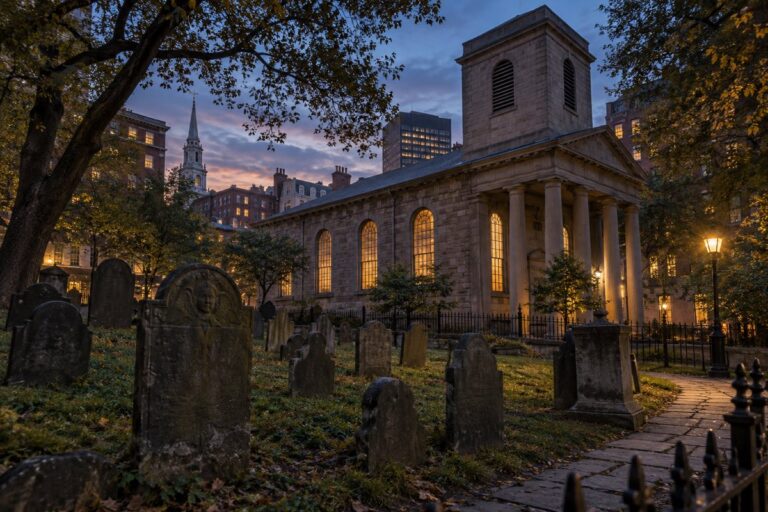
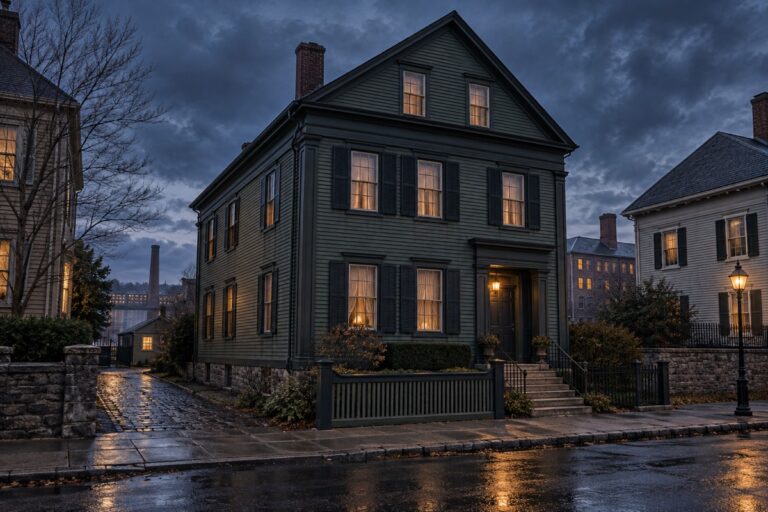
Editorial image: AI-created historical interpretation for HauntsUSA. It is not documentary evidence or proof of paranormal activity.