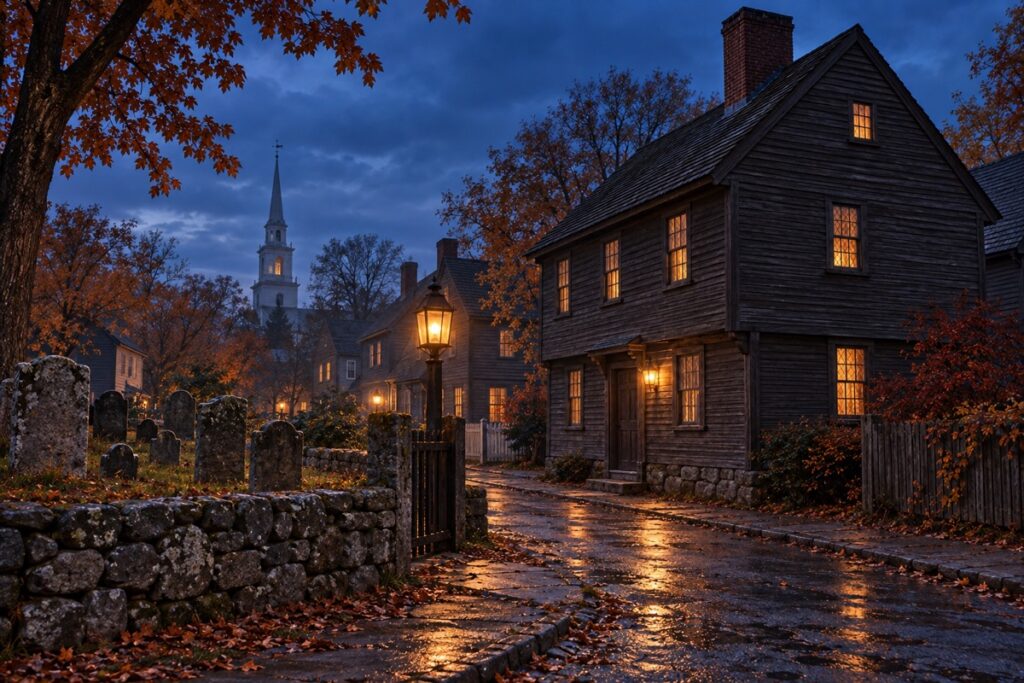
Quick answer: Salem preserves a small but important group of places connected to the witch trials of 1692, including the Jonathan Corwin House, the site of the former courthouse, Proctor’s Ledge, and later memorials. Many other buildings are gone, and several major events occurred in present-day Danvers and neighboring Essex County communities.
What survives from the Salem witch trials?
The Salem witch trials were a regional crisis, not a sequence of events contained within today’s downtown Salem. Accusations began in Salem Village, now Danvers, and spread through Essex County. Examinations, imprisonments, trials, executions, and the seizure of property involved multiple communities and levels of colonial government. A responsible visit begins by recognizing that the familiar name “Salem” describes a much larger landscape.
Very little of the physical world of 1692 survives unchanged. The best-known exception is the Jonathan Corwin House, commonly called the Witch House. The National Park Service identifies it as the only surviving Salem building directly associated with the trials. Corwin served as a magistrate.
The courthouse where the Court of Oyer and Terminer heard cases no longer stands. A marker near 70 Washington Street identifies the approximate site of the 1692 Town House. The loss of the building matters. Visitors are not entering the original courtroom when they walk through modern Salem, and a plaque cannot reproduce the fear, legal uncertainty, and unequal power that shaped the trials. It can, however, establish where colonial authority operated.
Proctor’s Ledge and the execution site
Nineteen people convicted of witchcraft were hanged in Salem in 1692. For generations, tradition placed the executions near the summit of Gallows Hill. Research completed by a team of historians and announced in 2016 confirmed a lower location known as Proctor’s Ledge. The conclusion drew on eyewitness descriptions, early mapping, land records, and the relationship between the ledge and nearby homes.
The City of Salem created a small memorial near the site. It is set within a residential neighborhood and is intended for quiet remembrance. The precise execution ground is not a theatrical attraction. Visitors should keep voices low, avoid blocking nearby streets or homes, and resist turning the memorial into a backdrop for costumes or staged paranormal content.
Giles Corey was not hanged at Proctor’s Ledge. He refused to enter a plea and was pressed to death in September 1692. Howard Street Cemetery is often associated with a legend that Corey was buried there or still appears nearby, but the location of his remains is unknown. The cemetery connection belongs to later folklore, not established burial evidence.
Memorials created long after 1692
Salem’s most visible memorial to the victims stands beside Charter Street Cemetery. Designed by Maggie Smith and James Cutler, the Salem Witch Trials Memorial was dedicated in August 1992 for the tercentenary of the trials. Stone benches bear the names of twenty people who were executed. The design uses an interrupted stone wall and inscribed fragments of the condemned people’s words, emphasizing how their statements were ignored or cut off.
The memorial is not itself a surviving trial site. Its importance comes from the community’s much later decision to acknowledge injustice publicly. The Peabody Essex Museum notes that formal exoneration unfolded over centuries, including legislative action in 2022 for Elizabeth Johnson Jr. Memorialization therefore remains part of an ongoing historical process rather than a finished act of apology.
Charter Street Cemetery next door predates the trials and is Salem’s oldest European burial ground. It contains the graves of judges and other residents connected to seventeenth-century Salem, but not the executed victims. The City of Salem operates a welcome center in the Pickman House and asks visitors to respect fragile stones and designated paths.
Where the documentary record can be found
Objects and records often provide a stronger connection to 1692 than reconstructed stories. The Peabody Essex Museum displays original trial-related objects and makes digitized legal documents available. State court records, local archives, and the Salem Witch Trials Documentary Archive trace accusations through households, churches, taverns, jails, and courts. They also reveal where later accounts simplified dates or locations.
How ghost lore grew around the trials
Salem’s haunted reputation developed through several layers. Nineteenth-century literature, local antiquarian writing, tourism, film, television, walking tours, and seasonal marketing all reshaped public memory. Ghost stories became attached to cemeteries, former jail sites, judges’ houses, and the execution landscape. Some are long-circulating community legends. Others are recent commercial interpretations.
These stories are evidence of how the trials are remembered, not evidence that paranormal events occurred. They can also obscure the documented experiences of people who were accused, imprisoned, dispossessed, or executed. HauntsUSA labels folklore separately and does not invent apparitions, last words, or burial locations where the record is silent.
Planning a responsible Salem history route
- Begin with context: Use the Peabody Essex Museum’s trial exhibition or an evidence-based orientation before visiting individual markers.
- Visit the Witch House: Confirm current hours and ticket requirements with the City of Salem before traveling.
- Walk to the courthouse marker: Remember that the original Town House is gone.
- Pause at the Salem Witch Trials Memorial: Read the names and inscriptions without treating the space as a performance set.
- Approach Proctor’s Ledge quietly: It is a small memorial in a residential neighborhood.
- Expand beyond downtown: Use a documented regional guide to understand sites in Danvers and other Essex County communities.
For broader Salem context, the House of the Seven Gables history guide explores a different waterfront landmark and the literary memory surrounding it.
October brings heavy crowds, street closures, and limited parking. Salem Maritime National Historical Park recommends checking current transportation, visitor-center, and closure information before arrival. Public transit can reduce congestion. Cemetery hours, museum schedules, and house access can change by season, so confirm details with each official operator.
Frequently asked questions
Is the Witch House the original home of a trial judge?
Yes. The Jonathan Corwin House was the home of magistrate Jonathan Corwin and is the only surviving Salem building directly associated with the trials. Confirm current admission details with the City of Salem.
Where were the Salem executions carried out?
Research confirmed Proctor’s Ledge as the site where nineteen people were hanged in 1692. A small city memorial stands near the location in a residential neighborhood.
Are the victims buried in Charter Street Cemetery?
No evidence places the executed victims there. Charter Street Cemetery contains graves connected to early Salem, including people from the wider trial-era community, but it should not be presented as the victims’ burial ground.
Was Giles Corey executed at Proctor’s Ledge?
No. Giles Corey was pressed to death after refusing to enter a plea. Stories connecting him to Howard Street Cemetery are folklore, and his burial place is unknown.
How long should a historical visit take?
Allow at least half a day for a focused downtown route and a museum or historic-house visit. A full day gives more time for the waterfront, archives, and travel to related Essex County sites.
Sources and editorial note
- Peabody Essex Museum: The Salem Witch Trials of 1692
- National Park Service: Salem heritage sites
- City of Salem: Charter Street Cemetery Welcome Center
- Salem Witch Museum: Witch Trials Online Sites Tour
HauntsUSA separates documented trial history, later memorialization, and folklore. Visitor information was reviewed on September 27, 2026. Confirm current access with the relevant city, museum, or site operator before traveling.
Editorial image: AI-created historical interpretation for HauntsUSA. It is not documentary evidence of the 1692 trials or paranormal activity.