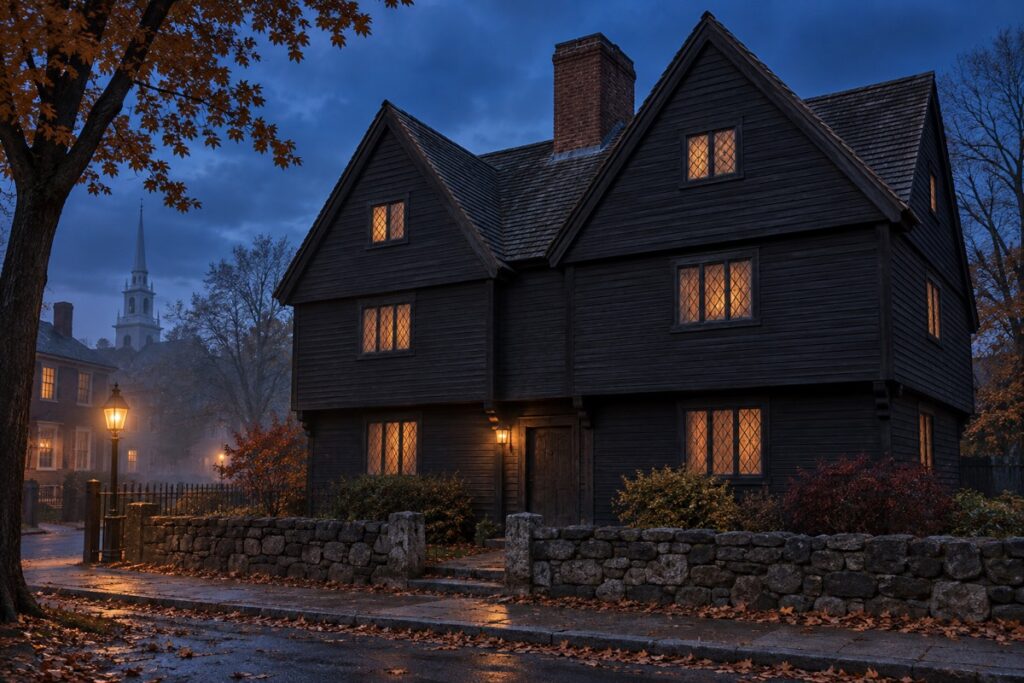
Quick answer: The Witch House at 310 Essex Street in Salem, Massachusetts, is the former home of magistrate Jonathan Corwin and one of the few surviving structures with direct ties to the witch trials of 1692. It is a city-owned museum focused on seventeenth-century life, material culture, and the court crisis that led to executions and lasting injustice.
Why the Witch House matters
The house matters because its link to 1692 is documented rather than invented for tourism. Jonathan Corwin participated in the legal machinery that examined accused people and sent cases toward the Court of Oyer and Terminer. The building therefore offers a rare place to consider how ordinary domestic life stood beside extraordinary failures of law, religion, and communal judgment.
Salem’s modern identity can make it difficult to see the trials clearly. Costumes, commercial witch imagery, and October crowds are now part of the city’s economy. Inside the Witch House, the more important work is slower. Rooms, furnishings, household objects, and interpretation help visitors imagine the social world in which accusation became authority.
The documented history
The structure was built during the seventeenth century and was purchased by Jonathan Corwin in 1675. Corwin was a merchant and civic leader as well as a magistrate. In 1692 he joined the proceedings that responded to accusations of witchcraft in Salem Village and neighboring communities. Nineteen people were hanged after refusing to confess, and Giles Corey died under pressing. Others died in custody.
The house remained in the Corwin family into the nineteenth century. By the twentieth century, road changes and development threatened the building. Preservationists raised funds, moved and restored the structure, and opened it to the public in the 1940s. That restoration reflects its own period of preservation thinking and should be understood as part of the site’s history.
Today the museum interprets architecture, furnishings, belief, household practice, and the trials. The surviving house cannot answer every question about 1692, but it can make the period tangible. It also provides a starting point for visiting memorials, archives, and other Salem sites that center the accused and their families.
History, memory, and the haunted reputation
A building this old naturally attracts ghost stories. Visitors sometimes describe footsteps, cold areas, photographs, or a sense of presence. Such accounts are personal reports. They are not the source of the Witch House’s historical importance, and the city museum does not need a paranormal claim to justify attention.
The word witch also requires care. The people prosecuted in 1692 were accused of witchcraft. They were not proved to possess supernatural powers. Treating them as fictional witches repeats the logic that made persecution possible and can turn injustice into costume drama.
A responsible haunted-history page can acknowledge that visitors bring supernatural expectations to the house. It should then redirect attention toward documented decisions, named victims, court procedure, and the pressures that moved neighbors to accuse one another.
What to notice during a visit
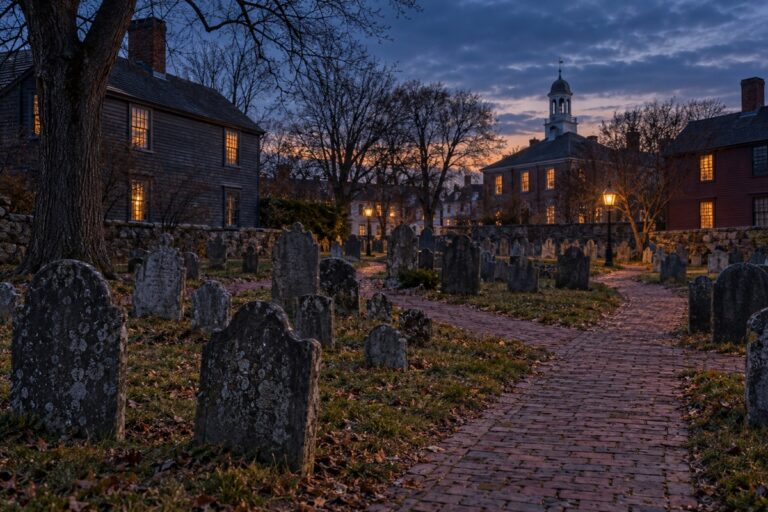
Look at the building’s asymmetry, steep roof, dark timber cladding, chimney, and small-paned windows. Inside, examine how furnishings and everyday tools explain rank, labor, food, religion, and gender in a seventeenth-century household. The point is not to find a hidden ghost but to read an unfamiliar world through its objects.
After the museum, walk toward the Salem Witch Trials Memorial and Charter Street Cemetery. The short geographic distance between civic, domestic, and memorial sites makes the scale of Salem’s history easier to grasp. October visitors should reserve more time because sidewalks, parking, and museum entry can become extremely busy.
Planning a visit
- Location: 310 Essex Street, Salem, Massachusetts 01970.
- Access: The museum has main-season and reduced winter hours. October reservations may be required. Confirm historic-house accessibility before arrival.
- Best for: Visitors studying the Salem witch trials, seventeenth-century domestic life, legal history, architecture, and responsible dark-history interpretation.
- Before you go: Confirm current hours, tickets, accessibility, and photography rules on the official website.
Frequently asked questions
Is the Witch House haunted?
People have reported unusual experiences, but the museum’s significance rests on documented ties to Jonathan Corwin and the 1692 proceedings. Haunting claims remain unverified reports.
Can the public visit?
Yes. The City of Salem operates the Witch House as a museum with self-guided admission. Hours change by season, and October demand can affect entry.
How much time should visitors allow?
Allow forty-five to seventy-five minutes inside, then add time for nearby memorial and historic sites. A thoughtful visit should not be rushed between Halloween attractions.
What is the most important historical context?
Remember that the accused were real people caught in a legal and social catastrophe. The house should be read as evidence of the community and authorities that judged them, not as proof of supernatural events.
Sources and editorial note
The City of Salem’s official Witch House page supplies the address, contact information, operating schedule, museum mission, restoration history, and connection to Jonathan Corwin. Court records and reputable Salem scholarship should guide any expansion of individual biographies.
HauntsUSA separates documented history from reported experiences, local legend, and venue marketing. Paranormal claims are never stated as proven fact. Generated artwork is labeled as an editorial interpretation rather than documentary photography.
Last reviewed September 26, 2026. Visitor details can change. Confirm current information with the site before travel.