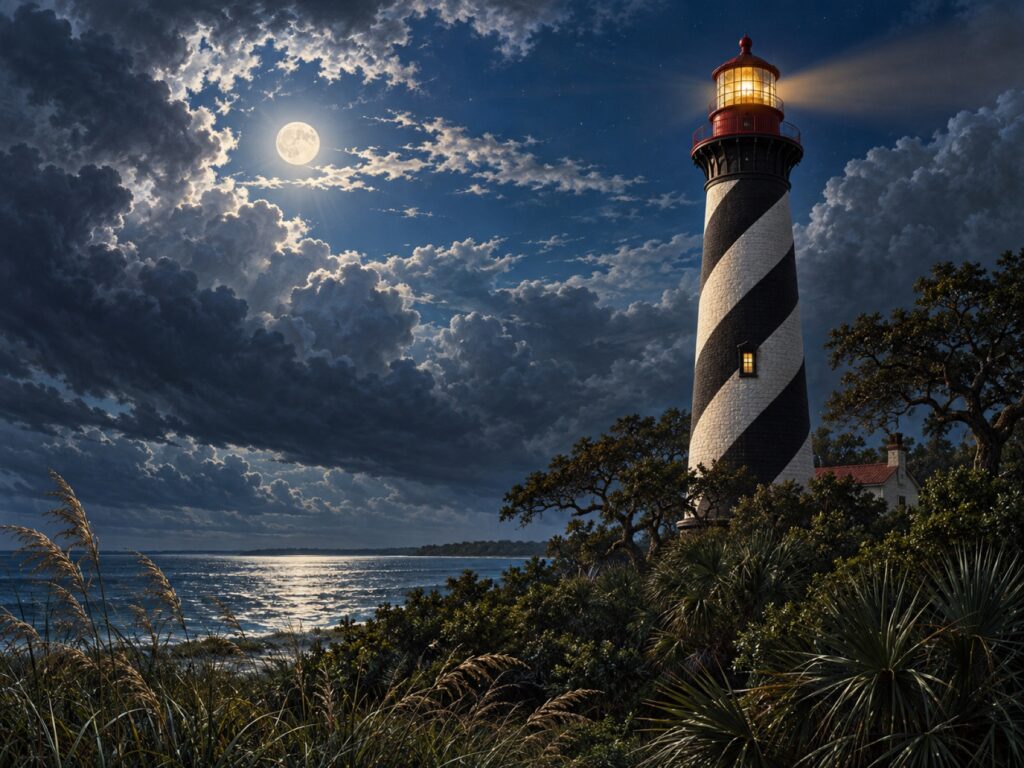
The St. Augustine Lighthouse & Maritime Museum preserves an active 1874 lighthouse, its restored keeper’s house, and the maritime history of Florida’s oldest port. The light station is also known for after-dark ghost programs, but its paranormal reputation is best understood as reported experience and museum-presented folklore layered onto a well-documented navigational landmark.
Why the St. Augustine Lighthouse matters
On the north end of Anastasia Island, the lighthouse connects several centuries of coastal history. Lookout towers protected the approaches to St. Augustine during the Spanish period. An earlier stone watchtower was converted into a lighthouse after Florida became a United States territory, but shoreline erosion eventually undermined it. The present tower was deliberately placed farther inland on higher ground.
The St. Augustine Lighthouse and Keeper’s Quarters were added to the National Register of Historic Places in 1981. The nomination identifies engineering, transportation, architecture, and maritime history as areas of significance. It describes the light station as an integral part of Atlantic coastal navigation and recognizes the lighthouse and keeper’s quarters as the oldest surviving brick structures in St. Augustine.
From coastal watchtower to the 1874 light
The site’s maritime story predates the current lighthouse. Historic documentation records a wooden Spanish watchtower in the 16th century, followed by a later stone tower. That structure served military and navigational purposes before its conversion to a lighthouse in 1823. The sea continued to advance, and the old tower collapsed in 1880 after erosion weakened its position.
Construction of the present lighthouse began in 1871 under superintendent Hezekiah H. Pittee. The tower was completed in 1874 at a documented cost of approximately $105,000. Rising 165 feet, it is a tapered brick structure on an octagonal base, marked by distinctive black-and-white spiral bands. A First Order Fresnel lens projected its light, while the pattern of flashes and the painted tower helped mariners identify the station at night and during the day.
The keeper’s duplex was completed in 1876. Families lived beside the tower while keepers maintained the light, wound its mechanism, carried fuel, cleaned equipment, watched weather, and recorded conditions. The light was electrified in 1936 and automated in 1955. It remains an active aid to navigation, and the original lens continues to shine because of an extensive preservation effort.
Preservation, museum work, and underwater archaeology
The keeper’s house suffered a major fire in 1970. Beginning in 1980, the Junior Service League of St. Augustine led a long campaign to restore the house, tower, and damaged Fresnel lens. The museum opened full-time in 1994, and the preservation program continued through the following decades. The nonprofit later received the tower and lens through the federal lighthouse-preservation process and acquired the remainder of the historic light station.
Today the museum interprets more than the lighthouse itself. Its mission encompasses the stories of the Nation’s Oldest Port, maritime collections, boatbuilding, marine science, artifact conservation, and underwater archaeology. The Lighthouse Archaeological Maritime Program researches shipwrecks and submerged cultural resources around Florida’s First Coast. That work gives visitors a direct connection to the people, vessels, labor, trade, and hazards that shaped the region.
Is the St. Augustine Lighthouse haunted?
The museum actively presents the lighthouse as a haunted historic site. Its Dark of the Moon programs combine after-hours access, historical storytelling, and opportunities for paranormal investigation. Stories associated with the site include lighthouse keepers, members of keeper families, and three children who drowned during the construction period. These narratives are part of the museum’s public programming and the city’s wider ghost-tour culture.
Reported footsteps, voices, shadows, sensations, and equipment readings do not establish paranormal activity as fact. They are personal accounts interpreted within an atmospheric historic setting. The distinction is especially important at a museum: documented deaths and family histories should not be sensationalized simply because later visitors connect them with a haunting. HauntsUSA presents the claims as folklore and reported experience while directing readers to the light station’s verifiable maritime record.
Planning a visit
The St. Augustine Lighthouse & Maritime Museum is at 100 Red Cox Drive, St. Augustine, Florida. The official site currently lists daily hours of 9:00 a.m.–6:00 p.m., with closure on Thanksgiving and Christmas Day and an early Christmas Eve closing. Specialty tours have separate schedules and tickets. Confirm the calendar before traveling, especially for after-dark programs. For current information, call 904-829-0745.
The climb to the observation deck requires 219 steps and may be affected by weather and safety restrictions. Visitors who cannot climb can use accessible museum resources, including a “View from the Top” video in the Maritime Education Center. Daytime admission, ghost tours, investigation programs, and other special experiences are different offerings, so review the official description of the specific ticket you intend to purchase.
Frequently asked questions
When was the St. Augustine Lighthouse built?
The present tower was constructed from 1871 to 1874 and replaced an older shoreline tower.
How many steps are in the lighthouse?
Visitors climb 219 steps to reach the observation deck.
Is the lighthouse still operating?
Yes. The restored lighthouse and its First Order Fresnel lens continue to serve as an active aid to navigation.
Continue exploring haunted history in Florida or browse the complete HauntsUSA directory of historic haunted places.
Sources and further reading
- St. Augustine Lighthouse & Maritime Museum: About and Preservation
- St. Augustine Lighthouse & Maritime Museum: Official Visit Information
- National Park Service: National Register Record
- National Park Service: National Register Nomination
- National Park Service: St. Augustine Lighthouse Overview
- Museum Account of Dark of the Moon Stories
Last reviewed September 26, 2026. Paranormal claims are attributed to the museum or identified as reported experience. AI-generated editorial artwork is an interpretation, not documentary photography.