Quick answer: Charter Street Cemetery, often called the Old Burying Point, is Salem’s oldest European burial ground. City records place it before 1637. It preserves fragile early markers and the graves of people connected to colonial Salem, but it is not the burial place of the people executed in the witch trials.
Salem’s early colonial burying ground
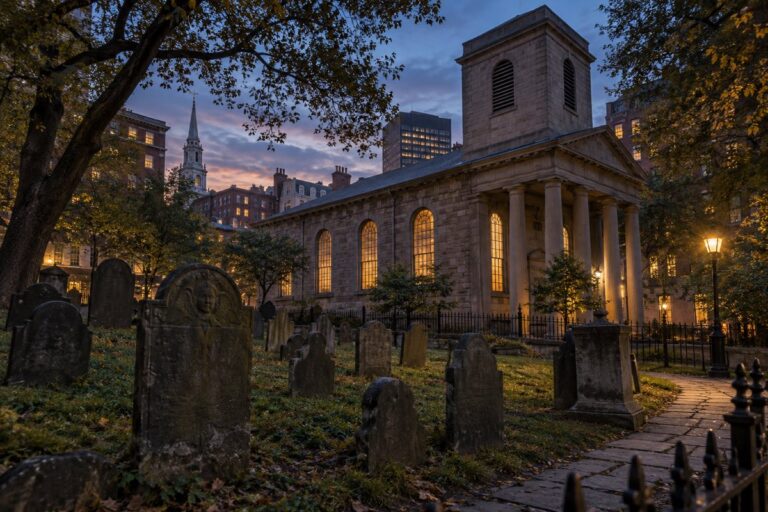
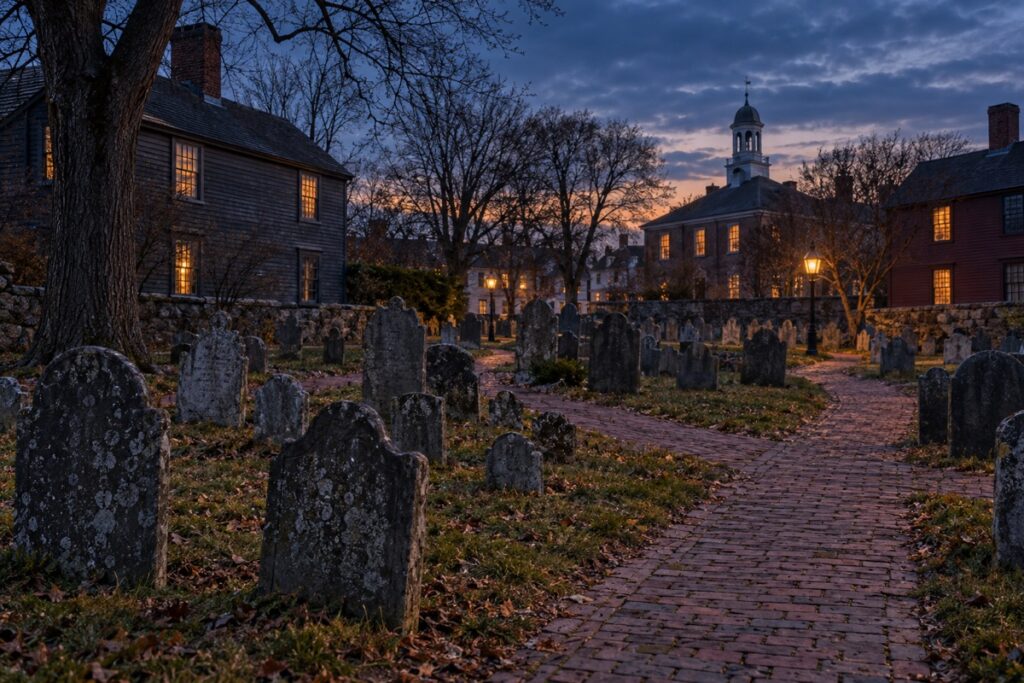
Charter Street Cemetery occupies a compact parcel in downtown Salem beside the Pickman House and the Salem Witch Trials Memorial. The City of Salem says it was established before 1637. A town record from that year already referred to the area as a burial place when John Horne received permission to erect a windmill there.
The site is sometimes promoted under the dramatic name Old Burying Point. Both names refer to the same historic cemetery. Its slate and stone markers record several centuries of mortality, family networks, craftsmanship, and changing religious ideas. Indigenous burial sites in Salem predate this European cemetery, a fact the city’s interpretation explicitly acknowledges.
Who is buried here?
The cemetery contains judges, merchants, ministers, mariners, craftspeople, children, and other residents of early Salem. Among the widely noted burials is Judge John Hathorne, a magistrate involved in the 1692 examinations. His presence connects the landscape to the trial-era community, but it does not make the cemetery an execution or victim-burial site.
No reliable evidence places the executed witch-trial victims in Charter Street Cemetery. Their bodies were not given conventional burials here. Repeating that claim turns a place of documented community burial into a false trial attraction. The nearby memorial, dedicated in 1992, honors the victims but is a much later commemorative landscape.
Reading the stones
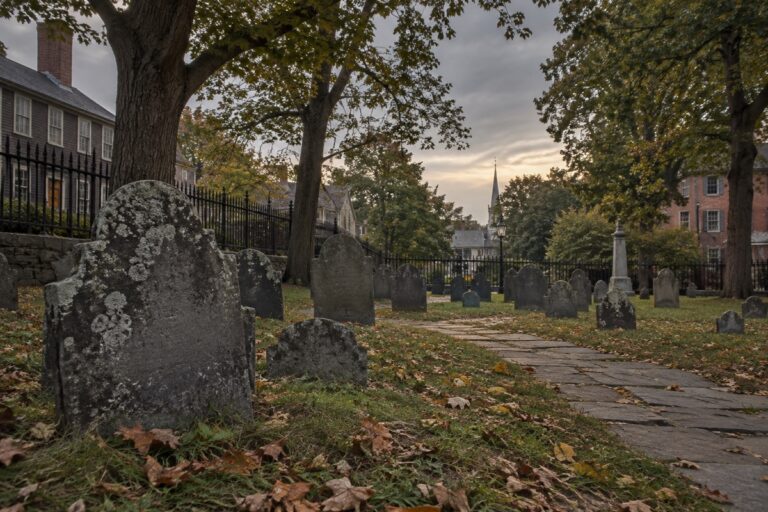
Early New England gravestones use visual symbols that changed over time. Winged skulls, hourglasses, cherubs, urns, and willows communicated beliefs about death and remembrance. A symbol is not a secret paranormal code. Its meaning should be read in the context of the carving date, local workshop traditions, and the inscription.
Weathering has softened many inscriptions, and the stones can be damaged by touch, chalk, rubbing, or leaning. Photographs taken from the path usually reveal more when side light crosses the carving. Visitors should never apply substances to make lettering easier to read.
Preservation and the welcome center
The cemetery is part of the Charter Street Historic District, listed in the National Register of Historic Places in 1975. The city completed a major preservation and landscape project before reopening the grounds with controlled access. The neighboring seventeenth-century Pickman House now serves as the Charter Street Cemetery Welcome Center, with exhibits on the cemetery, the house, the district, and Salem’s funerary history.
Hours and entry procedures can change with weather, preservation work, and seasonal crowd control. October is especially busy. Check city guidance, enter only through designated access points, and follow staff instructions. The cemetery is an archaeological and memorial resource, not an open set.
Folklore and respectful interpretation
Ghost-tour stories often associate judges, shadow figures, or unexplained photographs with the cemetery. Such accounts are difficult to trace and cannot establish a paranormal event. The documented history is already complex: the ground records disease, childhood mortality, maritime commerce, social inequality, and the growth of Salem.
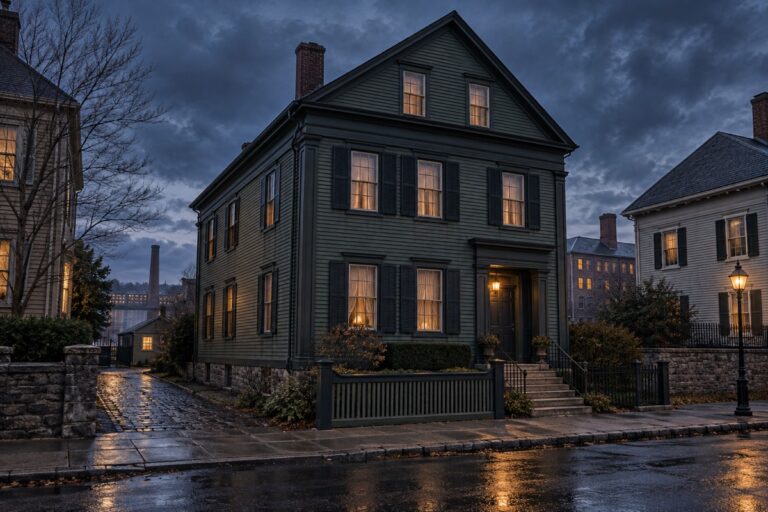
Folklore is best presented as a later layer of public memory. It should not erase names on the stones or imply that every person connected to 1692 was accused of witchcraft. Start with the Salem witch-trials historic-sites guide, then compare the cemetery with the surviving Witch House.
Planning a responsible visit
- Use the welcome center for orientation and current access rules.
- Stay on marked routes and give other visitors room for quiet reflection.
- Do not touch, rub, sit on, or lean against gravestones.
- Keep the witch-trial memorial and colonial cemetery historically distinct.
- Verify seasonal hours on the City of Salem website.
Frequently asked questions
Is Old Burying Point the same as Charter Street Cemetery?
Yes. Old Burying Point is a common historic and visitor-facing name for Charter Street Cemetery.
When was the cemetery established?
It was established before 1637, when Salem records already described the parcel as a burial place.
Are witch-trial victims buried here?
No reliable evidence places the executed victims in this cemetery. The adjacent 1992 memorial commemorates them.
Can visitors make gravestone rubbings?
No. Rubbing, chalking, touching, or leaning on fragile markers can cause damage. Follow city preservation rules.
Is the cemetery open every day?
Access can change by season, weather, and preservation needs. Confirm the current schedule with the City of Salem.
Sources and editorial note
- City of Salem: Charter Street Cemetery Welcome Center
- City of Salem: Cemetery Commission
- City of Salem: Historic Preservation Plan Update
HauntsUSA separates documented burial history, commemoration, and folklore. Visitor information was reviewed on September 27, 2026.
Editorial image: AI-created historical interpretation for HauntsUSA. It is not documentary evidence or proof of paranormal activity.