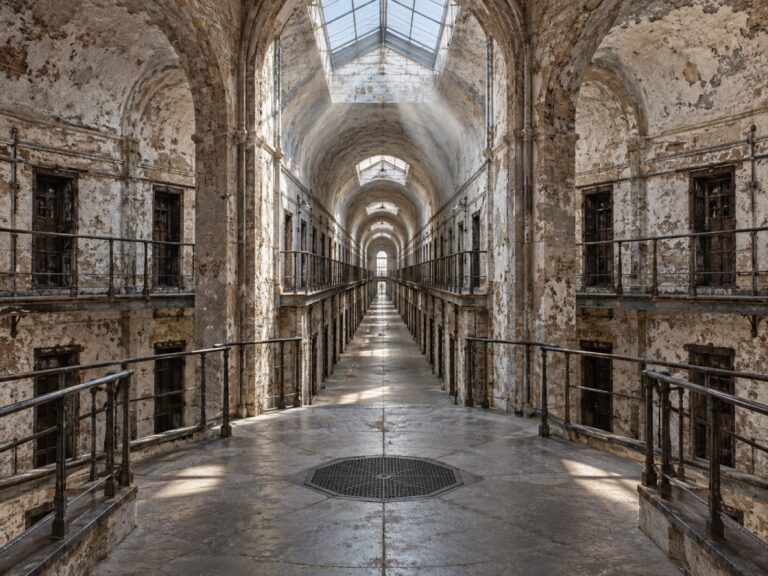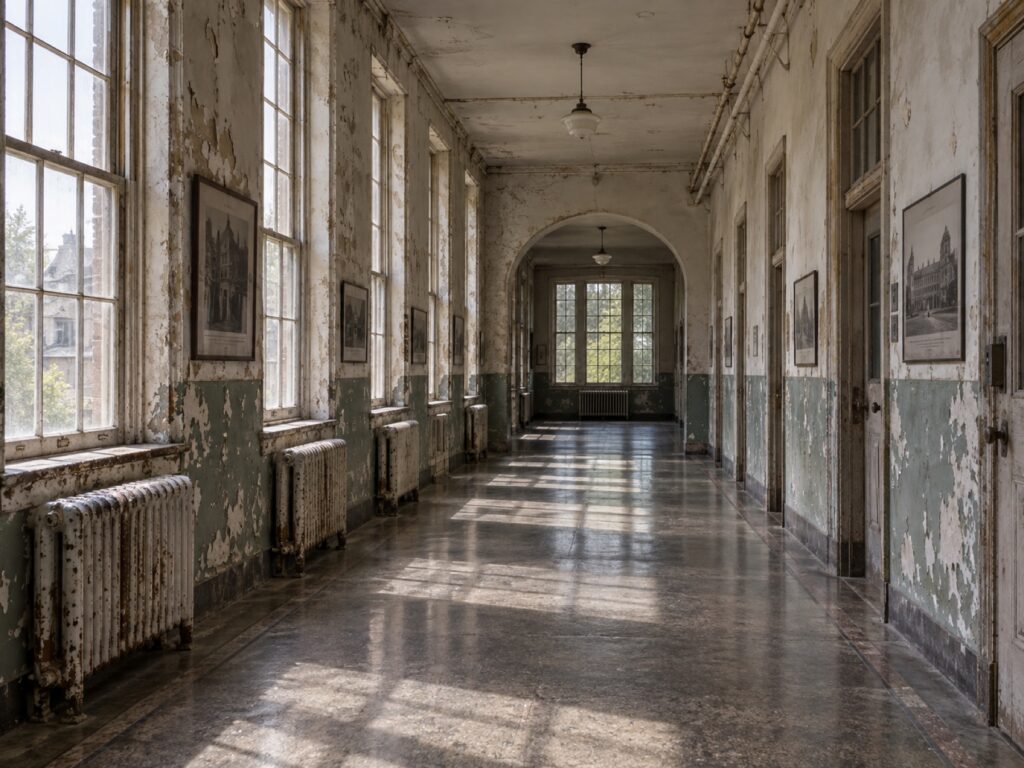
Pennhurst was a Pennsylvania state institution for people with intellectual and developmental disabilities that operated near Spring City from 1908 to 1987. Documented abuse, resident advocacy, investigative reporting, and the Halderman litigation made the campus central to the American disability-rights movement. Parts of the former campus now host history tours, paranormal events, and a seasonal haunted attraction, but entertainment should never replace the voices and civil-rights history of Pennhurst residents.
Why Pennhurst matters
Pennhurst is one of the most consequential institutional sites in the United States. Its story reaches far beyond abandoned buildings or paranormal television. It shows how public policy separated disabled people from their families and communities, how institutional systems could produce neglect and violence, and how residents, relatives, journalists, lawyers, researchers, and self-advocates forced change.
The Commonwealth authorized the institution in 1903, and it opened in 1908 under a name that used terminology now recognized as demeaning. Later names included Pennhurst State School and Hospital. Language matters here. Historic legal titles sometimes contain outdated words, but modern editorial coverage should describe people as people with intellectual and developmental disabilities, not as diagnoses or attractions.
Institutionalization at Pennhurst
Pennhurst was built as a large, segregated campus intended to house, educate, train, and supervise disabled people. Residents included children and adults with widely different support needs. Some families were told that institutional placement was the only available option. Admission could mean separation from home, limited personal freedom, institutional labor, and life under rules controlled by staff and the state.
The institution became severely overcrowded and understaffed. Official records, court findings, first-person accounts, and journalism documented dangerous conditions. In 1968, Philadelphia television reporter Bill Baldini aired “Suffer the Little Children,” a series that showed the public conditions inside Pennhurst. The broadcasts were not a ghost story; they were an investigation into the treatment of living people.
Residents were not passive figures in this history. Survivors described Pennhurst in their own words, built lives after leaving, and became leaders in self-advocacy. Roland Johnson, who spent years at Pennhurst, later helped lead Speaking For Ourselves and worked nationally for disability rights. Oral histories and resident testimony are essential sources because institutional files often reflect the viewpoints of administrators rather than the people confined there.
Halderman v. Pennhurst
In 1974, Terri Lee Halderman, a Pennhurst resident, became the named plaintiff in a federal class action against the institution and government officials. Other residents, families, advocacy organizations, and the United States joined the litigation. The plaintiffs argued that Pennhurst’s conditions and unnecessary institutionalization violated residents’ constitutional and statutory rights.
After a lengthy trial, the federal district court found serious and widespread violations. The case then moved through appeals and reached the United States Supreme Court twice. The Supreme Court decisions are important to federalism and disability-law history, but they do not erase the factual record of conditions or the broader movement toward community-based services.
A settlement and continuing advocacy contributed to the institution’s closure in 1987. Research following former residents found that community placement could improve quality of life and development when paired with appropriate support. Pennhurst became a national reference point in debates over institutionalization, public responsibility, due process, and the right to live in the least restrictive environment.
The campus after closure
After state operations ended, the large campus was divided among different owners and uses. Buildings deteriorated, artifacts were dispersed, and the site attracted photographers, explorers, preservationists, and paranormal media. A private operator later developed a seasonal haunted attraction on part of the property under the name Pennhurst Asylum. The operator also offers scheduled daytime history tours and maintains museum displays.
These uses are not interchangeable. A daytime history tour should be evaluated by its sourcing, inclusion of survivor perspectives, and treatment of disability rights. A seasonal haunted attraction is entertainment. Visitors should understand which experience they are purchasing and should not assume theatrical characters, props, or marketing language represent the institution’s actual history.
Is Pennhurst haunted?
Pennhurst has a strong paranormal reputation built through investigations, television, private events, and stories of voices, shadows, footsteps, and equipment responses. The current operator schedules paranormal programs and uses supernatural themes in its commercial identity. These are reported experiences and venue marketing, not verified evidence.
HauntsUSA does not imply that disability, institutionalization, or abuse makes a person frightening in death. The horror in Pennhurst’s documented history lies in systems that denied people dignity and control while they were alive. Any paranormal discussion should remain secondary to residents’ experiences and the disability-rights legacy.
Planning a respectful visit
The visitor entrance advertised by the current operator is at 601 North Church Street in Spring City, Pennsylvania. Access is event-based rather than daily. Daytime history tours are guided and can last about three hours, covering lower-campus buildings, remediated spaces, artifacts, and institutional history. Paranormal investigations, special events, and the autumn haunted attraction have separate tickets, schedules, rules, and age guidance.
The seasonal haunted attraction’s 2026 calendar currently runs on selected nights from late September into early November. Box-office times vary by day. Historical-tour dates are posted separately. Expect walking, outdoor areas, uneven historic surfaces, stairs, dark spaces, and emotionally difficult material. Confirm accessibility and the exact experience before purchasing. Group-sales questions can be directed to 484-886-6080.
Frequently asked questions
When did Pennhurst operate?
The state institution opened in 1908 and closed in 1987.
Why is the Pennhurst court case important?
The litigation documented institutional conditions, challenged segregation and inadequate care, and became influential in disability-rights and federalism law.
Is the haunted attraction the same as a history tour?
No. The commercial haunted attraction, daytime history tours, paranormal programs, and museum experiences are distinct offerings.
Continue exploring haunted history in Pennsylvania or browse the complete HauntsUSA directory of historic haunted places.
Sources and further reading
- Temple University Institute on Disabilities: File/Life Stories
- Disability Justice: Halderman v. Pennhurst
- U.S. Government Publishing Office: Pennhurst State School v. Halderman, 451 U.S. 1
- U.S. Department of Health and Human Services: Pennhurst Longitudinal Study
- Current Site Operator: Daytime History Tours and Museum
- Current Site Operator: Seasonal Visitor Calendar
Last reviewed September 26, 2026. This page uses person-first language and centers disability-rights history. Paranormal and entertainment claims are clearly separated from documented institutional history. AI-generated editorial artwork contains no patients and is not documentary photography.