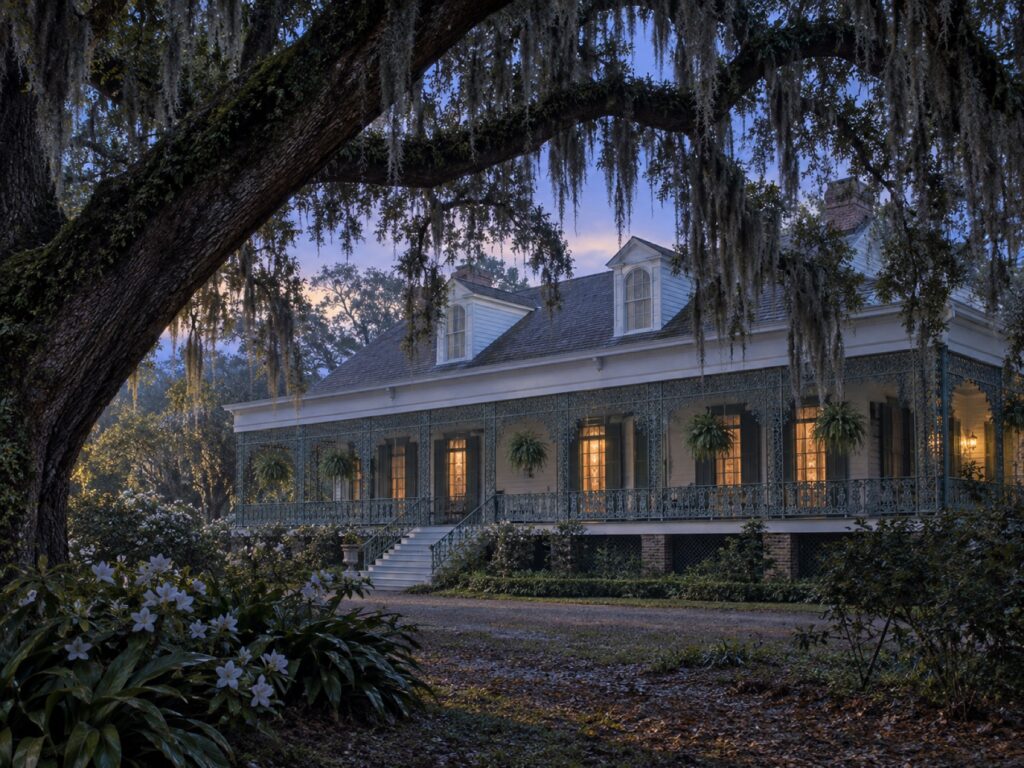
The Myrtles is a National Register-listed historic house and former plantation near St. Francisville, Louisiana, now operated as lodging, dining, and a tour destination. Its architecture and ownership history are documented, while its famous Chloe story and many other supernatural claims belong to folklore and commercial storytelling rather than settled historical fact.
Why The Myrtles matters
The Myrtles stands within the layered history of the lower Mississippi River region, Spanish West Florida, the early United States, plantation agriculture, slavery, the Civil War era, historic preservation, and modern tourism. The property is visually known for its long gallery, carved interior plasterwork, mature trees, and later additions. It was listed in the National Register of Historic Places in 1978 for architecture and its association with David Bradford.
A responsible account cannot treat the site only as a romantic antebellum house or a stage for ghost stories. Cotton and indigo plantations depended on the labor and coercion of enslaved people. Their lives belong at the center of the property’s history even when surviving summaries preserve far more information about owners than about the people they enslaved. Gaps in the record should be acknowledged, not filled with invented identities or recycled legends.
David Bradford and the early house
David Bradford was a Pennsylvania lawyer, judge, businessman, and participant in the Whiskey Rebellion of 1794. After federal forces moved against the uprising, he traveled to Spanish-controlled territory near Bayou Sara. The National Register nomination states that Bradford obtained a Spanish land grant of roughly 650 acres and built a plantation house in 1797. That document calls the property Richland; the present operator’s timeline uses the name Laurel Grove for Bradford’s early estate.
The house began as a raised cottage adapted to Louisiana’s climate. Later owners expanded and embellished it. Architectural features cited in the National Register record include a gallery extending more than one hundred feet and unusually fine carved plaster cornices and ceiling medallions. The building is valuable not because every room remains frozen in one year, but because its fabric records multiple periods of occupation and alteration.
The Woodruff, Stirling, and Winter families
Bradford’s daughter Sarah Mathilda married Clark Woodruff in 1817. The official property history reports that she died in 1823, probably from yellow fever, and that two of their children died the following year. Clark Woodruff later transferred the estate to Ruffin Gray Stirling, who expanded the house and gave it the name The Myrtles. The property then passed through the Stirling and Winter families and several later owners.
William Winter, who married Sarah Stirling, died after being shot in 1871. The event became central to later ghost storytelling, including a claim that he climbed a specific number of stairs before dying. The documentary record supports the homicide, but precise dramatic details repeated on tours and television should be treated as legend unless tied to a contemporary source.
During the twentieth century, owners restored the house and opened it to visitors. The property joined the local pilgrimage-tour tradition in the 1940s, developed gift-shop and tour operations, and later became a bed-and-breakfast. A 1992 book helped establish its national reputation as a haunted house. Today The Myrtles combines preservation, hospitality, dining, weddings, daytime interpretation, and evening mystery tours.
Is The Myrtles haunted?
The best-known legend describes Chloe, said to have been an enslaved woman punished by Clark Woodruff and later responsible for poisoning members of the family. The story is widely repeated, but important details conflict with the documented timeline. The property’s current history says Sarah Mathilda and two children probably died of yellow fever, not poisoning. Researchers have not identified reliable evidence confirming Chloe as a person enslaved by the Woodruff family at The Myrtles.
That does not erase the reality of slavery at the plantation. It means the history of enslaved people should not be represented through an unsupported tale that casts a Black woman primarily as a sexual victim, poisoner, or ghost. The distinction matters: documented injustice deserves direct treatment, while folklore should remain labeled as folklore.
Other reports describe a woman on the gallery, children’s voices, unusual photographs, footsteps, and William Winter’s supposed final movements. The venue presents these stories on evening mystery tours. They are reported experiences and commercial interpretations, not verified paranormal evidence.
Planning a visit
The Myrtles is at 7747 U.S. Highway 61 in St. Francisville, Louisiana. The grounds are open to the public seven days a week. The property currently offers guided day tours, self-guided house tours, evening mystery tours, private tours, and garden-and-grounds programs. Evening mystery tours are offered nightly, with additional times on some weekends. Lodging and the onsite restaurant follow separate schedules.
Advance reservations are wise because tour inventory, private events, and accommodations vary. Day tours focus on the downstairs rooms and historic furnishings; evening programs emphasize folklore and atmosphere. Confirm accessibility for the specific route, current times, ticket requirements, and photography rules directly before visiting. Call 225-635-6277 for current information.
Frequently asked questions
When was The Myrtles built?
The National Register nomination dates David Bradford’s original plantation house to 1797. Later owners significantly expanded and decorated it.
Is the Chloe story documented?
No reliable record has confirmed the familiar Chloe narrative, and documented family deaths conflict with its poisoning plot. It should be presented as legend.
Can visitors stay overnight?
Yes. The Myrtles operates as a hotel or bed-and-breakfast property in addition to offering tours and dining.
Continue exploring haunted history in Louisiana or browse the complete HauntsUSA directory of historic haunted places.
Sources and further reading
- The Myrtles: Official History and Culture
- The Myrtles: Official Tour Information
- National Park Service: Myrtles Plantation National Register Record
- National Park Service: National Register Nomination
- Louisiana Division of Historic Preservation: National Register Database
Last reviewed September 26, 2026. Plantation history is presented without romanticizing slavery. The Chloe narrative and paranormal accounts are labeled as legend or venue-presented experience. AI-generated editorial artwork is an interpretation, not documentary photography.