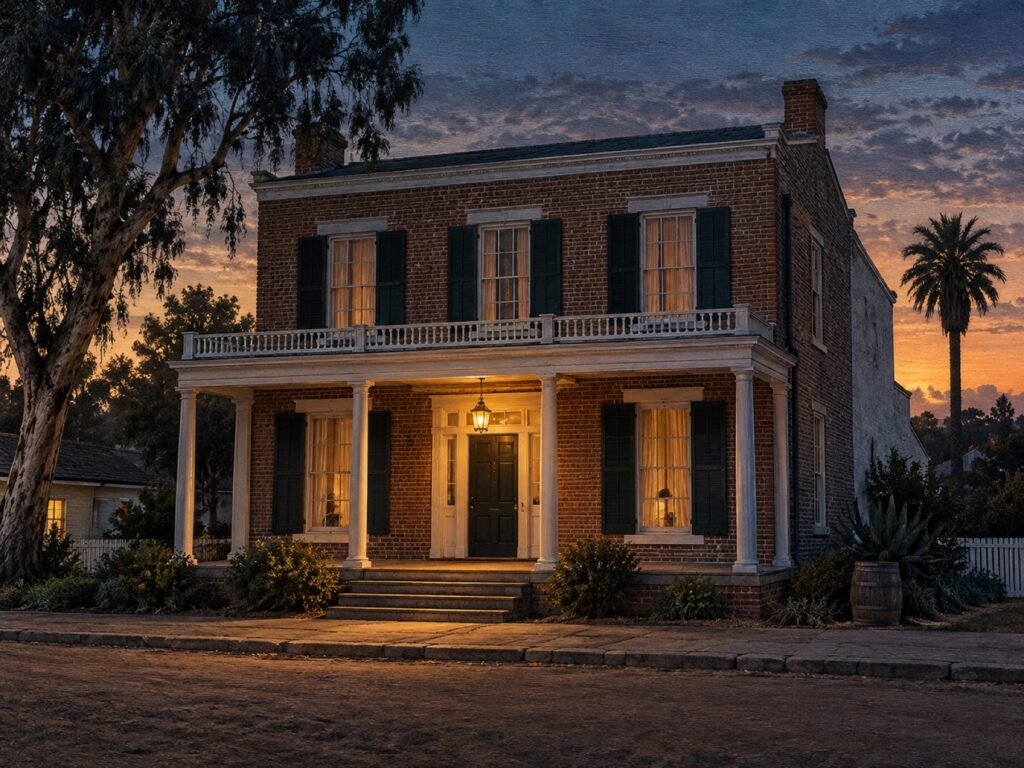
The Whaley House Museum is an 1857 Greek Revival brick house in Old Town San Diego that served as a family home, courthouse, general store, and theater. Its civic and architectural history is documented by California historic records. Stories of footsteps, apparitions, and the Whaley family are part of its long-running haunted reputation, but they remain reported experiences and folklore.
Why the Whaley House matters
The Whaley House is more than a famous stop on a ghost tour. It survives from the period when San Diego was shifting from a Mexican pueblo and frontier community into an American city. California State Parks identifies it as the first brick building erected in San Diego County and notes that the county court met there for roughly two decades. The house became California Historical Landmark No. 65 in 1932.
The building’s many uses make it an unusually concentrated record of Old Town life. Under one roof, the Whaley family lived, merchants traded, actors performed, and public officials conducted court business. Five generations of the family occupied the property at different times. The mixture of domestic, commercial, political, and theatrical history gives the museum a stronger foundation than the slogan often attached to it.
Thomas Whaley builds in Old Town
Thomas Whaley arrived in California during the Gold Rush era and established businesses in San Diego. On May 6, 1856, he began building a two-story Greek Revival house on San Diego Avenue. He designed the structure and used bricks fired in his own Old Town kiln. State records describe plaster made from ground seashells, while later historic surveys recognize the building as San Diego’s oldest surviving red-clay-brick structure.
Thomas, his wife Anna, and their children moved into the completed house in 1857. A general store operated in part of the building. After a period away from San Diego, the family returned, and the property entered its best-known civic phase. The county leased rooms for court sessions and records, bringing lawyers, officials, witnesses, and members of the public into what was still a family residence.
Courthouse, store, and theater
The Whaley House became closely tied to the contest between Old Town and the growing New Town near the bay. County court activity temporarily supported Old Town businesses, but the political and commercial center moved south during the early 1870s. California State Parks research records that county files were removed from the Whaley House in 1871, ending its role in the struggle over the county seat.
The house also contained a general store and San Diego’s first commercial theater. The Thomas Tanner Troupe performed in an upstairs room during the late 1860s. These overlapping uses explain why individual rooms can be interpreted in several different ways. The building was never only a mansion; it was an active piece of San Diego’s public life.
Family history includes success, movement, conflict, and death. One frequently discussed event is the 1885 death of Violet Whaley, an adult daughter of Thomas and Anna. Her story deserves to be treated as a human tragedy, not a supernatural prop. Modern interpretation should avoid implying that every difficult event automatically produced a ghost.
Yankee Jim and the haunted-house story
Before the house was constructed, James “Yankee Jim” Santiago was executed near the site in 1852 after a grand-larceny conviction. California State Parks confirms the execution and its connection to the property. Later stories claim that Thomas Whaley or subsequent occupants heard heavy footsteps attributed to Santiago. The execution is documented; identifying an unexplained sound as Santiago’s ghost is folklore.
Other reported experiences involve Thomas and Anna Whaley, children, scents, shadows, and movement inside the house. The current operator promotes the museum under a haunted-house trademark and offers evening tours and paranormal investigations. Television exposure has amplified the reputation. These programs document a modern tradition of interpretation and tourism, not scientific proof that a particular apparition exists.
Planning a visit
The Whaley House Museum is at 2476 San Diego Avenue in Old Town San Diego. The official visitor site currently lists daytime self-guided tours daily from 10:00 a.m. to 4:30 p.m. A short introduction is offered at regular intervals before guests explore the interior and grounds. Daytime reservations are not required, although buying ahead may save time.
Evening guided tours and after-hours paranormal investigations are separate ticketed experiences and require reservations. The operator rates the daytime tour PG and the evening and investigation programs PG-13; minors must be accompanied according to the ticket rules. Historic stairs and room layouts may affect accessibility, so confirm the route and accommodations directly. Hours and policies can change. Call 619-273-5824 before traveling.
Frequently asked questions
When was the Whaley House built?
Thomas Whaley began construction in 1856, and the family occupied the completed brick house in 1857.
Was the Whaley House really a courthouse?
Yes. San Diego County leased space in the house for court sessions and record storage during the nineteenth century.
Are daytime and haunted tours different?
Yes. The daytime visit is self-guided and history-centered. Evening tours and paranormal investigations are separately scheduled experiences.
Continue exploring haunted history in California or browse the complete HauntsUSA directory of historic haunted places.
Sources and further reading
- Whaley House Museum: Official Visitor Information and History
- Whaley House Museum: Official Tickets and Tour Details
- California Office of Historic Preservation: Whaley House
- California State Parks: First San Diego Courthouse and Yankee Jim
- California State Parks: Old Town San Diego Interpretation Plan
Last reviewed September 26, 2026. Paranormal claims are presented as folklore, reported experience, or venue marketing. AI-generated editorial artwork is an interpretation, not documentary photography.