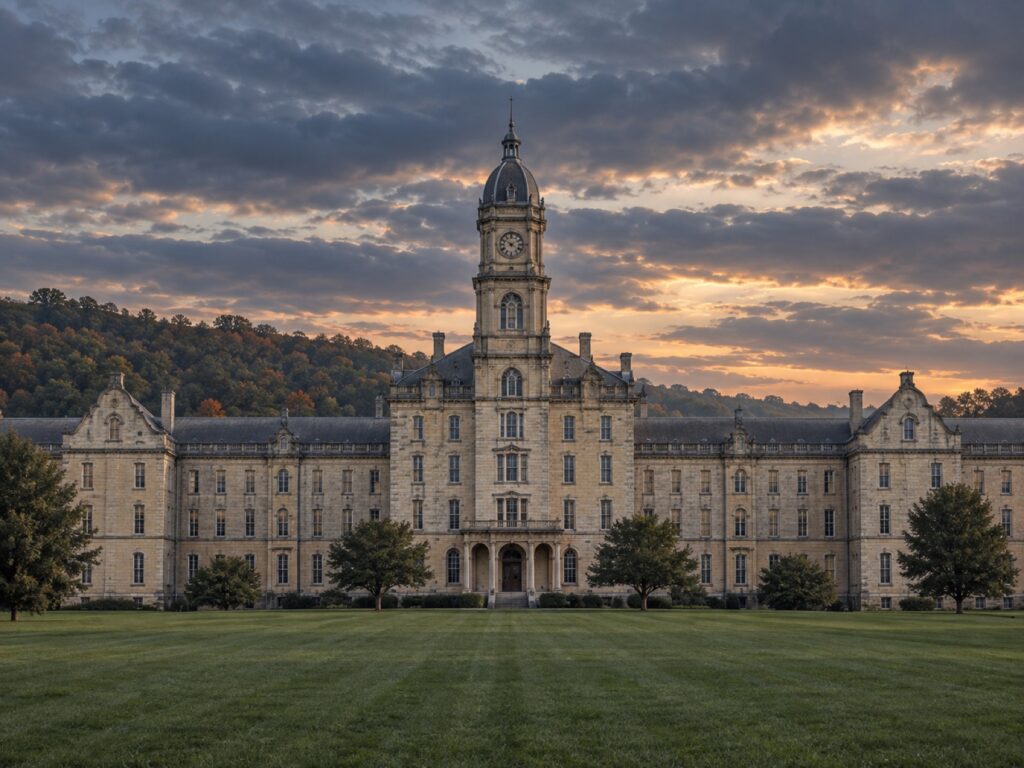
The Trans-Allegheny Lunatic Asylum is the publicly used name for the former Weston State Hospital, a National Historic Landmark in Weston, West Virginia. Opened during the Civil War era, the hospital reflects the ambitions and failures of institutional mental-health care, the architecture of the Kirkbride plan, and more than a century of life and work on its campus. Its current owners offer both history tours and paranormal programs, but reported supernatural experiences are not documented historical facts.
Why the Trans-Allegheny Lunatic Asylum matters
The enormous stone hospital is visually dramatic, yet its importance is not limited to scale or atmosphere. It records a period when reformers argued that people experiencing mental illness deserved purpose-built hospitals instead of confinement in jails, poorhouses, or unsafe private settings. It also records how reform ideals could deteriorate when institutions became overcrowded, underfunded, and disconnected from the communities they were meant to serve.
West Virginia recognizes the property as the Weston State Hospital, and the National Park Service designated it a National Historic Landmark in 1990. The landmark documentation identifies the main building as one of the largest hand-cut stone masonry buildings in the United States and an important surviving example of a hospital planned around the therapeutic ideas associated with physician Thomas Story Kirkbride.
A hospital shaped by the Kirkbride plan
Virginia authorized a new hospital west of the Allegheny Mountains in 1858 and funded the project in 1860. Baltimore architect Richard Snowden Andrews designed the complex. His plan reflected Kirkbride-era principles: long wings extended from a central administrative building, patient areas received light and fresh air, and landscaped grounds were intended to provide calm, work, and recreation. Different wards could separate residents according to health needs and behavior.
Construction began in 1861, but the Civil War disrupted both the work and the political map. West Virginia entered the Union in 1863, and construction resumed under the new state government. The first patients arrived in the south wing in October 1864 while builders continued the central structure. The main building was not completed until 1881. Its long Gothic Revival façade, pale sandstone, towers, and repeated windows gave architectural form to a theory that environment itself could support treatment.
The hospital also developed into a largely self-sufficient campus. Farms, gardens, kitchens, laundries, workshops, and other support buildings supplied food and services. Patients performed some of this labor as part of the institution’s treatment system. That history should not be reduced to a picturesque account of a working farm: institutional labor involved unequal power, and the experience of an individual patient depended on era, diagnosis, ward, staff, resources, and personal circumstance.
Overcrowding and the limits of institutional care
The hospital was designed for a much smaller population than it eventually held. Like many American public institutions, it received people with a wide range of disabilities, illnesses, social circumstances, and legal classifications. As admissions rose, the spacious environment envisioned by reformers gave way to crowding and strained resources. Later buildings expanded the campus, but adding space did not resolve the deeper problems of large-scale institutionalization.
The name changed over time, most notably to Weston State Hospital. During the twentieth century, treatment practices, professional standards, medications, disability rights, and public policy all changed. West Virginia gradually developed smaller facilities and community-based services. Weston State Hospital closed in 1994 and was replaced by the William R. Sharpe Jr. Hospital. The historic campus later returned to private ownership and reopened to visitors.
Modern readers should be cautious with old admission labels and sensational lists of supposed reasons for commitment. Historic terminology often reflected prejudice, limited medical knowledge, legal convenience, or social control. A responsible visit recognizes patients as people whose lives cannot be reconstructed from a diagnosis, a ward number, or a ghost story.
Is the Trans-Allegheny Lunatic Asylum haunted?
The property is widely promoted as a paranormal destination. Its operator schedules ghost hunts, nighttime investigations, and tours that discuss reported activity. Visitors and investigators have described voices, footsteps, apparitions, equipment responses, and sensations in various buildings. These are personal accounts and venue-presented claims, not independently verified evidence of paranormal activity.
The setting helps explain the site’s powerful reputation. The building is vast, acoustically complex, weathered, and associated with generations of difficult human history. Empty corridors and unfamiliar sounds can create intense experiences without proving a supernatural cause. HauntsUSA preserves the folklore because it shapes the property’s modern identity while keeping it separate from the archival record.
Planning a respectful visit
The Trans-Allegheny Lunatic Asylum is at 71 Asylum Drive in Weston, West Virginia. For GPS directions, the venue also publishes 50 South River Street as the front-gate address. The 2026 daytime heritage-tour season runs from March 28 through November 8. Walk-in historic tours operate six days a week, closed Mondays, with different opening times on Saturdays. The final 90-minute tour generally leaves at 4:00 p.m. and the final 45-minute tour at 5:00 p.m.
Historic tours, photography tours, paranormal tours, and overnight investigations are separate experiences with different schedules and rules. Some specialized tours require reservations. The building is not climate controlled, so indoor temperatures follow the weather, and routes may involve stairs and uneven historic surfaces. Confirm accessibility, age guidance, tickets, and the current calendar directly before traveling. Call 304-269-5070 or use the official website for current information.
Frequently asked questions
When did Weston State Hospital open?
The first patients arrived in October 1864. Construction of the main building continued until 1881.
When did the hospital close?
Weston State Hospital closed in 1994 after more than a century of operation.
Are the historic and paranormal tours the same?
No. The venue states that its daytime historic tours do not include paranormal information. Paranormal tours and investigations are separately scheduled programs.
Continue exploring haunted history in West Virginia or browse the complete HauntsUSA directory of historic haunted places.
Sources and further reading
- Trans-Allegheny Lunatic Asylum: Heritage and Historic Tours
- Trans-Allegheny Lunatic Asylum: Current Events Schedule
- Trans-Allegheny Lunatic Asylum: Official Visitor Information
- West Virginia State Historic Preservation Office: National Historic Landmarks
- West Virginia Archives and History: Establishment of Weston State Hospital
Last reviewed September 26, 2026. Historic terminology appears only when needed to identify the property or a source. Paranormal claims are labeled as venue marketing or reported experience. AI-generated editorial artwork is an interpretation, not documentary photography.