Quick answer: Pythian Castle in Springfield, Missouri, was built in 1913 by the Knights of Pythias as a home for children and older members. The United States military acquired the property during the Second World War and used it for troop rehabilitation and prisoner-of-war functions. Today the privately operated landmark offers scheduled history tours, ghost tours, investigations, and events. It is not open for casual entry outside a booked program.
A castle for a fraternal order
The Knights of Pythias built the massive limestone structure in 1913. Fraternal organizations played an important social and charitable role in the late nineteenth and early twentieth centuries. The Springfield building served as an orphanage and a residence for older members of the order.
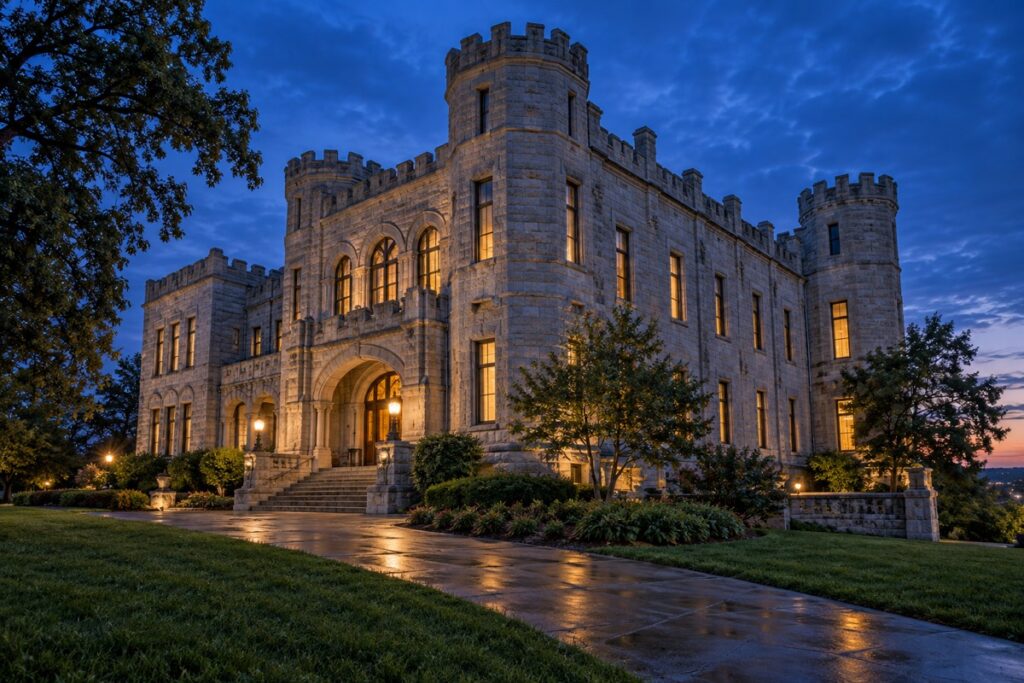
Its battlements, towers, arched openings, and heavy stone walls gave the institution the popular name Pythian Castle. The design projected permanence and protection. Inside, residents lived, worked, studied, and gathered in communal rooms. The architecture now attracts visitors, but the building’s first purpose involved care and institutional life.
Military ownership and wartime use
The United States military took control of the property during the Second World War. Historical accounts describe its use as a rehabilitation facility for American troops and in connection with prisoners of war. Music and dances also filled the ballroom during the 1940s, adding a social chapter to the military period.
The military remained associated with the building for more than fifty years. That long ownership altered rooms and uses while preserving the basic stone structure. Stories connected to children, soldiers, patients, and prisoners now appear in tours, but each specific claim needs evidence before it can be assigned to an individual.
Private owners later adapted the property as a cultural arts and event venue. The building opened more regularly to the public in 2009. Its current program combines historic interpretation, entertainment, private rentals, escape games, dinners, and paranormal experiences.
Ghost stories of Pythian Castle
Staff and visitors report voices, footsteps, shadowy movement, and unusual sensations in parts of the building. The owner has described hearing a clear greeting while alone in the lobby. Ghost tours and private investigations now provide access to spaces and stories associated with those reports.
The castle’s history makes such stories easy to personalize. Many people passed through the property during its institutional and military years. However, an unexplained voice cannot be reliably identified as an orphan, soldier, prisoner, or staff member. HauntsUSA labels these accounts as venue reports rather than documented events.
Old buildings also carry sound in unexpected ways. Stone walls, stairwells, pipes, event equipment, and visitors elsewhere in the building can create voices or footsteps without an obvious source. That context does not dismiss personal experience. It keeps the historical account honest.
Planning a visit
- Address: 1451 East Pythian Street, Springfield, Missouri 65802.
- Phone: 417-865-1464.
- Access: The official site states that visitors must attend a scheduled event and pay admission to enter the property.
- History tours: Guided tours generally run about one hour and involve walking and stairs.
- Paranormal programs: Ghost tours and private investigations follow separate schedules and booking rules.
- Accessibility: Missouri tourism information describes the site as partially wheelchair accessible. Contact the castle about the exact route.
Tour times, minimum group requirements, private events, and prices can change. Book through the official website rather than arriving without a reservation.
Continue through haunted Missouri history
Pythian Castle provides a useful comparison with the Missouri State Penitentiary, where institutional history is tied to a very different purpose and population. The Stanley Hotel offers another example of a historic property whose documented past and modern ghost tradition must remain distinct.
The castle belongs in the catalogue because it combines architecture, charity, wartime history, and present-day storytelling. A history tour provides the best foundation. A ghost tour can then be understood as an interpretation of reported experiences rather than a substitute for the record.
Frequently asked questions
When was Pythian Castle built?
The Knights of Pythias completed the building in 1913 for use as an orphanage and residence for older members.
Was Pythian Castle a prisoner-of-war camp?
The property came under military control during the Second World War and was used in connection with prisoners of war as well as rehabilitation for American troops.
Is Pythian Castle haunted?
The venue and visitors report voices, footsteps, and shadowy figures. These accounts are paranormal testimony and venue marketing, not verified scientific evidence.
Can visitors explore on their own?
No. The official site requires visitors to attend a scheduled, paid event. Access to rooms depends on the chosen program.
Are history tours and ghost tours the same?
No. History tours emphasize the building’s documented uses, while ghost tours focus on reported experiences and haunted lore. Check the current description before booking.
Sources and editorial note
- Pythian Castle: official visitor information
- Pythian Castle: official history-tour information
- Visit Springfield: Pythian Castle history
HauntsUSA separates documented institutional and military history from reported paranormal claims. Visitor information was reviewed on September 26, 2026. Confirm event schedules directly with the venue.
Editorial image: AI-created historical interpretation for HauntsUSA. It is not documentary evidence of paranormal activity.