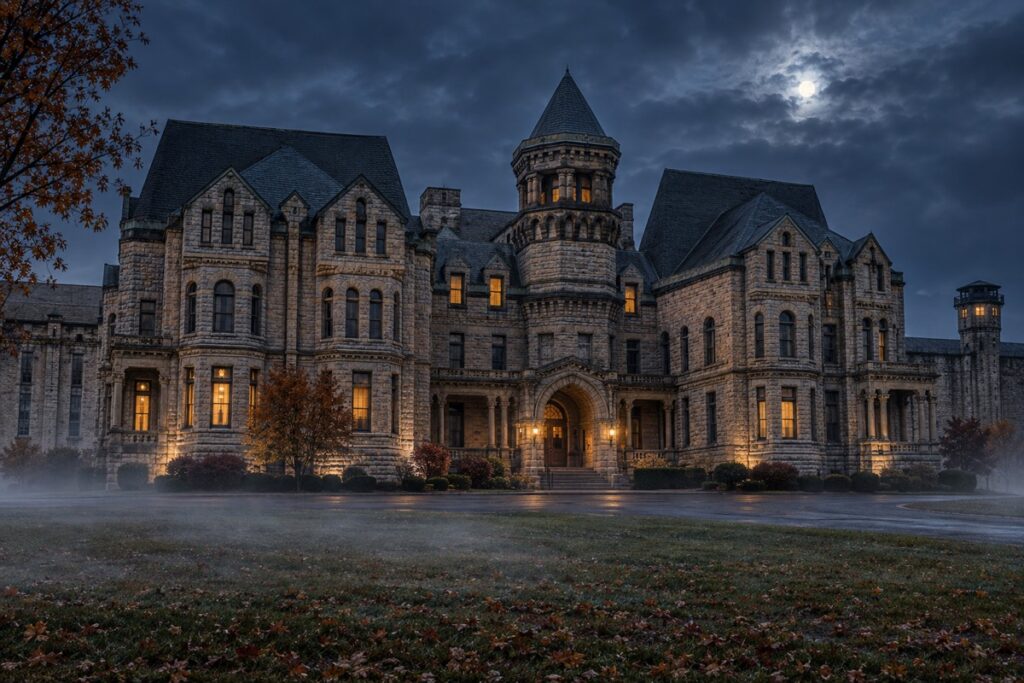
The Ohio State Reformatory is a preserved former prison and museum in Mansfield, Ohio, known for its monumental architecture, correctional history, reported paranormal activity, and role as a filming location for The Shawshank Redemption. The institution received its first prisoners in 1896 and closed in 1990. Today, visitors can explore it through history, film, architecture, and paranormal programs operated by the Mansfield Reformatory Preservation Society.
Why the Ohio State Reformatory matters
The Ohio State Reformatory occupies an unusual place in American public memory. It is simultaneously an architectural landmark, a record of changing correctional policy, a preserved prison, a celebrated movie location, and one of Ohio’s best-known paranormal destinations. Those identities overlap, but they should not be confused. The building’s documented history begins with nineteenth-century ideas about reform, labor, education, discipline, and incarceration—not with a ghost story.
Ohio authorized an intermediate penitentiary at Mansfield in 1884. The planned institution was intended to stand between a boys’ industrial school and the state penitentiary: a place where younger, first-time offenders might be trained and prepared for release. Construction began in 1886, and the first group of 150 men arrived in September 1896 while work on the vast complex was still underway.
Architecture designed to impress and discipline
Cleveland architect Levi T. Scofield designed the original administration building, drawing on Romanesque and Gothic forms that gave the institution the appearance of a castle. The visual drama was intentional. Reformers believed that order, beauty, education, religion, and productive work could influence behavior. Later additions by the firm Hancock and Dow expanded the institution into an enormous correctional complex.
The east cell block rises six tiers, and the west block rises five. Their scale is startling even before a visitor considers the lives organized inside them. The National Register of Historic Places listed the Ohio State Reformatory in 1983 for its architecture, social history, and connection to government. Its nomination identifies Scofield, Hancock and Dow, and the site’s significance across the late nineteenth and early twentieth centuries.
Reform ideals and prison reality
Early programs emphasized schooling, religion, military-style routine, and vocational labor. Men learned trades and worked in industries that produced clothing, shoes, furniture, and printed materials. The language of reform, however, did not guarantee humane conditions. As Ohio’s incarcerated population grew, cells designed for one person could hold two or three. The institution increasingly functioned as a conventional maximum-security prison, and violence, isolation, overcrowding, and deteriorating facilities shaped daily life.
By the late twentieth century, legal action challenged conditions in Ohio prisons. A federal consent decree required the state to close the aging Mansfield institution. The final prisoners left in 1990 for newer facilities. Parts of the complex were demolished, and the landmark faced an uncertain future.
Preservation and The Shawshank Redemption
The reformatory had already appeared in film productions, but its most influential screen role came after closure. Director Frank Darabont used the building as a principal location for the 1994 film The Shawshank Redemption. The movie’s enduring popularity introduced the site to an international audience and helped connect preservation with heritage tourism.
The Mansfield Reformatory Preservation Society formed in 1995 and took responsibility for saving and interpreting the surviving complex. Restoration remains an ongoing process. Visitors can see institutional spaces, architectural details, film locations, and museum exhibits while also observing the practical work required to stabilize windows, masonry, roofs, mechanical systems, and historic interiors.
The building anchors the regional Shawshank Trail, a self-guided driving route linking filming sites across Mansfield and surrounding communities. That film history is an important part of the modern visitor experience, but it is layered over a century of real incarceration. Responsible interpretation should keep the experiences of imprisoned people and employees visible alongside Hollywood memorabilia.
Is the Ohio State Reformatory haunted?
The Ohio State Reformatory has a long paranormal reputation. Visitors and investigators have reported footsteps, voices, shadows, unexplained touches, and unusual sensations in locations including cell blocks, solitary confinement, the chapel, and administrative areas. The preservation society offers scheduled ghost walks, ghost hunts, and private paranormal programs, and it describes paranormal exploration as one of several ways to experience the building.
These accounts are reports, personal interpretations, and venue programming—not verified evidence of supernatural activity. The prison’s imposing scale, acoustics, deteriorated surfaces, low light, emotional history, and popular media reputation can all shape a visitor’s expectations. HauntsUSA presents the claims as part of the site’s cultural history while separating them from documented facts.
Planning your visit to Mansfield
The Ohio State Reformatory is at 100 Reformatory Road in Mansfield, about halfway between Columbus and Cleveland. The preservation society offers self-guided admission and several guided experiences, including tours focused on history, architecture, incarceration, and film. A typical self-guided visit takes about 90 minutes. Guided-tour tickets may include access to the self-guided route.
Published 2026 hours are generally 11 a.m. to 4 p.m., seven days a week from April through October, with seasonal weekend extensions and a reduced winter schedule. Special events can close or alter portions of the route. From late summer into fall, setup for the separately ticketed Blood Prison attraction limits access to several historic areas. Always confirm the current calendar and route before traveling.
Historic prison architecture creates accessibility challenges. The organization reports that chair lifts and elevators support portions of its standard tour routes, but seasonal changes can make the cell blocks inaccessible to visitors who cannot use stairs. Contact the venue at 419-522-2644 before booking if anyone in your group needs step-free access, seating, an ASL tour, or another accommodation.
Frequently asked questions
When did the Ohio State Reformatory operate?
The first prisoners arrived in 1896, and the institution closed in 1990.
Was The Shawshank Redemption filmed here?
Yes. The former reformatory served as the principal prison location in the 1994 film, and visitors can see sets, props, and recognizable spaces.
Can visitors take a paranormal tour?
Yes. Paranormal programs are scheduled separately from daytime history and film tours. Dates, age rules, equipment policies, and prices vary.
Is the reformatory fully wheelchair accessible?
No historic prison of this scale is completely barrier-free. Elevators and chair lifts serve parts of standard routes, but some areas and seasonal routes require stairs. Confirm access directly before visiting.
Continue exploring haunted history in Ohio or browse the HauntsUSA directory of historic haunted places.
Sources and further reading
- Mansfield Reformatory Preservation Society: Tours, Hours and Visitor Information
- Mansfield Reformatory Preservation Society: Visit
- Mansfield Reformatory Preservation Society: Accessibility and FAQs
- National Park Service: Ohio State Reformatory National Register Record
- Ohio Memory: Penalty and Incentive—The Ohio State Reformatory
Last reviewed September 26, 2026. Paranormal claims are presented as reported experiences, not facts. Visitor hours and accessible routes can change for restoration and special events; confirm directly before travel. Any generated editorial artwork used on this page is illustrative and not documentary photography.