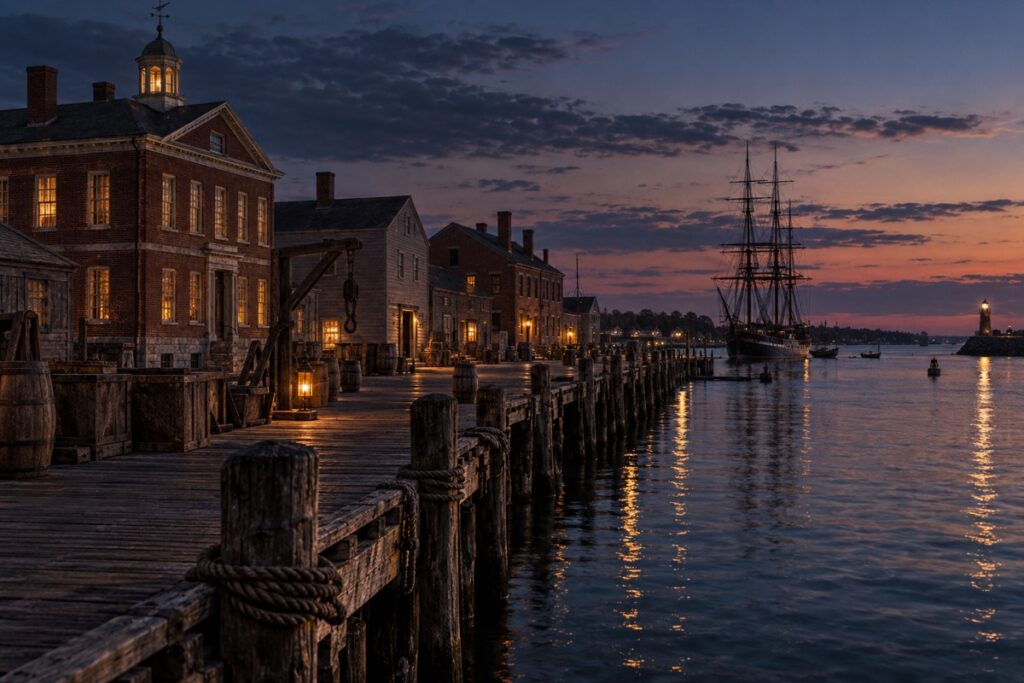
Quick answer: Salem’s preserved waterfront tells a national story of trade, labor, slavery, immigration, customs enforcement, and historic preservation. Salem Maritime was established in 1938 as the National Park Service’s first national historic site. Waterfront ghost stories are later folklore layered onto a well-documented working landscape.
Why the Salem waterfront matters
Salem Maritime National Historical Park preserves wharves, houses, warehouses, a custom house, archaeological sites, and a light station along Salem Harbor. Congress established the site in 1938. Its purpose extends beyond picturesque ships: the landscape explains how colonial ports developed, how international trade shaped the early United States, and how commerce fed industrial growth.
The park’s current interpretation spans more than six centuries of regional maritime history. That wider frame includes Indigenous homelands, European colonization, Atlantic and global trade, enslaved and free labor, merchant wealth, seafaring risk, immigration, industry, and the twentieth-century preservation movement.
Derby Wharf and the surviving wharves
Richard Derby and his son Elias Hasket Derby began Derby Wharf in 1762. It was extended repeatedly and reached its current half-mile length in 1806. The National Park Service preserves four historic wharves. They are remnants of more than fifty that lined the harbor during Salem’s early nineteenth-century trading peak.
Derby Wharf once held nearly twenty structures, including warehouses and the counting house of Elias Hasket Derby. Most disappeared as trade patterns changed and the waterfront declined. Archaeology now helps recover the footprint and construction of vanished buildings. The open, park-like wharf visitors see today should not be mistaken for the crowded commercial workplace of its busiest years.
Buildings that anchor the story
The Custom House, completed in 1819, represents federal regulation of maritime commerce. Nathaniel Hawthorne worked there before drawing on the setting in The Scarlet Letter. The 1762 Derby House reflects merchant wealth, while the Narbonne House, begun in the seventeenth century, preserves evidence of working and middle-class households across generations.
Warehouses and stores interpreted goods moving through the port. The reconstructed vessel Friendship of Salem represents the type of East Indiaman that connected the city to distant markets, though access depends on operations and maintenance. The park also preserves St. Joseph Hall, a center of Salem’s twentieth-century Polish community.
Trade, slavery, and incomplete memory
Salem’s wealth cannot be separated from Atlantic slavery. Merchants traded with slave societies, households enslaved people, and maritime networks carried goods produced by forced labor. The National Park Service has expanded its interpretation to identify enslaved and free people whose lives were often minimized in older accounts.
This context changes how a visitor reads elegant houses and profitable voyages. Architecture can demonstrate wealth while records reveal who generated it, who was excluded from it, and who resisted bondage. An evidence-led waterfront visit should leave room for those connected stories.
Ghost lore along the harbor
Stories of spectral sailors, unexplained lights, and figures in old buildings circulate through Salem tours and popular culture. Harbors naturally collect disappearance stories because maritime work involved storms, disease, injury, and long absences. Yet an atmospheric setting is not proof of a haunting.
HauntsUSA treats these reports as folklore unless a claim can be tied to a traceable account. The waterfront’s documented human history is the foundation. For a nearby literary site, see the House of the Seven Gables guide. For the city’s 1692 landscape, use the Salem witch-trials sites guide.
Planning an after-dark history walk
- Begin at the park visitor information and verify building or vessel access.
- Walk Derby Wharf only when weather and surfaces are safe.
- Remember that exterior grounds may be open when interiors are closed.
- Keep clear of working waterfront areas and respect posted barriers.
- Use the evening atmosphere to notice the landscape, not to invent claims.
Frequently asked questions
Was Salem Maritime the first national historic site?
Yes. It was established in 1938 as the first national historic site administered by the National Park Service.
How old is Derby Wharf?
Construction began in 1762. Successive extensions brought it to its current half-mile length in 1806.
Is the Friendship an original eighteenth-century ship?
No. Friendship of Salem is a modern reproduction used to interpret the city’s global maritime connections.
Can visitors walk the wharf after dark?
The National Park Service publishes current access and safety information. Use caution in darkness, wind, rain, ice, or high water.
Is the Salem waterfront proven to be haunted?
No. Sailor and apparition stories are folklore and personal reports, not independently verified evidence of paranormal activity.
Sources and editorial note
- National Park Service: History of Salem Maritime
- National Park Service: Salem’s Historic Wharves
- National Park Service: Places at Salem Maritime
- National Park Service: Stories of Salem Maritime
HauntsUSA separates documented maritime history from later waterfront folklore. Visitor information was reviewed on September 27, 2026.
Editorial image: AI-created historical interpretation for HauntsUSA. It is not documentary evidence or proof of paranormal activity.