Quick answer: New Orleans Pharmacy Museum is a historic place in New Orleans, Louisiana, associated with documented local history and a separate tradition of reported ghost stories. The building or landscape deserves attention for its architecture, people, and changing uses. Paranormal accounts are presented here as folklore, not established fact.
Why New Orleans Pharmacy Museum matters
A preserved Chartres Street apothecary where the history of medicine, regulation, commerce, and unsettling folklore survives behind rows of old bottles and instruments. Places such as this are valuable because they hold several kinds of evidence at once. The structure, street plan, surviving objects, archival record, and later stories all reveal how Americans remember the past. A useful visit begins with what can still be seen and what contemporary records can support.
New Orleans Pharmacy Museum also belongs to the larger story of New Orleans. Its meaning does not stop at a doorway or property line. Nearby streets, public squares, waterways, houses of worship, commercial buildings, and burial grounds help explain why the place was built and how it changed. That geographic context is essential for visitors and for anyone researching the location from home.
The documented history
The museum occupies a Creole townhouse built in 1822–1823 for Louis J. Dufilho Jr., identified by the institution as the first licensed pharmacist in the United States. Dufilho operated an apothecary on the ground floor and lived above it with his family until 1855.
After several private owners and commercial uses, the City of New Orleans acquired the building in 1937. The museum opened in 1950. Its collections document changing medicines, surgical instruments, patent remedies, compounding practices, and the uneven path from household cures to professional pharmacy.
The museum’s value lies in those records and objects. Bottles, labels, ledgers, tools, and advertisements reveal both scientific progress and the limits of nineteenth-century care. They also show why medical history requires exact names and dates. A vivid story is not evidence simply because it has been repeated on a tour.
Reading the place itself
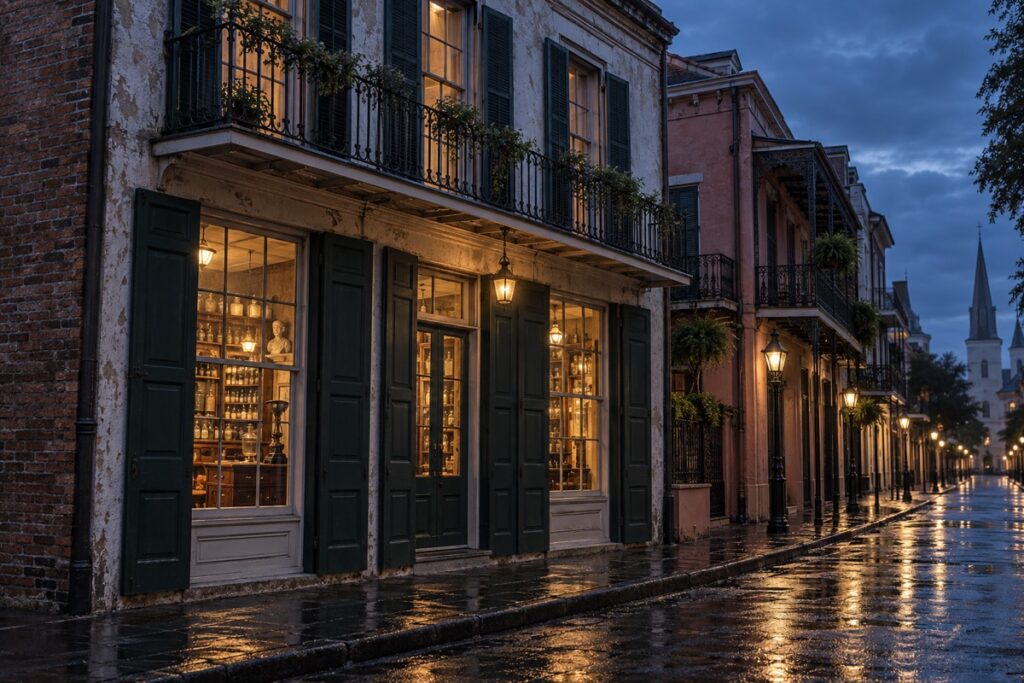
Begin with the narrow Chartres Street facade, then notice how the former shop, residence, courtyard, and upper rooms fit together. Inside, read labels carefully. Apothecary jars and surgical instruments can look theatrical under low light, but each object belongs to a specific history of trade, diagnosis, compounding, and treatment.
Patients, assistants, craftspeople, household workers, and customers also shaped the building’s life. Their experiences are harder to reconstruct than those of licensed professionals. Good interpretation acknowledges those gaps without filling them with sensational claims.
Reported hauntings and local folklore
Later ghost-tour stories often focus on Dr. James Dupas and claim that he poisoned patients or performed experiments on unwilling people. The museum states plainly that it has found no evidence for those allegations and suggests that some versions may confuse Dupas with the documented abuses committed by physician J. Marion Sims in Alabama. The distinction matters. A responsible haunted-history guide should repeat the museum’s correction, not the accusation.
Ghost stories often change as they pass from one guide, guest, newspaper, or television program to another. A name may appear decades after an event. A general sound can become a detailed apparition. A tragic episode can be moved from one room to another because the new version is easier to tell. Those changes do not make folklore worthless. They show how a community reshapes memory. They do mean that folklore and documented history need different labels.
Old buildings also produce ordinary mysteries. Sound travels through masonry, pipes, vents, stairwells, and timber in surprising ways. Light from streets and neighboring rooms can move across old glass. Temperature changes affect materials. Expectation can make a visitor notice details that would otherwise pass without comment. None of this disproves a personal experience. It simply gives the story an honest setting.
A note on care
Medical history includes pain, exploitation, racial inequality, and ineffective treatments. Avoid turning patients into props for a ghost story.
Respectful travel means following posted rules, protecting fragile fabric, and remembering that difficult history involved real people. Do not trespass, touch monuments, enter closed rooms, or interrupt hotel guests and private residents. A haunted-history guide should deepen public understanding, not turn suffering into decoration.
Planning your visit
The museum currently posts self-guided hours Tuesday through Saturday and limited guided tours on selected mornings. Schedules change during peak seasons.
- Address: 514 Chartres Street, New Orleans, Louisiana 70130.
- Phone: 504-490-6263.
- Official information: Check the official website before travel.
- Time needed: Most visitors spend about 45 minutes to one hour, according to the museum.
- Photography: Follow the property’s current rules. Flash, tripods, and commercial photography may be restricted.
- Accessibility: Historic stairs, thresholds, paving, and narrow rooms can limit access. Ask the operator about the specific route you plan to use.
Continue a French Quarter history route at the Hermann-Grima House for urban domestic history and at Historic BK House for architecture, preservation, and nearly two centuries of residents. Use each institution’s official schedule rather than assuming that one ticket or tour covers all three.
Frequently asked questions
Is New Orleans Pharmacy Museum really haunted?
New Orleans Pharmacy Museum is associated with reported experiences and local stories. These accounts are part of its modern reputation, but they do not establish paranormal activity as fact.
Can the public visit the Pharmacy Museum?
Yes. The museum offers self-guided admission on posted days and a limited guided-tour schedule. Reservations are generally required for the guided tour or special events, not ordinary self-guided admission.
What should history-focused visitors look for?
Prioritize the documented timeline, original or restored architectural features, and interpretation of the people who lived or worked here. Ask which stories are supported by records and which come from oral tradition.
How long should a visit take?
Most visitors should allow at least one hour. Guided tours, meals, special programs, or detailed architectural study can extend the visit to two hours or more.
Where should I confirm hours and admission?
Use the official website or telephone number immediately before travel. Historic properties often change schedules for private events, preservation work, weather, and seasonal programming.
Sources and editorial note
HauntsUSA separates documented history from reported folklore. Visitor details were last reviewed on September 26, 2026. Hours, prices, access, and tour policies can change without notice.