Quick answer: Gettysburg National Military Park preserves the landscape where Union and Confederate armies fought from July 1 through July 3, 1863. The park and national cemetery interpret the campaign, its casualties, civilians, medical aftermath, and national meaning. Reports of soldiers, lights, voices, and figures belong to cultural memory, not verified park history.
Why Gettysburg National Military Park matters
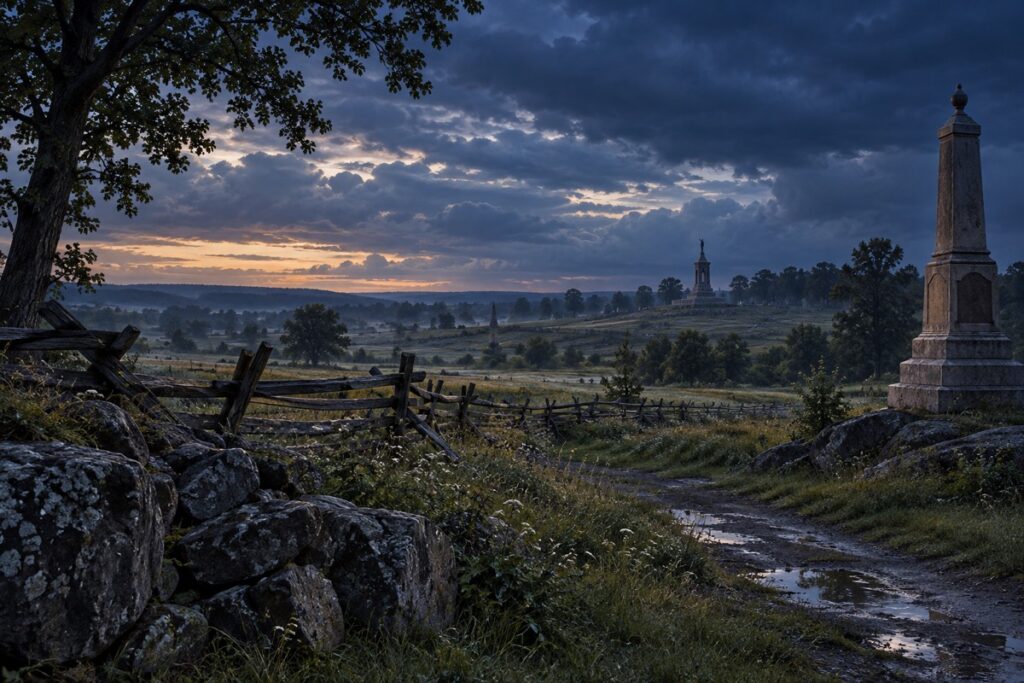
Gettysburg is both a place and an argument about the nation. Roads, farms, ridges, fields, houses, and stone walls became military positions, then memorial landscapes. Veterans returned to mark where units fought. Later generations built monuments, museums, roads, and stories that shaped how the battle would be remembered.
Ghost lore flourished because the landscape holds visible reminders of sudden death. Yet treating the battlefield as a paranormal playground can erase the names, choices, fear, courage, and suffering of real people. A respectful guide uses folklore to discuss memory without turning mass death into entertainment.
The documented history
The battle began west and north of Gettysburg on July 1, 1863. Union forces withdrew through town to defensive ground south of it. Fighting expanded on July 2 at locations that included Little Round Top, the Wheatfield, Peach Orchard, and Culp’s Hill. On July 3, the Confederate assault remembered as Pickett’s Charge failed against the Union center.
Casualties were immense. Soldiers were killed, wounded, captured, or missing, while civilians faced occupation, damaged property, medical crisis, and burial work. The battle ended the invasion but not the war. Its meaning continued to develop through the Gettysburg Address and later national commemoration.
The battlefield park and national cemetery now preserve thousands of acres, monuments, historic structures, and views. The National Park Service interprets military decisions along with slavery, emancipation, civilian experience, memory, and preservation.
History, memory, and the haunted reputation
Visitors report drums, gunfire, voices, campfire lights, marching figures, and soldiers who seem to vanish. Stories cluster around fields, bridges, houses, hospitals, roads, and rocky terrain. Some are personal accounts; others are legends retold by commercial tours.
Battlefield conditions can shape perception. Fog, distant reenactment sounds, wildlife, traffic, monuments, and changing light create ambiguous sights and sounds. None of those explanations diminishes grief or memory. They simply keep an unexplained moment from becoming a false historical claim.
The park has operating hours and protected resources. Ghost hunting never justifies entering closed areas, leaving roads, climbing monuments, disturbing cemeteries, or collecting objects. Respect for the dead begins with respect for the landscape.
What to notice during a visit
Begin at the Museum and Visitor Center, then choose a battlefield route. High ground helps explain decisions. Read monuments critically, noting when and by whom they were erected. Farms and houses reveal that battle unfolded across lived-in land.
Visit the Soldiers’ National Cemetery with particular restraint. The Gettysburg Address is short, but its language connects the battlefield to emancipation, democracy, sacrifice, and unfinished national obligations. That context should anchor the visit.
Planning a visit
- Location: Begin at the Museum and Visitor Center, 1195 Baltimore Pike, Gettysburg, Pennsylvania 17325.
- Access: Roads, grounds, museum, visitor center, cemetery, and individual buildings follow different schedules. Weather and preservation work can cause closures.
- Best for: Civil War readers, families, military-history travelers, memorial-landscape researchers, and visitors interested in the relationship between grief and folklore.
- Before you go: Confirm current hours, tickets, accessibility, and photography rules on the official website.
Frequently asked questions
Is Gettysburg National Military Park haunted?
Many visitors report ghostly experiences, but the National Park Service interprets Gettysburg through documented history. Reports remain folklore and testimony.
Can the public visit?
Yes. The park is publicly accessible during posted hours. Some buildings, roads, and grounds have seasonal or daily limits.
How much time should visitors allow?
A first visit deserves at least half a day. A full day allows the museum, major battlefield stops, and national cemetery without rushing.
What is the most important historical context?
Gettysburg must be placed within the Civil War over slavery and Union. Tactics matter, but they are not the whole meaning of the battle.
Sources and editorial note
National Park Service pages provide operating details, battlefield interpretation, resource rules, and historical context. Unit histories, official records, civilian accounts, and scholarship should support individual event claims.
HauntsUSA separates documented history from reported experiences, local legend, and venue marketing. Paranormal claims are never stated as proven fact. Generated artwork is labeled as an editorial interpretation rather than documentary photography.
Last reviewed September 26, 2026. Visitor details can change. Confirm current information with the site before travel.
Gettysburg town and civilian life
The borough was not a blank map beneath the armies. Residents hid, fled, treated wounded men, protected property, buried the dead, searched for relatives, and rebuilt businesses. African American residents faced the additional threat of capture and enslavement by Confederate forces. A complete guide connects the military landscape to those civilian experiences and follows the consequences beyond the three days of battle.