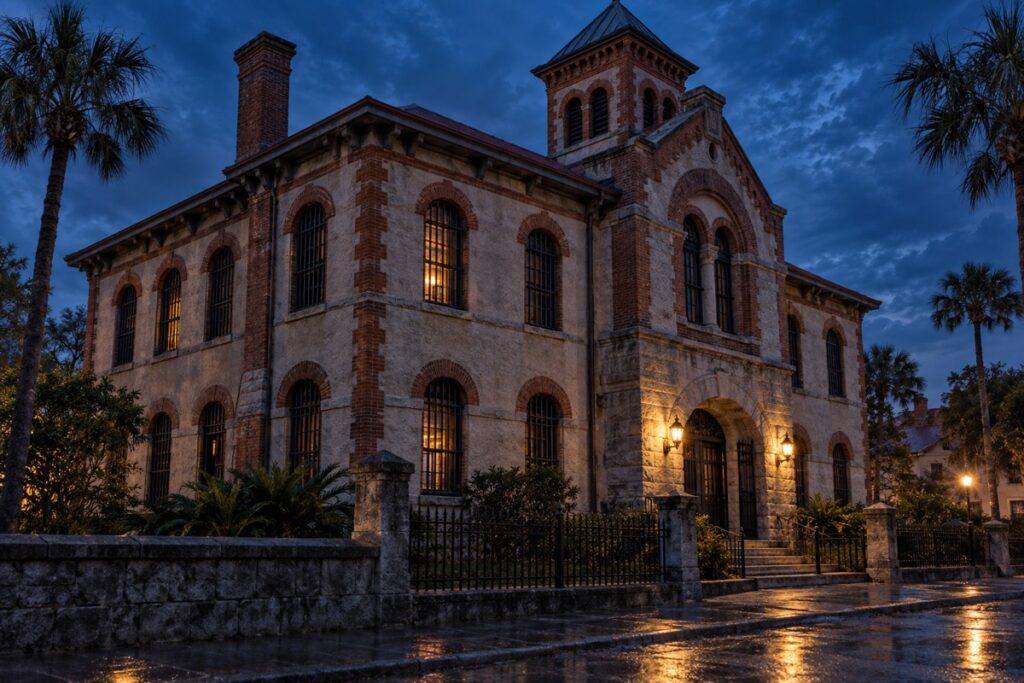
Quick answer: The Old Jail Museum at 167 San Marco Avenue in St. Augustine, Florida, served as the St. Johns County jail from 1891 to 1953. Henry Flagler influenced its location and appearance, and the exterior was designed to resemble a Victorian lodging property rather than a prison. Day tours and ticketed night programs now interpret the building.
Why the Old Jail Museum matters
The jail is visually deceptive. Its porch, color, and domestic scale soften the exterior, while cells and security spaces inside reveal confinement. That contrast helps visitors consider how communities placed punishment close to civic life while attempting to control how it looked.
The museum also shows the practical world of a county jail. Sheriffs, deputies, incarcerated men and women, family members, cooks, and visitors shared a complex environment. Their experiences should be reconstructed from records rather than reduced to costumes or frightening rooms.
The documented history
The jail opened in 1891 during the period when Henry Flagler was investing heavily in St. Augustine. The older jail’s location did not suit plans for a refined resort city, and the new facility was placed farther from Flagler’s central hotels. Its unusual exterior helped hide the building’s purpose.
Inside, the institution separated people by gender and security classification. Cells, corridors, barred doors, and administrative spaces reveal the technologies of confinement used at the turn of the twentieth century. The sheriff and family lived in adjoining quarters, making incarceration part of a domestic workplace.
The jail remained in use until 1953. Its conversion to a museum preserved spaces that might otherwise have disappeared. Costumed interpretation can make operations understandable, but a responsible visit should remember that the people confined there were not characters created for entertainment.
History, memory, and the haunted reputation
The museum offers nighttime haunted-history programs and paranormal investigation experiences. Visitors and guides report voices, shadows, footsteps, physical sensations, and activity near cells or execution-related spaces.
Prisons often collect ghost stories because confinement, punishment, isolation, and death already carry emotional weight. Those subjects can easily be sensationalized. A useful guide states what records show about individual people and labels modern reports separately.
After-dark programming should never encourage disrespect, trespass, or mockery of incarcerated people. The strongest interpretation uses the atmosphere to ask how law, race, class, violence, and local government shaped who entered the jail.
What to notice during a visit
Compare the welcoming exterior with the interior cell blocks. Pay attention to ventilation, sanitation, sight lines, locks, and the distance between family living quarters and cells. These practical details communicate daily experience better than staged scares.
Place the museum within Flagler-era St. Augustine. The city was being marketed as a beautiful winter resort while institutions such as the jail were moved and visually managed. That tension is an important part of local history.
Planning a visit
- Location: 167 San Marco Avenue, St. Augustine, Florida 32084.
- Access: The museum offers daytime entry and separate night programs. Hours and ticket packages change; historic stairs and cells may limit access.
- Best for: Visitors studying carceral history, Flagler-era development, adaptive reuse, and carefully framed paranormal tourism.
- Before you go: Confirm current hours, tickets, accessibility, and photography rules on the official website.
Frequently asked questions
Is the Old Jail Museum haunted?
The operator presents haunted tours and guests report experiences. These claims are venue programming and personal testimony, not proven fact.
Can the public visit?
Yes, with museum admission or a ticketed night program. Choose the experience carefully, especially for children.
How much time should visitors allow?
Allow sixty to ninety minutes for a daytime tour. Night programs can run considerably longer.
What is the most important historical context?
The contrast between the hotel-like exterior and the realities of confinement is essential. The lives of incarcerated people deserve more attention than a generic scary-jail image.
Sources and editorial note
The official Old Jail Museum and Visit St. Augustine pages provide the address, phone number, operating identity, 1891 opening, 1953 closure, and current tour offerings. Archival jail registers should guide biographical additions.
HauntsUSA separates documented history from reported experiences, local legend, and venue marketing. Paranormal claims are never stated as proven fact. Generated artwork is labeled as an editorial interpretation rather than documentary photography.
Last reviewed September 26, 2026. Visitor details can change. Confirm current information with the site before travel.