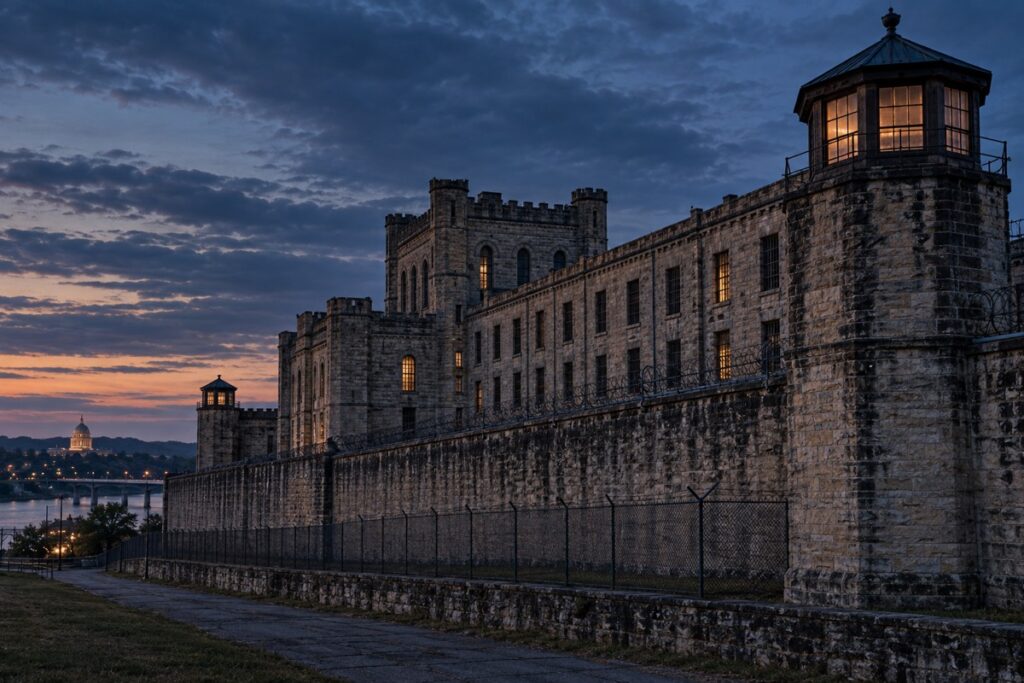
The Missouri State Penitentiary is a decommissioned prison complex in Jefferson City that operated from 1836 until 2004. Now interpreted through guide-led history, former-inmate, and paranormal tours, the site records 168 years of incarceration beside the Missouri River. Reports of voices, footsteps, shadows, and other phenomena form part of its modern reputation, but they remain claims rather than verified supernatural evidence.
Why the Missouri State Penitentiary matters
Missouri opened its state penitentiary in Jefferson City in 1836, only fifteen years after statehood. Its position near the state capitol linked punishment directly to government, law, and the expanding settlement of the West. By the time it closed in 2004, the institution had operated longer than any other prison west of the Mississippi then still in use.
The surviving buildings do not represent one moment. Cellblocks, workshops, administrative spaces, walls, and later security systems reflect repeated expansion and changing ideas about discipline. For much of the nineteenth century, prison labor was central to the institution. Incarcerated people produced goods and worked under systems designed to offset operating costs, while overcrowding and harsh conditions became recurring problems.
The penitentiary held men and women from across Missouri. Its records include ordinary people whose lives rarely entered public history as well as nationally known prisoners. The site also carried out executions and contained death-row facilities. Interpretation must therefore balance architecture and famous stories with the experiences of thousands of incarcerated people, employees, and families.
Conflict, reform, and the 1954 riot
Conditions changed repeatedly as reform movements, new laws, population growth, and political priorities reshaped Missouri corrections. Older buildings were adapted long after their original systems became obsolete. The prison’s reputation for violence was amplified in the twentieth century, when one publication labeled it the “bloodiest 47 acres in America.” The phrase is memorable marketing language, not a neutral statistical measure.
On September 22, 1954, a major riot spread through the penitentiary. Prisoners took hostages, fires damaged buildings, and state forces entered the complex to restore control. Several people died and many were injured. The event became a defining episode in the institution’s public history and exposed serious tensions inside an overcrowded prison.
Later decades brought additional building projects and policy changes, but the aging site remained difficult to maintain. Missouri transferred incarcerated people to the new Jefferson City Correctional Center and decommissioned the old penitentiary in September 2004.
From active prison to historic tour site
The State of Missouri still owns the former penitentiary. The Jefferson City Convention and Visitors Bureau operates public programs that take visitors through selected cellblocks, yards, housing units, and other spaces. A separate museum preserves artifacts and interpretation connected to prisoners, officers, executions, escapes, women incarcerated at the site, and the 1954 riot.
All tours are guide-led; the site does not allow ordinary self-guided access. Options include standard history tours, more detailed programs, former-inmate tours, student tours, ghost tours, and overnight paranormal investigations. Routes vary by program and building conditions, so one ticket does not necessarily include every area.
Is the Missouri State Penitentiary haunted?
Guides, guests, investigators, and former workers have reported unexplained voices, footsteps, touches, shadows, and equipment readings in cellblocks and other spaces. The tour operator offers two-hour ghost tours, three-hour hunts, and longer overnight investigations. Those programs combine site history with opportunities for participants to conduct their own observations.
Reported activity should not be confused with proof. Empty institutional buildings contain metal, masonry, long corridors, mechanical spaces, wildlife, outside noise, and pronounced temperature changes. Darkness and knowledge of executions or violence can intensify ordinary sensations. HauntsUSA documents the claims as part of the place’s cultural afterlife while separating them from archival history.
Planning your visit to Jefferson City
The public tour season runs from March through November, weather permitting. Tours are not offered in December, January, or February. Walk-ins may be available, but advance reservations are strongly recommended because guided groups can sell out. Tour schedules, age minimums, prices, and included buildings differ.
The historic complex has no air conditioning or heat in tour areas. Visitors should dress for the weather and expect extended standing, uneven surfaces, outdoor walking, and stairs. The operator states that routes are not fully wheelchair accessible because of narrow doorways and multiple flights of stairs. Everyone must sign a liability waiver, with a parent or guardian signing for minors.
Check-in is at 115 Lafayette Street in Jefferson City, Missouri. Free on-street parking is available on Lafayette and State streets. Call 573-632-3999 for booking changes, accessibility questions, and current route information. Photography is allowed during tours, but the operator asks visitors not to record video of the tour.
Frequently asked questions
When did the Missouri State Penitentiary operate?
It opened in 1836 and was decommissioned in September 2004, a span of 168 years.
Are people still incarcerated there?
No. Prisoners were transferred to the newer Jefferson City Correctional Center when the old facility closed.
Can you explore without a guide?
No. All public visits are guide-led, including history and paranormal programs.
Is the tour wheelchair accessible?
Not completely. Historic doorways, stairs, and surfaces limit access. Contact the tour office before booking to discuss current routes and accommodations.
Continue exploring haunted history in Missouri or browse the HauntsUSA directory of historic haunted places.
Sources and further reading
- Missouri State Penitentiary: Official History
- Missouri State Penitentiary: History and Paranormal Tours
- Missouri State Penitentiary: Official Visitor FAQs
- Missouri State Archives: Penitentiary Collection Guide
- Missouri Division of Tourism: Visitor Guide
Last reviewed September 26, 2026. Paranormal claims are presented as reports, not facts. Tour seasons, routes, and age rules can change; confirm directly before travel. Any generated editorial artwork used on this page is illustrative and not documentary photography.