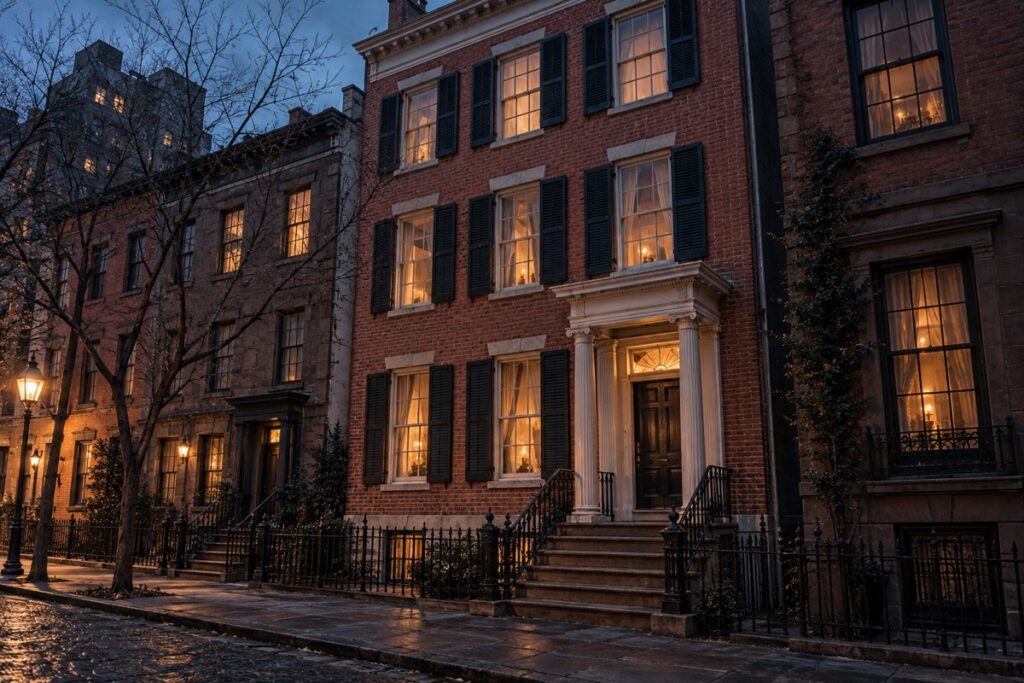
The Merchant’s House Museum at 29 East Fourth Street is New York City’s only nineteenth-century family home preserved substantially intact inside and out. Built in 1832 and occupied by the Tredwell family for nearly a century, it retains original furnishings and domestic spaces. The museum also documents decades of reported sounds, sightings, and other unexplained experiences, while presenting those accounts separately from verified architectural and social history.
A rare surviving home in lower Manhattan
When hatter and real-estate investor Joseph Brewster built the brick-and-marble row house in 1832, Fourth Street was part of a fashionable residential area north of the crowded commercial city. The Greek Revival residence reflected the taste and prosperity of New York’s growing merchant class. Its restrained façade, formal parlors, service rooms, rear garden, and carefully finished interior created both a family home and a public statement about status.
Merchant Seabury Tredwell purchased the house in 1835 and moved in with his wife, Eliza, their children, and Irish servants. Eight Tredwell children grew up there. The house remained associated with the family for almost one hundred years, even as factories, theaters, tenements, shops, and waves of immigration transformed the surrounding neighborhood.
That long occupancy is central to the museum’s importance. The collection is not simply a group of unrelated antiques placed in an old building. Furniture, decorative objects, clothing, household equipment, documents, and personal possessions remain connected to the people who used them. Together they allow visitors to examine family life, consumption, work, gender, childhood, aging, and domestic service in nineteenth-century New York.
The Tredwells and their household
Interpretation at the Merchant’s House extends beyond the wealthy family members named in ownership records. Irish women lived and worked in the house as servants, maintaining fires, preparing meals, cleaning rooms, carrying water and fuel, laundering clothing, and supporting the rituals of genteel life. The fourth-floor servants’ quarters and basement kitchen reveal the labor behind the polished parlors below.
Gertrude Tredwell, born in an upstairs bedroom in 1840, was the youngest of the family’s children. She never married and remained in the house until her death there in 1933 at age 93. By then, the once-residential neighborhood had changed dramatically, and the family home had become an architectural survivor.
Saving the house as a museum
After Gertrude’s death, a relative recognized that the building, its interiors, and its contents formed an unusually complete record. George Chapman arranged to purchase the property and preserve it. The house opened to the public as a museum in 1936.
The Merchant’s House became a New York City landmark in the twentieth century and is also recognized at the state and national levels. Preservation remains active rather than finished. Urban construction, vibration, moisture, masonry movement, and aging materials require continuing research and conservation. The museum currently remains open during restoration, with visitors entering through Manuel Plaza at 35 East Fourth Street.
Recent building investigation also identified a concealed passage beneath a built-in chest of drawers. Museum interpretation connects the feature to Joseph Brewster’s abolitionism and the Underground Railroad. Because research on concealed spaces is evolving, visitors should look to the museum’s current documentation for the latest findings rather than repeating embellished stories.
Is the Merchant’s House Museum haunted?
Staff members, volunteers, visitors, neighbors, and passersby have reported unexplained sounds, odors, movements, and apparitions since the museum’s early years. Many stories focus on Gertrude Tredwell, whose lifetime spanned nearly the entire period of family occupancy. The house is often promoted as “Manhattan’s most haunted house,” and the museum offers scheduled candlelight ghost tours, private programs, and discussions of ongoing paranormal research.
The reports are part of the museum’s institutional history, but they do not prove that Gertrude or any other person remains in the building. Old row houses carry sound through wood, masonry, stairs, pipes, party walls, and neighboring properties. Visitors also enter knowing the home’s reputation, which can influence how ordinary sensations are interpreted. HauntsUSA treats the stories as documented claims and cultural folklore, not confirmed supernatural events.
Planning your visit
The museum’s current self-guided hours are Wednesday through Sunday, 1 to 5 p.m., with last entry at 4:30 p.m. Guided house tours are generally offered on those days at noon and last about 75 minutes. The museum closes for major holidays, and special events can alter access. Check the calendar before visiting.
A self-guided visit typically takes 45 to 60 minutes. The museum occupies five floors reached by stairs and is not wheelchair accessible. It is also not air conditioned, a practical concern in summer. Large bags must be checked, and groups of ten or more must arrange a private visit in advance.
The street address is 29 East Fourth Street between Lafayette Street and the Bowery, with the restoration-period entrance at 35 East Fourth Street. Call 212-777-1089 or consult the official site for current admission, tour, accessibility, and program information. Ghost tours are limited events, especially around October, rather than the ordinary daily experience.
Frequently asked questions
When was the Merchant’s House built?
Joseph Brewster built the house in 1832. The Tredwell family purchased it in 1835.
Are the furnishings original?
Many furnishings, decorative objects, garments, and possessions are original to the house and the Tredwell family, making the collection unusually cohesive.
Who is said to haunt the museum?
Many stories identify Gertrude Tredwell, the last family member to live in the house. That identification is folklore and interpretation, not a verified fact.
Is the museum accessible without stairs?
No. The historic house has five floors reached by stairs and is not wheelchair accessible. Contact the museum for current accommodations and virtual resources.
Continue exploring haunted history in New York or browse the HauntsUSA directory of historic haunted places.
Sources and further reading
- Merchant’s House Museum: Mission and Significance
- Merchant’s House Museum: Museum History
- Merchant’s House Museum: Current Hours, Admission and Accessibility
- Merchant’s House Museum: Reported Ghosts and Paranormal Programs
- National Park Service: Merchant’s House Museum
Last reviewed September 26, 2026. Paranormal claims are presented as reports, not facts. Hours, entrances, and room access may change during restoration; confirm directly before travel. Any generated editorial artwork used on this page is illustrative and not documentary photography.