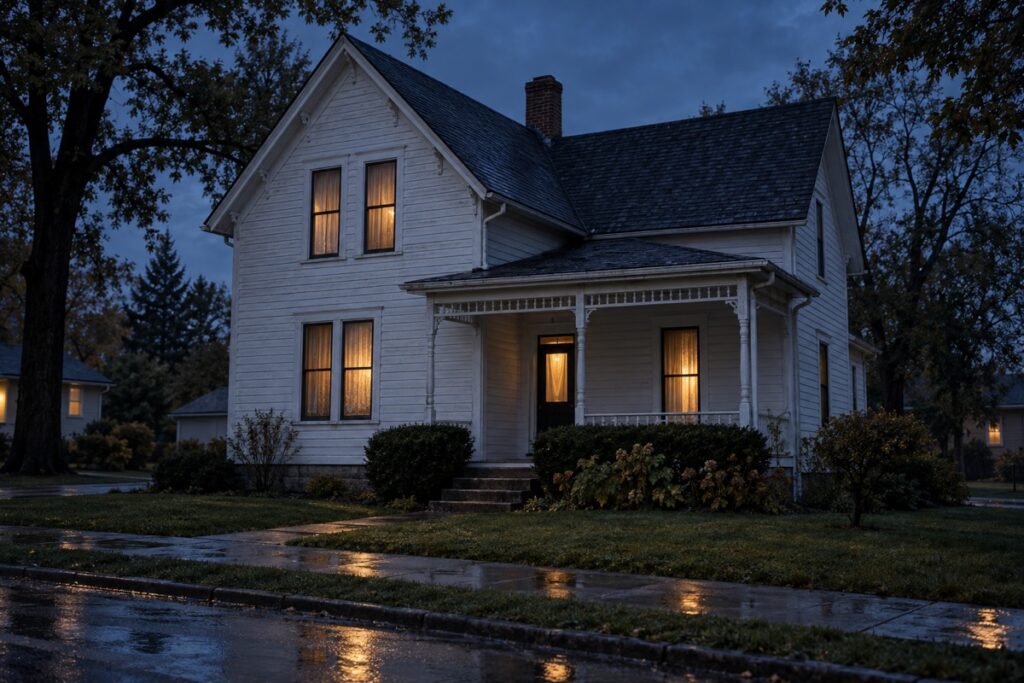
The Villisca Axe Murder House is a restored 1868 home in Villisca, Iowa, where eight people—including six children—were killed in June 1912. The crime remains officially unsolved. Today the house operates as a historical site offering daytime tours, private tours, cemetery programs, and overnight stays, while its reported paranormal activity is presented as folklore and visitor experience rather than established fact.
Why the Villisca house matters
The small white frame house at 508 East Second Street is nationally known because of a tragedy, but its deeper significance begins with the town around it. Villisca developed in southwest Iowa after the Chicago, Burlington and Quincy Railroad reached the community in 1867. The railroad connected local farms and merchants to larger markets, helping the town grow into a regional trade center of roughly 2,500 residents by the early twentieth century.
George Loomis built the approximately 600-square-foot house in 1868. It was typical of modest homes in the area, with a parlor, kitchen, downstairs sewing room, two upstairs bedrooms, and an outhouse. Josiah “J.B.” Moore purchased it in 1903. Moore owned a local implement business and lived there with his wife, Sarah, and their four children: Herman, Katherine, Boyd, and Paul.
The events of June 1912
On the evening of June 9, 1912, the Moore family attended a children’s program at the Presbyterian church. Katherine invited two sisters, Ina and Lena Stillinger, to spend the night. Sometime after the household returned home, an assailant entered the house and killed all eight occupants. The victims were discovered the following morning.
The investigation drew intense public attention. Officials considered multiple suspects, witnesses offered conflicting accounts, and one man was tried twice before being acquitted. No conviction followed. More than a century later, the murders remain unsolved. Responsible interpretation should center the people whose lives were lost and avoid presenting speculation as proof.
The case also reveals the limits of early twentieth-century criminal investigation. The house filled with townspeople before the scene could be controlled, evidence standards differed sharply from modern practice, and rumors quickly became entangled with testimony. That mixture of incomplete evidence, public fear, and an unresolved outcome helped transform a local crime into enduring American folklore.
Restoration and public interpretation
The building remained a private residence for decades and changed owners several times. Later preservation work removed modern alterations and returned rooms to an appearance associated with 1912. The house is now curated as an immersive historical environment. Its plain rooms, period furnishings, and compact floor plan help visitors understand how closely the family and their guests lived together.
Restoration cannot reproduce every detail with certainty, and visitors should distinguish a historically interpreted interior from an untouched crime scene. Even so, the surviving building offers valuable geographic context. The route between the house, town square, Presbyterian church site, local businesses, and Villisca Cemetery shows how the case unfolded within a small, interconnected railroad community.
Is the Villisca Axe Murder House haunted?
Owners, guides, investigators, and guests have reported voices, footsteps, moving objects, unexplained sounds, and unusual sensations inside the house. Some accounts associate the activity with children; others describe impressions without assigning an identity. The venue offers paranormal equipment rentals and overnight access, and it markets the house as one of America’s haunted destinations.
These are reported experiences, not verified evidence of supernatural activity. An old wood-frame building can produce changing sounds, temperature shifts, vibrations, and shadows. Knowledge of a violent event can also heighten attention and influence interpretation. HauntsUSA documents the paranormal reputation because it is part of the site’s modern cultural history, while keeping the claims separate from the known historical record.
Planning a respectful visit
The official site offers self-guided daytime admission and guided private house tours. Programs discuss the town, the Moore and Stillinger families, the investigation, later folklore, restoration, and reported hauntings. A separate GPS-guided cemetery and town tour connects the house to graves and other locations associated with the case.
Overnight stays are also available by room or as a whole-house rental. The historic building does not have conventional plumbing or electrical service inside; restroom facilities are located next door, and the operator provides limited modern accommodations. Rules prohibit candles, smoking, vaping, incense, and leaving objects in the house. Confirm current prices, age rules, availability, and accessibility before traveling.
Call or text 712-250-5122 for current visitor information. The property is in Villisca, roughly 70 miles southeast of Omaha. Visitors should approach it as both a memorial landscape and a historic site: use respectful language, follow photography and overnight rules, and remember that the victims were members of a real community rather than characters in a horror story.
Frequently asked questions
When did the Villisca murders happen?
The murders occurred during the night of June 9–10, 1912. Eight people in the house were killed.
Was anyone convicted?
No. Investigators pursued several theories and one suspect faced two trials, but the case remains unsolved.
Can visitors go inside?
Yes. The operator offers daytime admission, private tours, and overnight stays. Advance booking is recommended, especially for guided and overnight experiences.
Is the house historically original?
The 1868 building survives and has been restored to evoke its 1912 appearance. Furnishings and presentation are interpretive rather than proof that every object is original to the Moore household.
Continue exploring haunted history in Iowa or browse the HauntsUSA directory of historic haunted places.
Sources and further reading
- Official Villisca Axe Murder House: House and Town History
- Official Villisca Axe Murder House: Tours and Overnight Information
- Official Villisca Axe Murder House: Preservation and Site Background
- Villisca Historical Society
- State Historical Society of Iowa: Historic Sites
Last reviewed September 26, 2026. This page discusses a real crime involving children and avoids graphic detail. Paranormal claims are presented as reports, not facts. Confirm current hours, prices, and policies directly before travel. Any generated editorial artwork used on this page is illustrative and not documentary photography.