Quick answer: The Queen Mary is a retired 1930s ocean liner permanently berthed in Long Beach, California. Visitors come for its Art Deco interiors, maritime exhibits, hotel rooms, guided history tours, and paranormal programs. The ship has a rich documented history, while its famous ghost stories remain reports and venue folklore rather than proven fact.
Why the Queen Mary matters
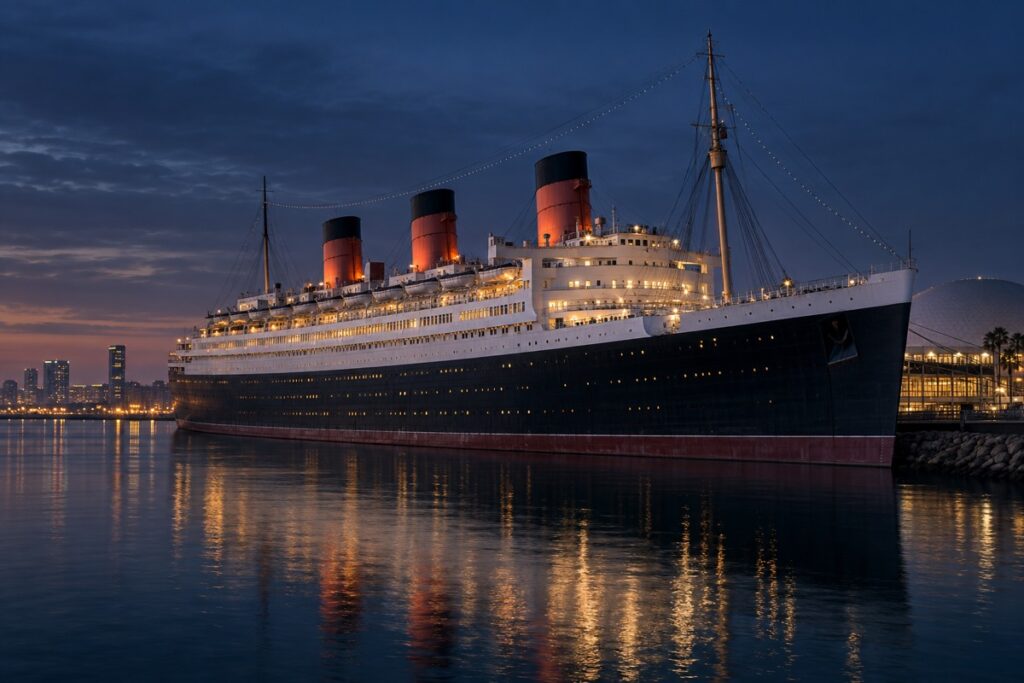
The Queen Mary is not merely a hotel shaped like a ship. It is the ship itself, one of the great surviving ocean liners of the twentieth century. Its long black hull and three funnels still dominate the Long Beach waterfront. Step aboard and the scale becomes clearer. Public rooms, companionways, machinery spaces, cabins, and decks preserve the design language of an era when an Atlantic crossing was both transportation and theater.
That physical survival gives the Queen Mary unusual value. Many famous liners ended at the breaker’s yard. This one remains large enough to communicate the ambitions of interwar engineering and intimate enough to show how passengers and crew actually moved through the vessel. Its later reputation as a haunted ship draws attention, but the documented maritime story is the reason the place endures.
From transatlantic liner to wartime service
Built for Cunard White Star, RMS Queen Mary entered passenger service in 1936. The liner carried travelers between Europe and North America with a speed and style that made it an international symbol. Its interiors blended modern technology with polished woods, murals, metalwork, and the restrained geometry now associated with Art Deco design.
The Second World War changed the ship’s purpose. The Queen Mary was converted for troop transport and carried enormous numbers of service members. Its speed was a defense. The vessel could outrun many threats that slower ships could not. Wartime service also brought danger and loss. In October 1942, the Queen Mary collided with the escort cruiser HMS Curacoa off Ireland. Hundreds of Curacoa crew members died. Any discussion of the ship’s darker history should begin with the human reality of events such as this, not with theatrical language.
After the war, the liner returned to passenger service. Air travel soon transformed the Atlantic market, however, and the Queen Mary completed its final voyage in 1967. The City of Long Beach purchased the vessel and developed it as a stationary hotel, attraction, and civic landmark. That decision preserved a vast artifact that would otherwise have been extraordinarily difficult to save.
Documented history and reported hauntings
The Queen Mary has accumulated decades of stories about footsteps, voices, figures, and unusual sensations. Some accounts are attached to particular cabins or working areas. Others concern the ship’s pool, engine rooms, or long interior passages. The venue now offers paranormal programs alongside conventional history tours, which means visitors can choose the kind of interpretation they prefer.
No responsible guide can verify a haunting as a historical fact. A sound in a steel vessel can travel far from its source. Temperature, machinery, old plumbing, expectation, and the ship’s complicated acoustics all shape a visitor’s experience. Still, the stories matter as folklore. They reveal how later generations have responded to a place built for movement but now held permanently at one dock.
The most useful way to explore the subject is to keep two questions separate. What do records tell us about the ship, its passengers, crew, and wartime service? What have visitors and employees reported in later years? Both questions can produce a good story, but they require different standards of evidence.
What to see aboard
A history-focused visit should leave time for the preserved public rooms and open decks. Look closely at the materials and proportions. Doorways, signs, railings, clocks, and ventilation details tell as much about shipboard life as the grand rooms do. Exhibits and guided tours add context about passenger classes, navigation, engineering, and wartime conversion.
Tour routes change, and not every part of the ship is open every day. Some specialty tours enter areas that general admission does not. The official Queen Mary website should be checked for the current admission package, tour schedule, hotel availability, and event calendar before traveling to Long Beach.
Planning a visit to the Queen Mary
- Address: 1126 Queens Highway, Long Beach, California 90802.
- Phone: 562-435-3511.
- Tickets: Buy through the official website, especially for guided or paranormal programs.
- Time needed: Allow at least two to three hours for a first visit. A specialty tour or overnight stay requires more time.
- Accessibility: The Queen Mary is a historic vessel. Some routes include stairs, narrow passages, or spaces that are not accessible. Review the official access information before choosing a tour.
- Best approach: Visit in daylight for architectural detail, then stay through blue hour to see the ship illuminated against the harbor.
Frequently asked questions
Is the Queen Mary really haunted?
The Queen Mary is widely described as haunted, and the venue presents paranormal tours based on reported experiences. Those accounts are folklore and personal testimony. They do not establish paranormal activity as fact.
Can you tour the Queen Mary without staying overnight?
Yes. The ship sells admission and guided-tour products separately from hotel rooms. Available packages vary by date, so confirm the current options on the official website.
Why is the Queen Mary in Long Beach?
The City of Long Beach purchased the retired liner in 1967. The ship has remained at the waterfront as a hotel, attraction, event venue, and historic landmark.
Is the Queen Mary good for children?
Many daytime exhibits and history experiences can suit families, but individual tours differ in length, physical demands, and subject matter. Check the official description before booking a paranormal or below-decks program.
What should history lovers prioritize?
Choose a history-focused guided tour, study the preserved Art Deco interiors, and spend time on the open decks. The ship makes the most sense when read as a complete working environment rather than a collection of isolated ghost stories.
Sources and editorial note
Primary visitor information comes from the Queen Mary’s official guided-tours and contact pages. The official visitor map records that the liner retired in 1967 and was purchased by the City of Long Beach. HauntsUSA treats paranormal material as reported folklore and identifies generated imagery as editorial interpretation.
Last reviewed September 26, 2026. Hours, admission products, and tour routes can change. Confirm details with the venue before travel.