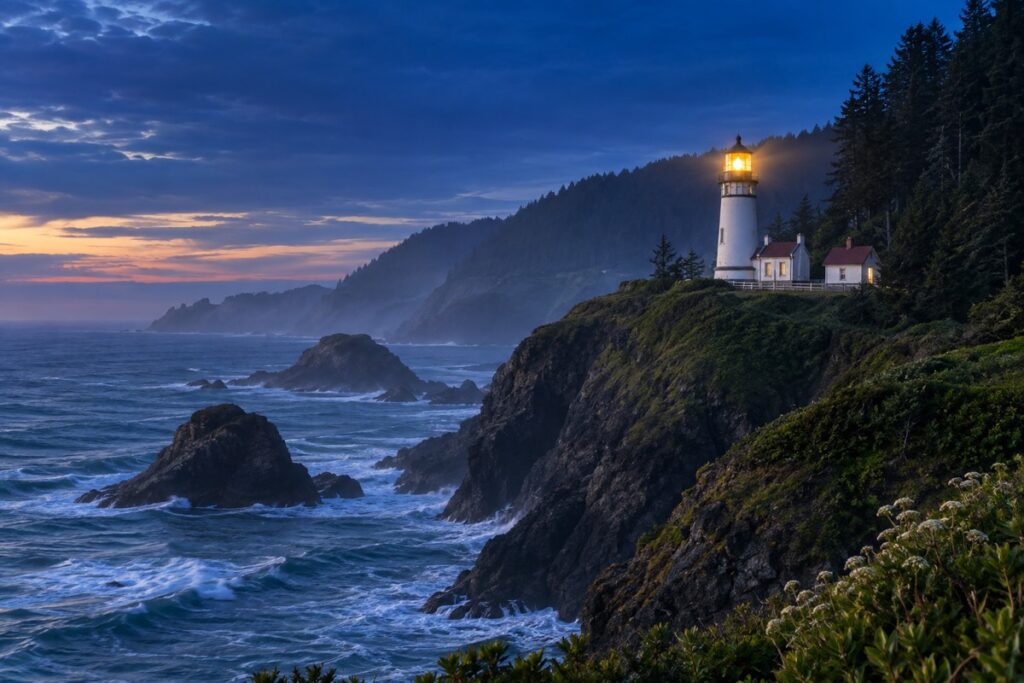
Quick answer: Heceta Head Lighthouse is an active historic light within an Oregon State Parks viewpoint north of Florence. The 56-foot tower was built in 1892 and 1893 and first illuminated in 1894. The surviving assistant keeper’s house now operates as a bed and breakfast, where reports of a Gray Lady became part of Oregon coast folklore.
Why Heceta Head Lighthouse matters
The setting explains the lighthouse before any legend does. Heceta Head rises more than two hundred feet above the Pacific. Rock, wind, fog, waves, migration routes, and a dangerous coastline made a powerful navigational light necessary. The tower and keeper’s house were working infrastructure.
Life at a light station combined technical duty with isolation and domestic labor. Keepers maintained the lens and fuel systems, watched weather, recorded conditions, and protected the light. Families cooked, raised children, managed supplies, and lived with a schedule set by darkness and storms.
The documented history
Construction took place in 1892 and 1893, and the light first shone in 1894. The tower stands fifty-six feet tall, while its position on the headland lifts the beam far above the ocean. Oregon State Parks describes it as the strongest light on the Oregon coast.
The station included residences and support buildings for keepers and assistants. The head keeper’s house was later demolished, while the assistant keeper’s duplex survived. Electrification and automation changed staffing needs during the twentieth century.
The lighthouse became fully automated in 1963. State and federal transfers eventually placed the viewpoint under Oregon parks management, while the surviving keeper’s house became a bed and breakfast. The tower was listed in the National Register of Historic Places in 1978.
History, memory, and the haunted reputation
Guests and staff at the keeper’s house have reported a woman in gray, unexplained sounds, moved objects, and unusual scents. The figure is often called Rue or the Gray Lady. Versions differ about her identity and whether a grave on the property relates to the story.
Those details require caution. A nickname repeated in travel writing does not establish a biography. The haunting belongs to regional folklore and hospitality storytelling unless documentary sources identify a historical person.
The coastal environment can also produce vivid sensory effects. Wind presses against old walls, salt air affects hardware, fog changes distance, and waves carry sound unevenly. These natural conditions are part of the experience without resolving every report.
What to notice during a visit
Walk the half-mile trail from the parking area past the keeper’s house toward the tower. The climb gains roughly 150 feet. Pause where the view opens toward offshore rocks, migrating whales, seabirds, and the marine reserve.
Inside access is limited to the ground floor during posted seasonal hours, weather and staffing permitting. The upper tower remains closed. That limitation protects the historic structure and keeps the active light secure.
Planning a visit
- Location: Heceta Head Lighthouse State Scenic Viewpoint, about thirteen miles north of Florence on U.S. 101, Oregon 97439.
- Access: The lighthouse requires an uphill half-mile walk. Ground-floor access varies by season, weather, and volunteer staffing; upper levels are closed.
- Best for: Oregon coast travelers, lighthouse enthusiasts, maritime-history readers, hikers, birders, and visitors interested in regional folklore.
- Before you go: Confirm current hours, tickets, accessibility, and photography rules on the official website.
Frequently asked questions
Is Heceta Head Lighthouse haunted?
The keeper’s house has a widely reported Gray Lady tradition, but the accounts remain folklore and guest testimony.
Can the public visit?
Yes. The state park, trail, viewpoint, and seasonally staffed ground floor are public. The keeper’s house operates separately as lodging.
How much time should visitors allow?
Allow ninety minutes to two hours for parking, the climb, views, interpretation, and return. Weather can slow the visit.
What is the most important historical context?
The operational light, keeper labor, automation, park stewardship, and surviving assistant keeper’s house are the essential documented themes.
Sources and editorial note
Oregon State Parks provides the construction dates, tower height, trail distance, seasonal access, automation history, and park management. U.S. Coast Guard history supplies additional lighthouse context.
HauntsUSA separates documented history from reported experiences, local legend, and venue marketing. Paranormal claims are never stated as proven fact. Generated artwork is labeled as an editorial interpretation rather than documentary photography.
Last reviewed September 26, 2026. Visitor details can change. Confirm current information with the site before travel.