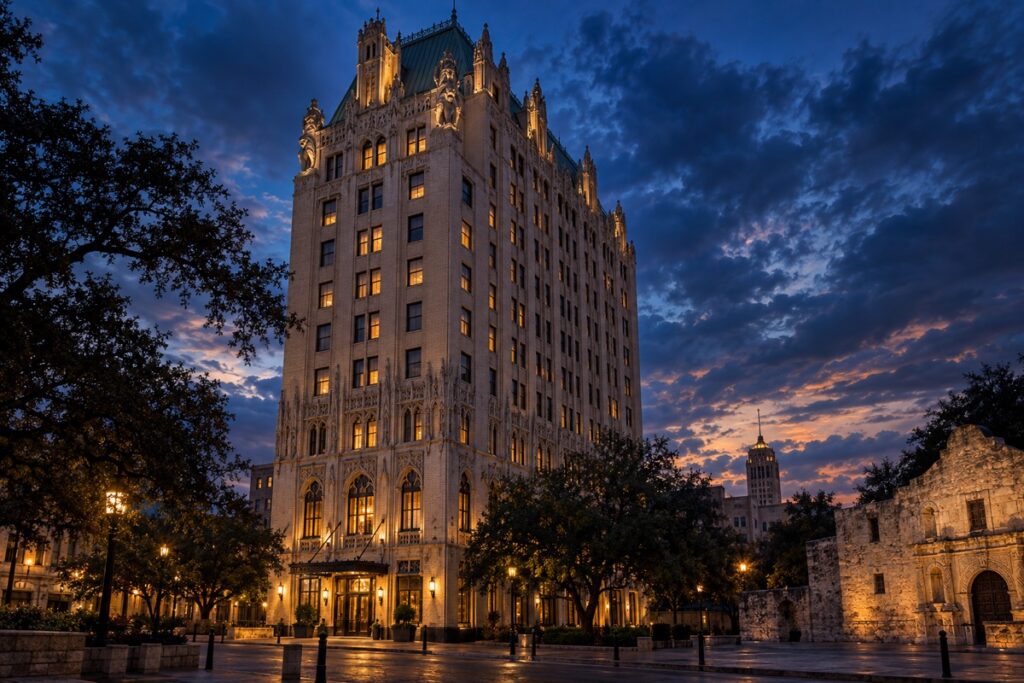
Quick answer: The Emily Morgan Hotel is a historic Gothic Revival tower at 705 East Houston Street beside the Alamo in San Antonio. It opened in the 1920s as the Medical Arts Building and was later converted into a hotel. Its former medical use and dramatic architecture helped inspire a reputation for elevator anomalies and reported apparitions.
Why the Emily Morgan Hotel matters
The building was designed to look memorable in the skyline. Vertical lines, a narrow profile, Gothic ornament, and terra-cotta details give it a slightly theatrical character even in daylight. Its visual language helps explain why ghost stories feel natural there, but appearance is not evidence.
The Medical Arts Building also reflects the professional growth of San Antonio. Doctors and related services gathered in a modern downtown tower near transport and civic institutions. Converting that office building into a hotel changed room layouts and circulation while preserving a recognizable exterior.
The documented history
Completed during the late 1920s, the tower was built for medical offices. Its design is frequently described as Gothic Revival, with ornament that evokes carved stone even where modern materials were used. The building became part of the evolving Alamo Plaza skyline.
Medical tenants served patients in offices rather than in a conventional hospital ward. That difference matters. Popular ghost summaries sometimes turn every former medical building into a place of mass suffering. The actual office history should be researched through directories, plans, and contemporary advertisements.
The building was eventually adapted as a hotel and named for Emily Morgan, a legendary figure connected to the Texas Revolution. That name brings another layer of myth and contested memory. The hotel’s modern identity therefore combines architecture, medicine, hospitality, and regional legend.
History, memory, and the haunted reputation
Guests describe elevators stopping without a request, lights behaving unexpectedly, phones ringing, figures in hallways, and unusual activity on particular floors. The building’s numbered levels and former medical purpose feature prominently in these accounts.
Mechanical systems are a practical place to begin. Older elevator controls, sensors, staff calls, and programming can produce events that feel personal to a guest. A natural explanation does not invalidate the experience, but it does prevent an unexplained stop from becoming proof.
The hotel’s reputation is best presented as reported tradition. Stories should be attributed to guests, staff, or venue materials, and claims about deaths or medical procedures should not be published without records.
What to notice during a visit
Look upward from Alamo Plaza to understand the tower’s narrow profile and ornament. Inside public areas, notice how designers converted professional office space into hospitality. Windows, corridors, elevators, and floor divisions reveal the challenge.
Pair the hotel with a careful visit to the Alamo and surrounding civic sites. San Antonio’s history includes Spanish colonization, Indigenous communities, Mexican Texas, revolution, statehood, military growth, and tourism. No single legend should dominate that landscape.
Planning a visit
- Location: 705 East Houston Street, San Antonio, Texas 78205.
- Access: The property operates as a hotel. Public access is limited to designated hospitality areas; guest floors are private.
- Best for: Architecture travelers, adaptive-reuse readers, Alamo Plaza visitors, and guests interested in modern haunted-hotel folklore.
- Before you go: Confirm current hours, tickets, accessibility, and photography rules on the official website.
Frequently asked questions
Is the Emily Morgan Hotel haunted?
The Emily Morgan is frequently described as haunted, but the stories remain reported experiences without verified supernatural cause.
Can the public visit?
Yes, as a guest or patron of designated public areas. Do not roam hotel floors without a legitimate reason.
How much time should visitors allow?
Allow thirty to sixty minutes for exterior context and Alamo Plaza, or book a stay for the full lodging experience.
What is the most important historical context?
The building began as medical offices, not simply as a generic hospital. Its Gothic design and later conversion are central to an accurate account.
Sources and editorial note
The official hotel and contact pages provide current address and phone information. National Register material, city surveys, directories, and architectural sources should support construction and tenant history.
HauntsUSA separates documented history from reported experiences, local legend, and venue marketing. Paranormal claims are never stated as proven fact. Generated artwork is labeled as an editorial interpretation rather than documentary photography.
Last reviewed September 26, 2026. Visitor details can change. Confirm current information with the site before travel.
The name and the legend
The hotel’s name invokes Emily Morgan, often linked in popular tradition to the song and legend of the Yellow Rose of Texas. Historians debate major parts of that story. The name therefore offers a useful lesson in memory: a modern business can inherit a familiar figure while the evidence behind the public legend remains contested. The page should signal that uncertainty rather than repeating romance as biography.
Questions for the museum
Visitors can ask how many people the jail held, how race and poverty affected arrest and sentencing, what medical care existed, how food was prepared, and how contact with family worked. Answers may not appear in every tour. Raising the questions still improves the visit because it shifts attention from locks and punishment toward the human systems that operated the institution for more than sixty years.
That distinction strengthens the guide.
It also explains why respectful public access and private guest space must remain clearly separated today.