Quick answer: The 1886 Crescent Hotel & Spa is a working historic hotel at 75 Prospect Avenue in Eureka Springs, Arkansas. It opened as a luxury resort, later became a women’s college and a hospital operated by medical impostor Norman Baker, and eventually returned to hotel use. Nightly ghost tours draw on reported experiences and the building’s dramatic past.
Why the Crescent Hotel matters
The Crescent is valuable because its story spans several distinct American institutions. It began as an ambitious resort created during the rise of Eureka Springs as a health and leisure destination. Its stone walls and mountaintop position still communicate the confidence of that first era. Later owners adapted the same building for education, medicine, and hospitality, leaving physical and documentary layers that can be read together.
Its haunted reputation is not separate from that history. The stories grew because people continued to reuse a large, aging building with a complicated public identity. Visitors should resist the temptation to reduce the property to a morgue or a collection of named ghosts. The stronger account explains why the hotel was built, how its purpose changed, and why some episodes became especially powerful in public memory.
The documented history
The hotel opened in 1886, when rail travel and mineral-spring tourism were reshaping the Ozarks. It was designed as a grand resort and promoted the mountain air, scenery, and social life of Eureka Springs. The scale of the structure was part of the message. Guests were meant to understand that this remote Arkansas town could offer the architectural confidence of a major resort.
The building later served as the Crescent College and Conservatory for Young Women. That chapter connected the property to education and to the changing opportunities available to women in the early twentieth century. In the 1930s, Norman Baker converted the property into a hospital and advertised treatments for cancer. Baker had no legitimate medical credentials, and his claims became part of a wider history of medical fraud and exploitation.
After periods of uncertainty and a damaging fire, the Crescent returned to hospitality. Modern restoration has aimed to keep the hotel operating while acknowledging its earlier uses. The building is a member of Historic Hotels of America, and income from lodging, events, dining, and tours supports continued care of the property.
History, memory, and the haunted reputation
The hotel markets itself as one of America’s most haunted hotels. Tours introduce figures known as Michael and Theodora, along with stories tied to Baker’s hospital and the building’s former morgue. Guests and staff have described apparitions, voices, movement, and other experiences that they could not readily explain.
These accounts belong to venue storytelling and reported folklore. Some details are repeated so often that they begin to sound archival even when their earliest source is unclear. A careful visitor can enjoy the tour while noticing which statements are supported by dates and records, which come from personal testimony, and which have been shaped for performance.
The Baker era needs particular restraint. Medical fraud harmed real people, and unsupported death totals can make that harm harder to understand. The most unsettling truth is documented: a persuasive showman sold hope to seriously ill patients without sound medical authority. That history deserves more attention than any theatrical claim.
What to notice during a visit
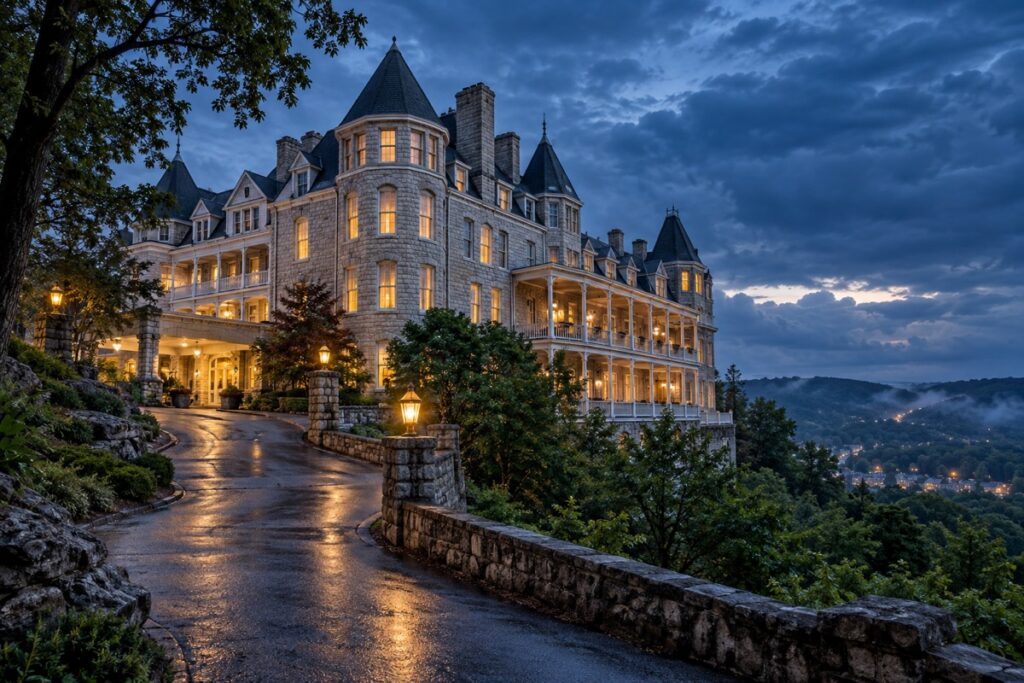
Begin with the exterior. The stonework, roofline, porches, and tower show how the resort was designed to command its hillside. Inside, notice where later functions altered the hotel and where restoration has reintroduced period character. Exhibits and guided interpretation can help connect rooms to each chapter of use.
A ghost tour is most useful when paired with a daytime look at Eureka Springs. The town’s steep streets, springs, hotels, and tourism economy explain why the Crescent existed in the first place. The property is not an isolated haunted building. It is part of a larger landscape built around health claims, travel, scenery, and reinvention.
Planning a visit
- Location: 75 Prospect Avenue, Eureka Springs, Arkansas 72632.
- Access: The hotel operates year-round. Ghost tours are ticketed and often sell out, so advance purchase is wise.
- Best for: Historic-hotel enthusiasts, architecture readers, Ozarks travelers, and visitors interested in the boundary between medical history and ghost lore.
- Before you go: Confirm current hours, tickets, accessibility, and photography rules on the official website.
Frequently asked questions
Is the Crescent Hotel haunted?
The venue describes the Crescent as haunted and offers several paranormal programs. Visitors and staff have reported unusual experiences, but those reports do not prove a supernatural cause.
Can the public visit?
Yes. Overnight lodging is not the only way to experience the property. Ticketed ghost tours and selected public areas provide access, although schedules and policies can change.
How much time should visitors allow?
Allow about ninety minutes for a standard tour and additional time to study the hotel, grounds, and surrounding town. An overnight stay creates a different experience but is not required.
What is the most important historical context?
The most important context is the building’s repeated reinvention, especially the Norman Baker hospital period. Baker’s lack of medical legitimacy is documented and should not be blurred by sensational legend.
Sources and editorial note
Primary visitor information and the venue’s own chronology come from the official Crescent Hotel website, its frequently asked questions, and its ghost-tour pages. Independent historical research should be added before any disputed medical statistic is presented as settled fact.
HauntsUSA separates documented history from reported experiences, local legend, and venue marketing. Paranormal claims are never stated as proven fact. Generated artwork is labeled as an editorial interpretation rather than documentary photography.
Last reviewed September 26, 2026. Visitor details can change. Confirm current information with the site before travel.