Quick answer: Colonial Park Cemetery is a historic place in Savannah, Georgia, associated with documented local history and a separate tradition of reported ghost stories. The building or landscape deserves attention for its architecture, people, and changing uses. Paranormal accounts are presented here as folklore, not established fact.
Why Colonial Park Cemetery matters
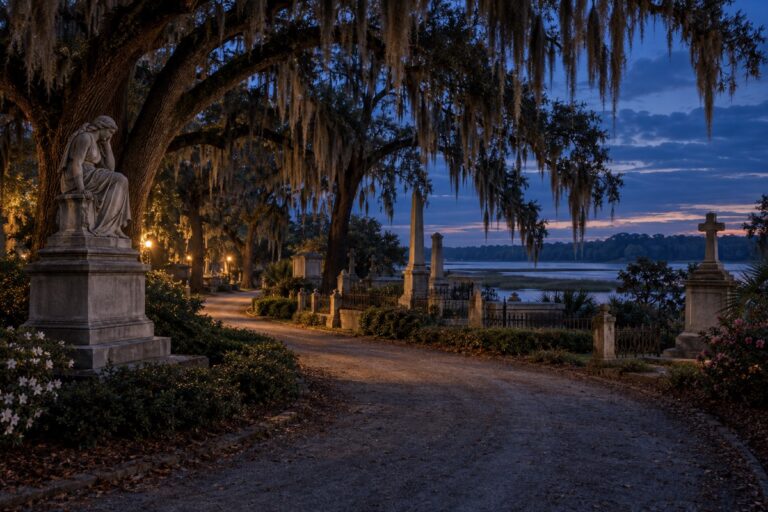
Savannah’s oldest intact municipal cemetery preserves more than a century of burials, civic memory, weathered monuments, and stories shaped by the city’s long afterlife in folklore. Places such as this are valuable because they hold several kinds of evidence at once. The structure, street plan, surviving objects, archival record, and later stories all reveal how Americans remember the past. A useful visit begins with what can still be seen and what contemporary records can support.
Colonial Park Cemetery also belongs to the larger story of Savannah. Its meaning does not stop at a doorway or property line. Nearby streets, public squares, waterways, houses of worship, commercial buildings, and burial grounds help explain why the place was built and how it changed. That geographic context is essential for visitors and for anyone researching the location from home.
The documented history
Established in 1750, the cemetery expanded several times and served as Savannah’s primary public burial ground until 1853. The city states that the six-acre site contains more than nine thousand graves.
War, epidemic disease, changing burial customs, vandalism, and urban growth all left marks on the landscape. Many stones survive, while others were moved or damaged over time.
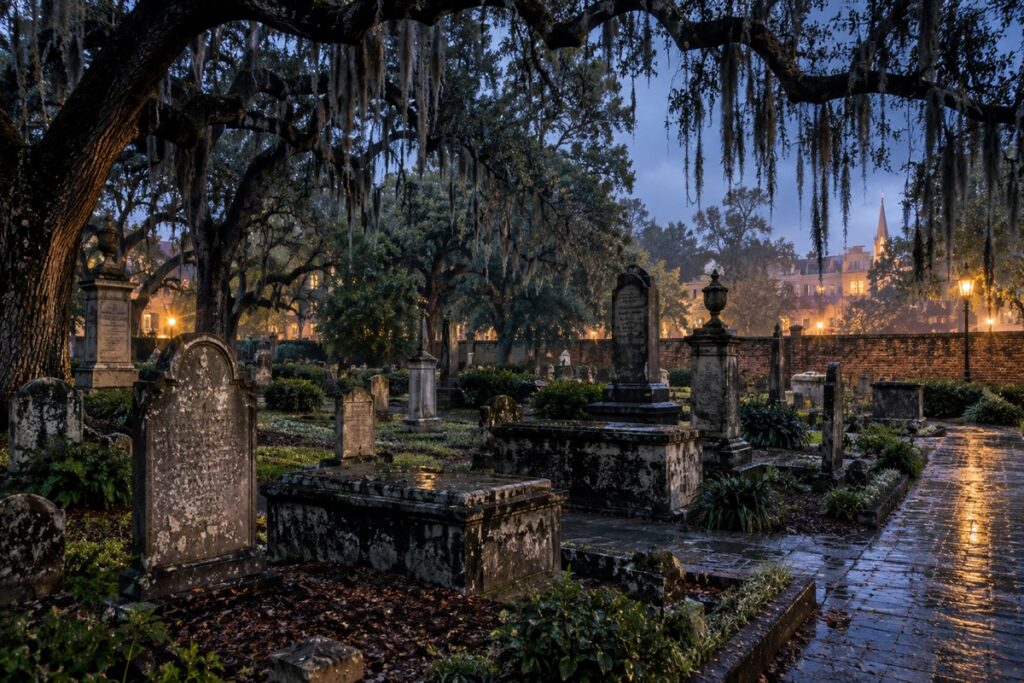
By 1789, three expansions had brought the cemetery close to its present boundaries. The burial ground closed to new interments in 1853, yet it remained embedded in daily city life. Its stones record epidemics, war, migration, family ties, and the growth of Savannah from a colonial settlement into a nineteenth-century port. Some inscriptions are crisp enough to read at a glance. Others have nearly surrendered to heat, rain, and time.
Reading the place itself
Enter through the public gate and read the cemetery as a landscape rather than a collection of curiosities. Look at the spacing of family plots, the change from simple tablets to larger vaults, and the wall where displaced stones were mounted. The surrounding streets are never far away. That closeness is part of the cemetery’s character. Colonial Park is both a protected burial ground and a surviving piece of Savannah’s early urban plan.
Names linked to public office and the Revolution receive much of the attention, but the cemetery’s meaning is broader. Epidemic victims, children, newcomers, craftspeople, and families whose stories survive only in fragments also belong to this ground. A visitor should resist turning every damaged date or unusual carving into a supernatural clue. The monuments are historical evidence first.
Reported hauntings and local folklore
Ghost tours often attach dramatic stories to the cemetery and its altered markers. Reported figures and sensations are part of Savannah’s tourism tradition, but the burial ground first deserves respect as a civic and family memorial.
Ghost stories often change as they pass from one guide, guest, newspaper, or television program to another. A name may appear decades after an event. A general sound can become a detailed apparition. A tragic episode can be moved from one room to another because the new version is easier to tell. Those changes do not make folklore worthless. They show how a community reshapes memory. They do mean that folklore and documented history need different labels.
Old buildings also produce ordinary mysteries. Sound travels through masonry, pipes, vents, stairwells, and timber in surprising ways. Light from streets and neighboring rooms can move across old glass. Temperature changes affect materials. Expectation can make a visitor notice details that would otherwise pass without comment. None of this disproves a personal experience. It simply gives the story an honest setting.
A note on care
Remain on open paths, obey posted hours, never touch fragile markers, and do not stage disrespectful photographs. Treat every grave as a real human burial.
Respectful travel means following posted rules, protecting fragile fabric, and remembering that difficult history involved real people. Do not trespass, touch monuments, enter closed rooms, or interrupt hotel guests and private residents. A haunted-history guide should deepen public understanding, not turn suffering into decoration.
Planning your visit
The city currently lists seasonal pedestrian hours, generally 8 a.m. to 5 p.m. in cooler months and 8 a.m. to 8 p.m. during daylight-saving months. Verify before visiting.
- Address: 200 Abercorn Street, Savannah, Georgia 31401.
- Phone: 912-651-6843.
- Official information: Check the official website before travel.
- Time needed: Allow about one to two hours for a focused visit unless a tour, meal, event, or overnight stay requires more time.
- Photography: Follow the property’s current rules. Flash, tripods, and commercial photography may be restricted.
- Accessibility: Historic stairs, thresholds, paving, and narrow rooms can limit access. Ask the operator about the specific route you plan to use.
Colonial Park fits naturally into a history-focused Savannah walk. Continue with the Kehoe House, the Pirates’ House, and the nearby 17Hundred90 Inn. Visit the cemetery only during posted hours. After the gates close, view the boundary from legal public areas and do not attempt entry.
Frequently asked questions
Is Colonial Park Cemetery really haunted?
Colonial Park Cemetery is associated with reported experiences and local stories. These accounts are part of its modern reputation, but they do not establish paranormal activity as fact.
Can the public visit Colonial Park Cemetery?
Yes. The cemetery is a city-maintained public site during posted pedestrian hours. The city prohibits trespassing after closing, and organized or commercial groups may be subject to separate rules.
What should history-focused visitors look for?
Prioritize the documented timeline, original or restored architectural features, and interpretation of the people who lived or worked here. Ask which stories are supported by records and which come from oral tradition.
How long should a visit take?
Most visitors should allow at least one hour. Guided tours, meals, special programs, or detailed architectural study can extend the visit to two hours or more.
Where should I confirm hours and admission?
Use the official website or telephone number immediately before travel. Historic properties often change schedules for private events, preservation work, weather, and seasonal programming.
Sources and editorial note
HauntsUSA separates documented history from reported folklore. Visitor details were last reviewed on September 26, 2026. Hours, prices, access, and tour policies can change without notice.