Quick answer: Old Fort Jackson is a historic place in Savannah, Georgia, associated with documented local history and a separate tradition of reported ghost stories. The building or landscape deserves attention for its architecture, people, and changing uses. Paranormal accounts are presented here as folklore, not established fact.
Why Old Fort Jackson matters
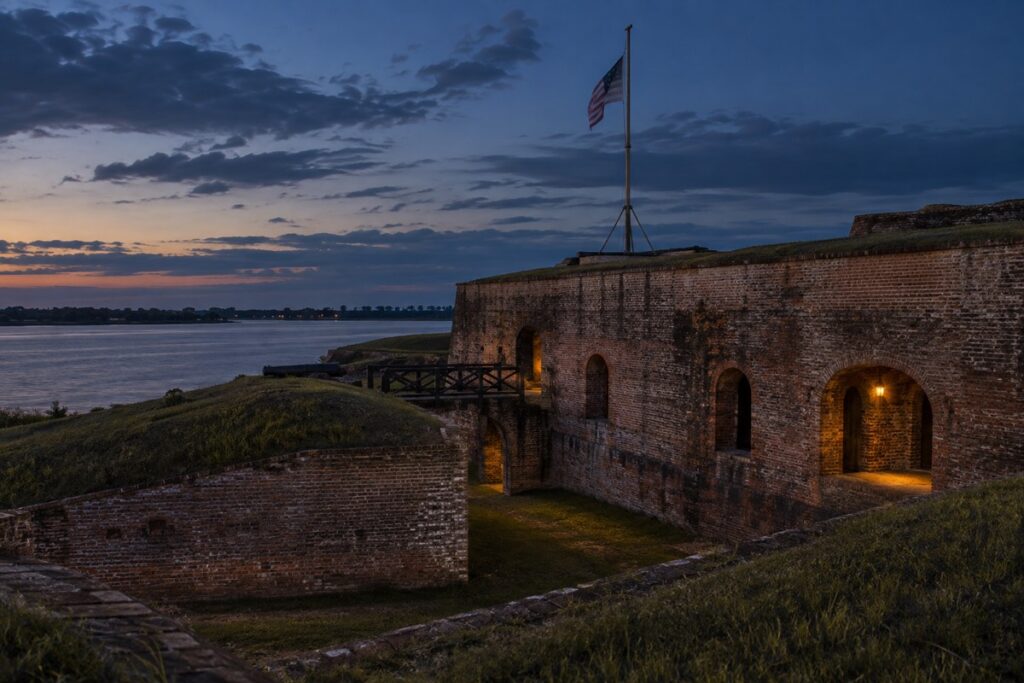
Georgia’s oldest surviving brick fortification stands on the Savannah River, preserving two centuries of military history and a quieter body of reported ghost lore. Places such as this are valuable because they hold several kinds of evidence at once. The structure, street plan, surviving objects, archival record, and later stories all reveal how Americans remember the past. A useful visit begins with what can still be seen and what contemporary records can support.
Old Fort Jackson also belongs to the larger story of Savannah. Its meaning does not stop at a doorway or property line. Nearby streets, public squares, waterways, houses of worship, commercial buildings, and burial grounds help explain why the place was built and how it changed. That geographic context is essential for visitors and for anyone researching the location from home.
The documented history
Construction began in the early nineteenth century to defend the river approach to Savannah. The fort served through the War of 1812 era and later became an important part of Confederate river defenses during the Civil War.
The site survived changing military needs and eventual decommissioning. It now operates as a historic site with interpreters, exhibits, and demonstrations under the Coastal Heritage Society.
That chronology should guide any account of the property. Dates, owners, public uses, restoration campaigns, and changes in access can often be checked against deeds, newspapers, public records, preservation studies, or the institution’s own archives. The record may still contain gaps. A gap is not an invitation to invent a dramatic answer. It is a reason to state what remains uncertain.
Reading the place itself
A historic site is best understood slowly. Begin with the exterior. Notice the relationship between the building and the street, the height of the entrance, the materials, windows, roofline, and any additions. These details often show which parts belong to the original design and which reflect later needs. Inside, room proportions, stairs, fireplaces, service passages, hardware, and worn surfaces can reveal daily patterns that a broad historical summary misses.
Visitors should also ask whose work made the place function. Prominent owners are usually the easiest people to find in the record, but they were rarely alone. Family members, laborers, craftspeople, employees, servants, soldiers, patients, prisoners, tenants, and guests may have left fewer documents. Good interpretation makes room for them without claiming more than the evidence can prove.
Reported hauntings and local folklore
Visitors and guides have reported footsteps, voices, and military figures after quiet hours. These accounts belong to local tradition and should never replace the documented experiences of soldiers and civilians.
Ghost stories often change as they pass from one guide, guest, newspaper, or television program to another. A name may appear decades after an event. A general sound can become a detailed apparition. A tragic episode can be moved from one room to another because the new version is easier to tell. Those changes do not make folklore worthless. They show how a community reshapes memory. They do mean that folklore and documented history need different labels.
Old buildings also produce ordinary mysteries. Sound travels through masonry, pipes, vents, stairwells, and timber in surprising ways. Light from streets and neighboring rooms can move across old glass. Temperature changes affect materials. Expectation can make a visitor notice details that would otherwise pass without comment. None of this disproves a personal experience. It simply gives the story an honest setting.
A note on care
Treat wartime death, disease, and military labor with restraint. Do not encourage entry after closing or access to restricted areas.
Respectful travel means following posted rules, protecting fragile fabric, and remembering that difficult history involved real people. Do not trespass, touch monuments, enter closed rooms, or interrupt hotel guests and private residents. A haunted-history guide should deepen public understanding, not turn suffering into decoration.
Planning your visit
Visitor information has recently listed daily daytime operations, but hours and programs vary. Confirm the schedule with the Coastal Heritage Society.
- Address: 1 Fort Jackson Road, Savannah, Georgia 31404.
- Phone: 912-232-3945.
- Official information: Check the official website before travel.
- Time needed: Allow about one to two hours for a focused visit unless a tour, meal, event, or overnight stay requires more time.
- Photography: Follow the property’s current rules. Flash, tripods, and commercial photography may be restricted.
- Accessibility: Historic stairs, thresholds, paving, and narrow rooms can limit access. Ask the operator about the specific route you plan to use.
The best experience usually comes from combining this place with other historic sites in Savannah. Study the neighborhood in daylight, then return to public streets near evening if the area is open and safe. The shift in light can clarify architectural form without requiring theatrical effects.
Frequently asked questions
Is Old Fort Jackson really haunted?
Old Fort Jackson is associated with reported experiences and local stories. These accounts are part of its modern reputation, but they do not establish paranormal activity as fact.
Can the public go inside?
Public access depends on the current museum, lodging, dining, tour, or event schedule. Check directly before arriving.
What should history-focused visitors look for?
Prioritize the documented timeline, original or restored architectural features, and interpretation of the people who lived or worked here. Ask which stories are supported by records and which come from oral tradition.
How long should a visit take?
Most visitors should allow at least one hour. Guided tours, meals, special programs, or detailed architectural study can extend the visit to two hours or more.
Where should I confirm hours and admission?
Use the official website or telephone number immediately before travel. Historic properties often change schedules for private events, preservation work, weather, and seasonal programming.
Sources and editorial note
HauntsUSA separates documented history from reported folklore. Visitor details were last reviewed on September 26, 2026. Hours, prices, access, and tour policies can change without notice.