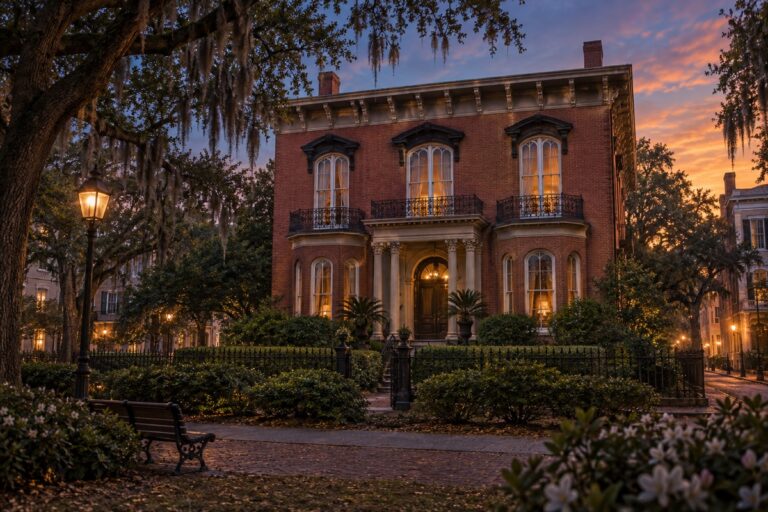
Quick answer: The Sorrel-Weed House is a historic mansion at 6 West Harris Street beside Madison Square in Savannah, Georgia. Built for merchant Francis Sorrel during the nineteenth century, it is known for monumental architecture, guided history tours, ghost tours, and paranormal investigations. Its antebellum history requires clear treatment of slavery and household labor.
Why the Sorrel-Weed House matters
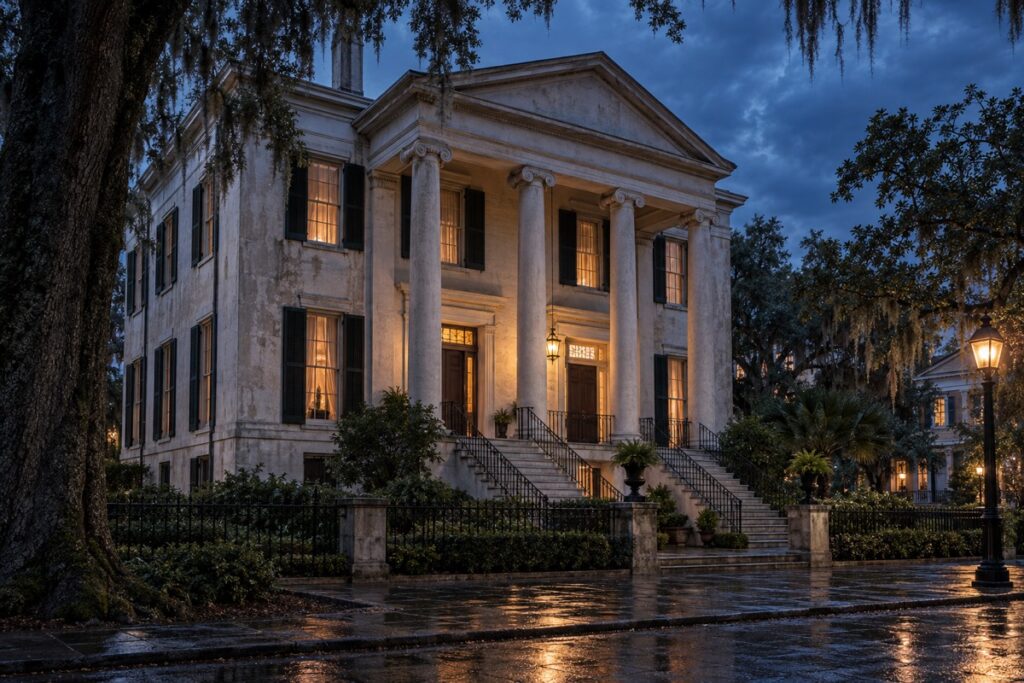
The house commands attention because its design is both formal and theatrical. Broad surfaces, deep openings, a prominent portico, and carefully organized rooms reflect wealth and social position. That architecture was not neutral. It depended on commercial networks and domestic labor that included enslaved people.
Modern tours often emphasize dramatic family stories and paranormal reports. Those narratives can draw visitors into the building, but they should not displace research into who built, maintained, and inhabited the household. The strongest guide treats architecture, slavery, family history, and folklore as related but distinct subjects.
The documented history
Construction began in the 1830s for Francis Sorrel, a prosperous merchant. Architect Charles Cluskey is associated with the design, which blends Greek Revival monumentality with Regency influence. The house occupied a prominent position on Madison Square and helped express the ambitions of its owner.
The Sorrel household existed within Savannah’s slave society. Enslaved people performed the labor that sustained elite domestic life, and their experience cannot be recovered simply by repeating later ghost stories. Archival records, names, legal documents, and material evidence should guide interpretation wherever possible.
The house passed through later ownership and preservation efforts before becoming a museum and tour venue. Its survival allows visitors to study scale, circulation, service areas, formal rooms, and the relationship between a private residence and the public square.
History, memory, and the haunted reputation
The operator offers historical tours, ghost tours, and paranormal investigations. Stories often concern family conflict, death, reported figures, and activity in particular parts of the house. Television programs have helped spread the property’s haunted reputation far beyond Savannah.
Popular versions frequently become more certain with retelling. A tragic claim may be repeated without a contemporary record, and a person’s biography may be reshaped to fit a ghost narrative. Responsible editorial work should identify the earliest available source and state when evidence remains incomplete.
Paranormal tourism can still encourage careful attention. A visitor who arrives for a ghost story may leave with questions about design, status, race, labor, and memory. The tour is most valuable when it opens those questions rather than using historical suffering as scenery.
What to notice during a visit
Study the facade from Madison Square and notice how the building claims space. Inside, compare formal rooms with circulation routes and service areas. Doors, stairs, and changes in floor level can reveal how residents and workers were expected to move differently.
Place the house within a wider Savannah walk. Madison Square, nearby churches, streets, and other residences show the planned ward system and the way elite homes related to civic space. That geography is essential for local SEO and for honest history.
Planning a visit
- Location: 6 West Harris Street, Savannah, Georgia 31401.
- Access: Entry is through ticketed history tours, ghost tours, or investigations. Schedules and age guidance vary by program.
- Best for: Architecture readers, Savannah history travelers, visitors studying antebellum households, and adults interested in carefully labeled paranormal programming.
- Before you go: Confirm current hours, tickets, accessibility, and photography rules on the official website.
Frequently asked questions
Is the Sorrel-Weed House haunted?
The venue markets ghost tours and investigations, and many visitors report experiences. These reports do not establish paranormal activity as fact.
Can the public visit?
Yes, with a ticketed tour. Choose the historical or paranormal format that matches your interests and confirm accessibility in advance.
How much time should visitors allow?
Most visits require at least an hour. Add time for Madison Square and nearby historic-district sites.
What is the most important historical context?
The house must be understood within slavery, merchant wealth, domestic labor, and Savannah’s urban development. Family legend alone is not enough.
Sources and editorial note
The official Sorrel-Weed House tour site supplies the address, phone number, and current program types. Visit Savannah provides public destination information. Archival and preservation sources are required for disputed biographical details.
HauntsUSA separates documented history from reported experiences, local legend, and venue marketing. Paranormal claims are never stated as proven fact. Generated artwork is labeled as an editorial interpretation rather than documentary photography.
Last reviewed September 26, 2026. Visitor details can change. Confirm current information with the site before travel.
Reading the house responsibly
One useful question is whose story a room is prepared to tell. Formal parlors often preserve the tastes of owners, while service spaces reveal the labor that made those rooms possible. Enslaved people can disappear from a tour when interpretation relies only on furnishings and family anecdotes. Names, tasks, legal status, family ties, and later freedom should be recovered whenever the records allow it.