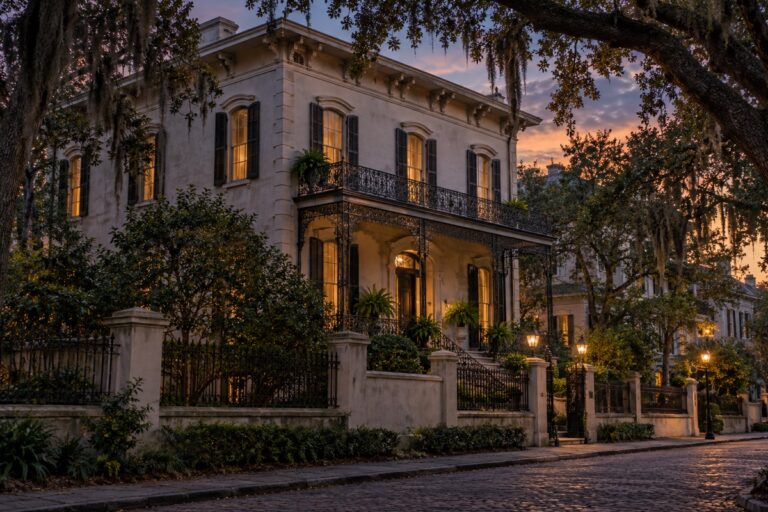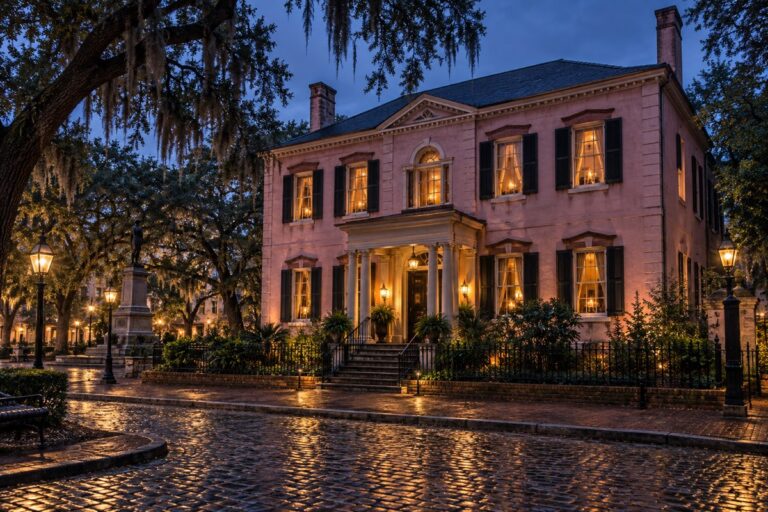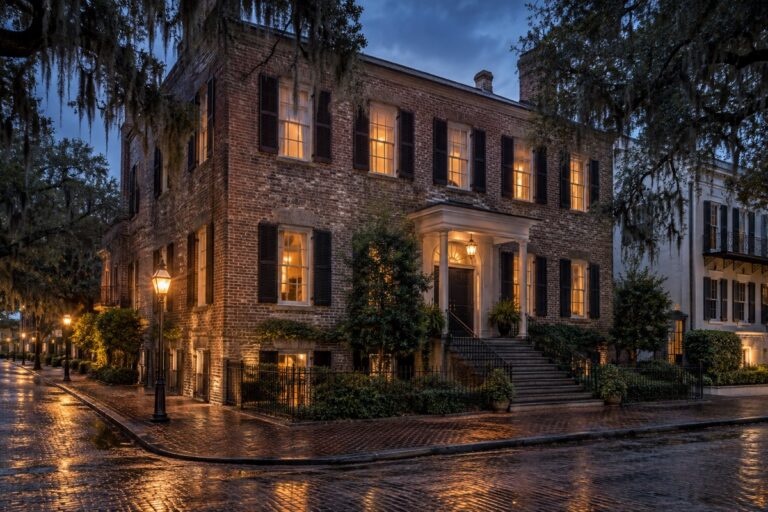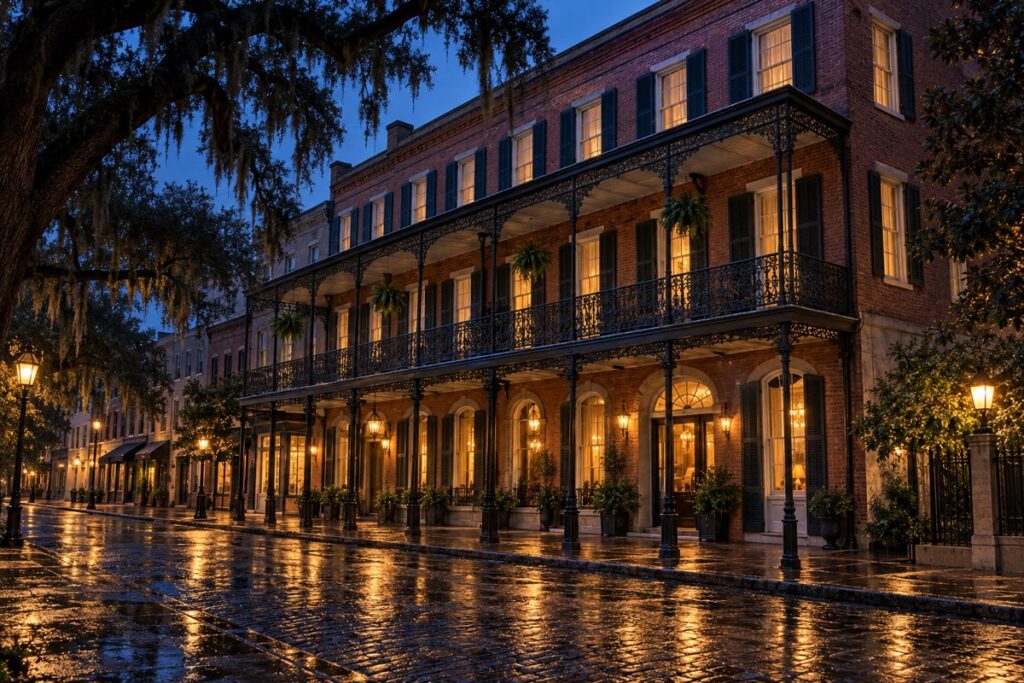
Quick answer: The Marshall House is a working historic hotel at 123 East Broughton Street in Savannah, Georgia. Businesswoman Mary Magdalene Marshall opened it in 1851. The building later served as a Union hospital, closed for four decades, and reopened after restoration in 1999. Its haunted reputation is promoted by the hotel and local tours.
Why the Marshall House matters
Savannah has many old buildings, but the Marshall House offers an unusually legible sequence of use. It was built for hospitality during a period of rapid urban growth, adapted to wartime medical need, modernized more than once, closed when code requirements became difficult, and eventually restored. Each stage reflects a different Savannah.
Mary Marshall deserves attention in her own right. She developed property in a nineteenth-century city where commercial influence is too often narrated only through men. Her portrait and the hotel’s surviving record provide a route into women’s business history as well as the history of travel.
The documented history
The hotel opened in 1851 on Broughton Street, then one of Savannah’s important commercial corridors. An iron veranda was added in the 1850s and became a defining feature. The building’s position near shops, traffic, and civic life made it practical for visitors and residents alike.
During 1864 and 1865, Union troops used the hotel as a hospital. Accounts also connect the property with yellow fever periods in the city. Those episodes involved real patients, caregivers, fear, and loss. They should be interpreted with restraint rather than treated as automatic proof of haunting.
The hotel closed in 1895, reopened in 1899, underwent later modernization, and closed again in 1957. Restoration began in 1998, and the Marshall House reopened in 1999. Reproduced veranda elements and recovered artifacts help the present building recall its earlier appearance without pretending every surface is untouched.
History, memory, and the haunted reputation
The Marshall House appears on many Savannah ghost tours. Guests and storytellers describe children in hallways, unexplained sounds, faucets, figures, and Civil War associations. The hotel itself acknowledges the haunted reputation as part of its public story.
Some tales are plausible only in the broadest sense. A former hospital can inspire stories, but that function alone does not verify a particular apparition. Good interpretation asks when a story first appeared, who reported it, and whether later versions changed the details.
Savannah’s ghost culture is also a form of civic storytelling. It connects hotels, squares, houses, epidemics, wars, and disasters into memorable routes. The Marshall House belongs to that tradition, but its verified architecture and ownership history should remain the foundation.
What to notice during a visit
Begin outside with the long cast-iron veranda and the rhythm of windows above Broughton Street. Inside, examine display cases, photographs, and artifacts. The courtyard atrium and restored details show how designers adapted a historic plan to modern hotel use.
A walk from the hotel toward Savannah’s squares reveals how commercial streets and residential wards overlap. That urban setting explains why soldiers, travelers, shopkeepers, and later tourists all passed through the same building.
Planning a visit
- Location: 123 East Broughton Street, Savannah, Georgia 31401.
- Access: The property operates as a hotel. Lobby history talks and public-area access depend on current policy, events, and guest needs.
- Best for: Historic-hotel travelers, Savannah architecture readers, Civil War students, and visitors comparing documented history with ghost-tour tradition.
- Before you go: Confirm current hours, tickets, accessibility, and photography rules on the official website.
Frequently asked questions
Is the Marshall House haunted?
The hotel and local tours describe the Marshall House as haunted. Guest reports are personal testimony and venue lore, not confirmed supernatural evidence.
Can the public visit?
Yes, primarily as a guest. Non-guests should use only clearly public areas and respect hotel operations.
How much time should visitors allow?
An overnight stay offers the fullest access. A careful exterior look and nearby historic-district walk can fit into an hour.
What is the most important historical context?
Mary Marshall’s ownership, the 1851 opening, Union hospital use, and the 1998 to 1999 restoration are central to the building’s documented story.
Sources and editorial note
The official Marshall House history supplies the timeline and Mary Marshall account. Explore Georgia and Visit Savannah provide public destination context. Wartime and epidemic claims should be checked against archival sources before adding detail.
HauntsUSA separates documented history from reported experiences, local legend, and venue marketing. Paranormal claims are never stated as proven fact. Generated artwork is labeled as an editorial interpretation rather than documentary photography.
Last reviewed September 26, 2026. Visitor details can change. Confirm current information with the site before travel.
A hotel that still works
Historic hotels survive by continuing to serve guests, which creates a practical tension between preservation and comfort. Elevators, bathrooms, climate systems, fire safety, and accessibility must be fitted into a building designed for another century. At the Marshall House, those adaptations are part of the story. Visitors should notice both the surviving fabric and the thoughtful modern work that keeps the property useful.
Continue exploring Savannah
Compare the documented history and clearly labeled traditions at Andrew Low House and Bonaventure Cemetery. Check each guide for sources and current access information.