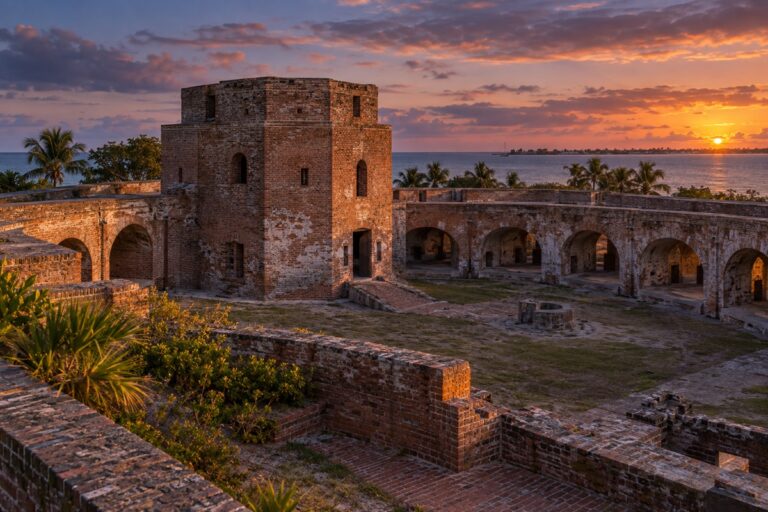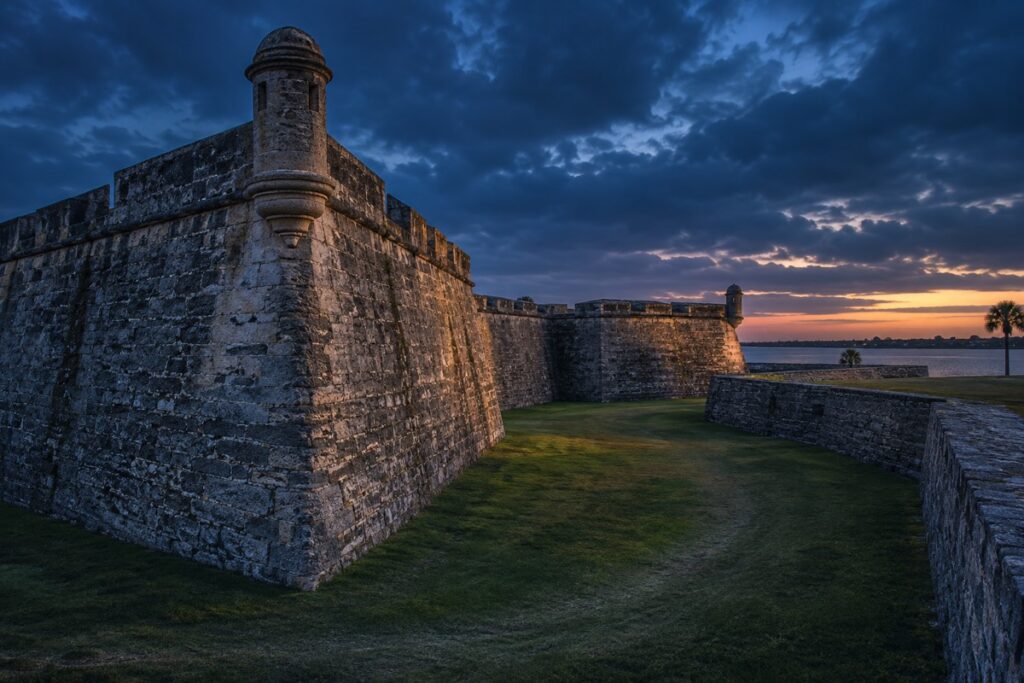
Quick answer: Castillo de San Marcos is a seventeenth-century Spanish fortress at 11 South Castillo Drive in St. Augustine, Florida. It is the oldest surviving masonry fort in the continental United States and a National Park Service site. Ghost stories circulate around its rooms and walls, but its documented colonial, military, carceral, and Indigenous history comes first.
Why Castillo de San Marcos matters
The Castillo is one of the clearest surviving witnesses to the long struggle for control of Florida. Its coquina walls embody engineering knowledge, imperial ambition, coerced and skilled labor, and adaptation to a difficult coastal environment. Spain, Britain, and the United States used the fort under different names, each adding another political layer.
The structure also complicates the simple image of a fortress. At different times it sheltered townspeople, housed soldiers, stored weapons, and confined prisoners. It was part of a colonial system that brought European empires into conflict with Indigenous nations and with one another. The walls are visually impressive, but they should not be separated from the people whose lives were controlled within them.
The documented history
Spanish authorities began the present masonry fortress in 1672 after earlier wooden defenses proved vulnerable. Builders used coquina, a local limestone made of compacted shell fragments. The material could absorb the force of cannon fire rather than shatter like harder stone. Thick walls, bastions, a moat, and protected rooms turned the Castillo into an unusually durable defensive work.
When Britain gained Florida in 1763, the fort became Fort St. Mark. Spain recovered the colony in 1783, and the United States took possession in 1821. American authorities later called it Fort Marion and used it in connection with the Seminole Wars, Indigenous imprisonment, military storage, and the Civil War. Congress restored the Spanish name in 1942.
The National Park Service now preserves the fortress and interprets more than three centuries of North American history. Exhibits explain construction, changing empires, military life, and people held at the site. The Castillo’s survival owes much to coquina, repeated repair, and generations of preservation decisions.
History, memory, and the haunted reputation
St. Augustine ghost tours often include the Castillo. Stories describe soldiers, prisoners, figures in period clothing, strange lights, and voices in rooms that can be cool and echoing even on hot days. These are reported experiences and local traditions, not findings presented by the National Park Service as historical fact.
Fort architecture naturally shapes perception. Thick walls alter sound. Narrow openings frame sudden movement. Wind crosses the bay, temperature changes between sun and shade, and voices carry along stone passages. A visitor does not need to dismiss a personal experience to recognize that the setting has powerful physical effects.
The ethical question is more important than the supernatural one. Some people confined at the Castillo suffered through warfare, displacement, imprisonment, and cultural suppression. Their history should never become anonymous atmosphere for a ghost story. Names, nations, dates, and records deserve priority.
What to notice during a visit
Walk the exterior first and study the star-shaped plan. The bastions allowed defenders to cover the walls from several angles. In the rooms, inspect the coquina texture and the vaulting. From the gun deck, the relationship among the fort, Matanzas Bay, the old city, and the harbor approach becomes legible.
Read exhibit labels slowly, then compare the Spanish, British, and American periods. The site is most rewarding when visitors notice continuity and change instead of treating the building as frozen in one century. Ranger programs and the official NPS app can deepen that reading.
Planning a visit
- Location: 11 South Castillo Drive, St. Augustine, Florida 32084. The park’s mailing address is listed separately by the National Park Service.
- Access: The fort is generally open during posted daytime hours, while the grounds have longer hours. Weather, federal holidays, and preservation work can affect access.
- Best for: Colonial history readers, military-architecture enthusiasts, families using Junior Ranger resources, and visitors seeking a careful account of St. Augustine ghost lore.
- Before you go: Confirm current hours, tickets, accessibility, and photography rules on the official website.
Frequently asked questions
Is Castillo de San Marcos haunted?
The Castillo is frequently described as haunted by tour operators and visitors. Those accounts are folklore and testimony. The National Park Service interprets the site through documented history.
Can the public visit?
Yes. The monument is open to the public and managed by the National Park Service. Check the official operating-hours page before arrival.
How much time should visitors allow?
Plan for one to two hours. Add more time for a ranger program, the NPS app, photography, or a walk through the surrounding historic district.
What is the most important historical context?
The Castillo is not only a Spanish military landmark. Its British and American periods, use as a prison, and connections to Indigenous displacement are essential to understanding the place.
Sources and editorial note
The National Park Service’s official plan-your-visit, architecture, construction, and management pages supply the verified chronology, visitor hours, phone number, and description of coquina engineering. Ghost accounts are presented only as attributed local tradition.
HauntsUSA separates documented history from reported experiences, local legend, and venue marketing. Paranormal claims are never stated as proven fact. Generated artwork is labeled as an editorial interpretation rather than documentary photography.
Last reviewed September 26, 2026. Visitor details can change. Confirm current information with the site before travel.