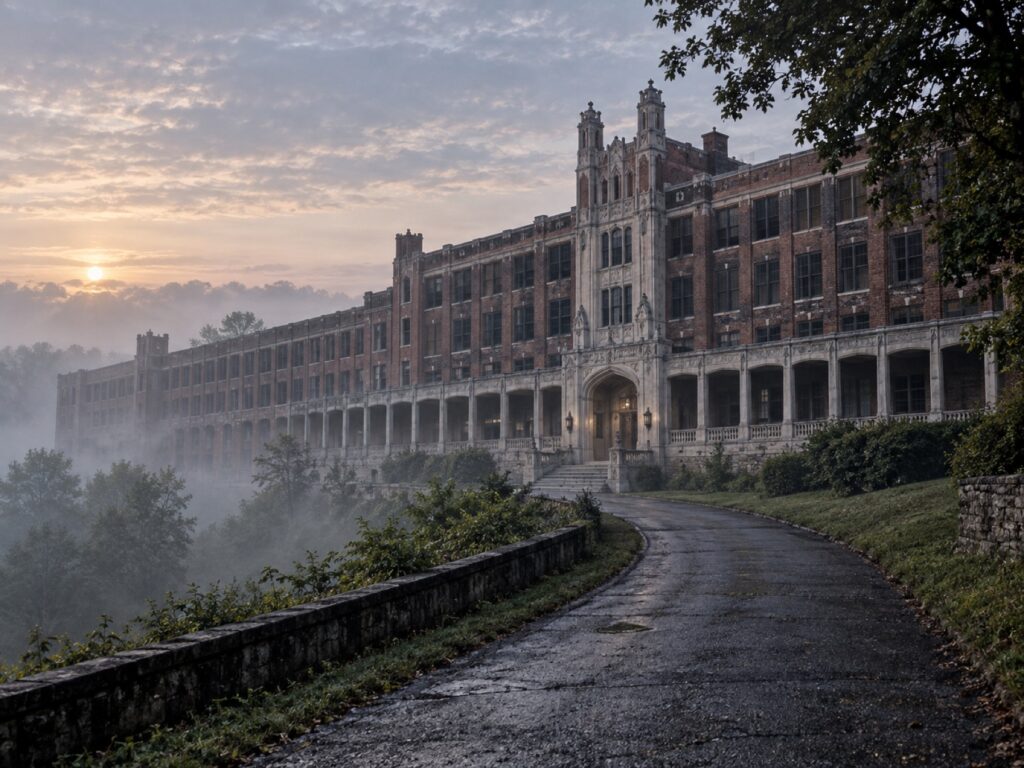
Waverly Hills Sanatorium is a National Register-listed former tuberculosis hospital in Louisville, Kentucky, built to isolate and care for people with a highly contagious disease before effective antibiotic treatment. Its public-health history, Tudor Gothic architecture, and surviving medical campus are documented. Its modern reputation as a haunted location comes from venue programming, visitor accounts, and paranormal media rather than verified supernatural evidence.
Why Waverly Hills matters
Waverly Hills preserves the physical history of the tuberculosis crisis that shaped American cities in the early twentieth century. Tuberculosis spread through the air and could move quickly through crowded homes and workplaces. Before reliable drug treatment, public-health officials relied on education, screening, isolation, rest, nutrition, fresh air, sunlight, and, in severe cases, surgical procedures. Sanatoriums placed those ideas into architecture.
The Waverly Hills historic buildings were added to the National Register of Historic Places in 1983 for health, medicine, architecture, and social history. The record recognizes the complex as an important example of early twentieth-century Tudor Gothic design. Long wings, balconies, large windows, and a hillside setting were not merely decorative: they supported the period’s belief that air, light, and separation could aid recovery and reduce transmission.
Louisville confronts tuberculosis
Louisville and Jefferson County created a tuberculosis-hospital board in 1906. Local taxes funded the first sanatorium, built from about 1909 to 1911 on land acquired from Major Thomas H. Hays. The name came from Hays’s country property, Waverley. University of Louisville records describe the original institution as very small, with only a handful of patients when it opened.
Demand soon exceeded the original buildings. The hospital admitted people at different stages of disease and developed facilities for children, advanced cases, staff, and support services. A much larger building opened in the 1920s. The main surviving structure curves across the hillside in brick and stone, with a central tower and Gothic-arched entrance. Its scale reflects both the extent of the epidemic and the city’s commitment to a specialized hospital.
Life at Waverly Hills included medical care, school, work, recreation, long periods away from family, and constant awareness of illness. Historical photographs show patients, nurses, physicians, social workers, rooms, porches, and hospital routines. Those records are more reliable than anonymous lists of supposed deaths or treatments circulated in ghost-tour advertising.
Treatment before antibiotics
Sanatorium care often emphasized bed rest, nutritious food, controlled exercise, and exposure to outdoor air. Physicians could also use procedures intended to rest a diseased lung. Some treatments now appear severe, but they should be interpreted within a period when tuberculosis killed large numbers of people and doctors lacked today’s antimicrobial drugs. Patients and families made decisions under frightening conditions with limited options.
Effective antibiotic combinations changed tuberculosis care after the 1940s. As treatment increasingly moved into general hospitals and outpatient settings, the need for a large isolated sanatorium declined. Waverly Hills stopped operating as a tuberculosis hospital around 1961. The complex then served as a geriatric and medical center before that use ended. Later vacancy, vandalism, redevelopment proposals, and preservation work shaped the site visitors encounter today.
Death counts and the “body chute”
Popular accounts often attach enormous death totals to Waverly Hills. Many figures are repeated without a traceable patient index or annual report. Tuberculosis unquestionably caused many deaths, but an exact cumulative number should come from institutional records, not multiplication or television narration. HauntsUSA does not repeat sensational totals that cannot be verified.
A service tunnel connected parts of the hospital campus and is frequently marketed as the “body chute” or “death tunnel.” It may have been used for utilities, supplies, staff movement, and removal of deceased patients. Its practical functions and later nickname should not be collapsed into a single horror-story explanation.
Is Waverly Hills Sanatorium haunted?
Waverly Hills is widely promoted as haunted. Reported stories include footsteps, voices, shadow figures, children, and activity associated with particular rooms or the service tunnel. The property offers guided paranormal tours and investigations, and television appearances have spread these accounts internationally. They are venue-presented claims and personal experiences, not independently established facts.
The building’s acoustics, darkness, age, medical associations, and decades of abandonment can create powerful sensations. Responsible interpretation keeps those experiences separate from the lives of actual patients and staff. Illness is not evidence of haunting, and people who received care at Waverly Hills should not be reduced to anonymous ghosts.
Planning a visit
Waverly Hills Sanatorium is at 4400 Paralee Drive in Louisville, Kentucky. Entry is through scheduled tours, investigations, or events rather than ordinary museum hours. The official venue says its main tour season generally ends in late August, with limited private tours, investigations, and events possible during colder months. Weather can affect access because the building is not a conventional climate-controlled museum.
Reservations are required for most experiences. Tour types, minimum group sizes, age rules, accessibility, and permitted equipment vary, so read the exact ticket description before booking. Wear practical shoes and expect stairs, darkness, uneven surfaces, and seasonal temperatures. Confirm current availability directly at 502-690-7880.
Frequently asked questions
Was Waverly Hills a mental hospital?
No. Its defining historic role was as a tuberculosis sanatorium. The campus later had geriatric and other medical uses.
When did the large building open?
The large surviving sanatorium was completed and documented during the 1920s, replacing the much smaller early facility.
Can visitors walk in without a tour?
No. Public access is tied to scheduled tours and events; advance booking is recommended or required.
Continue exploring haunted history in Kentucky or browse the complete HauntsUSA directory of historic haunted places.
Sources and further reading
- Waverly Hills Sanatorium: Official Events and Visitor Information
- National Park Service: Waverly Hills National Register Record
- National Park Service: Kentucky Historic Resources Inventory
- University of Louisville Digital Collections: Sanatorium Records and Photographs
- Kentucky Historic Institutions: Waverly Hills Documents
Last reviewed September 26, 2026. Unverified death totals are intentionally excluded. Paranormal claims are labeled as venue marketing or reported experience. AI-generated editorial artwork is an interpretation, not documentary photography.